TL;DR: Most articles on the 4 management functions stop at definitions. This one shows where each function actually breaks down in growing IT teams and what specific workflow changes fix the gap before it costs you a project.
What are the 4 management functions?
Abstract 3D illustration of four interconnected spheres representing core management functions in professional navy and silver
The 4 management functions are planning, organizing, leading, and controlling — a framework first published by French industrialist Henri Fayol in 1916 that still defines how effective managers structure their work.
Fayol identified these four functions while studying what separated high-performing organizations from struggling ones. The framework has held up because it describes what managers actually do, not what they should theoretically do.
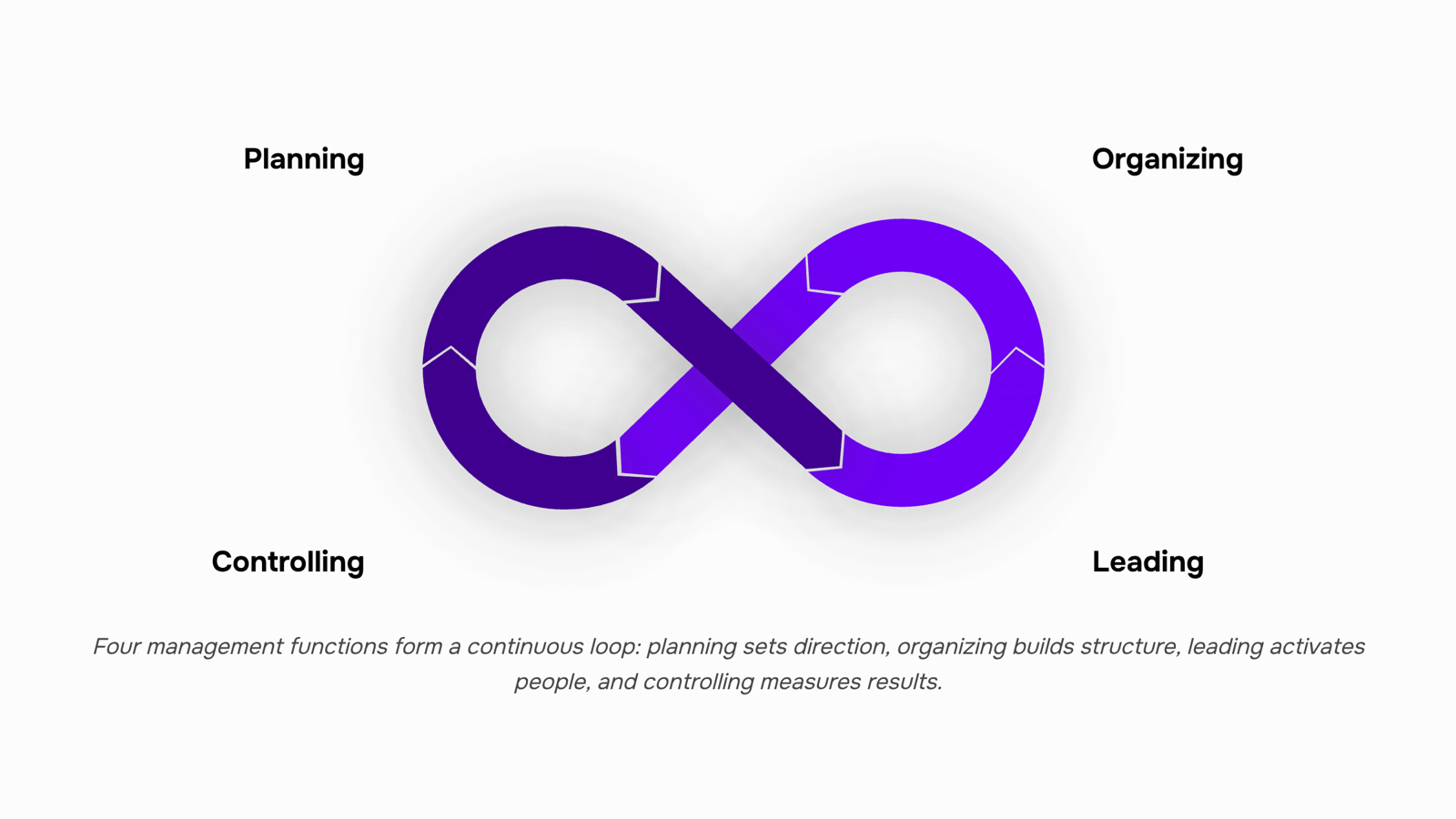
Here's what each function covers:
Planning — defining goals, setting timelines, and deciding how resources will be used to reach a target outcome
Organizing — structuring teams, assigning roles, and aligning the right people and tools to execute the plan
Leading — directing and motivating the team through communication, decision-making, and day-to-day guidance
Controlling — tracking progress against the plan, identifying gaps, and adjusting before small problems become project failures
For IT company owners, these functions of management show up across every project cycle. A software delivery team planning a release, organizing sprint assignments, leading standups, and reviewing velocity metrics is running all four functions — often within a single week.
The daily responsibilities of a project manager map almost directly onto this framework: planning and controlling dominate the morning, leading and organizing fill the rest.
According to PMI's 2024 Pulse of the Profession report, 39% of projects fail due to poor planning — which makes the planning function the highest-leverage place to invest attention, especially in fast-moving IT environments where scope and priorities shift quickly.
The components of a work management system are built around supporting all four functions, not just task tracking.
How the 4 management functions work together
The four functions don't run in parallel — they run in sequence, then loop back.
Planning sets the direction: goals, timelines, resource requirements. Organizing converts that plan into structure: who owns what, what tools are in place, how work flows between people. Leading activates the structure: managers communicate priorities, resolve blockers, and keep the team moving. Controlling closes the loop: actual output gets measured against the plan, and gaps trigger adjustments.
That last step is where the cycle restarts. If controlling surfaces a missed deadline or a budget overrun, planning has to respond — revised scope, reallocated resources, updated milestones. In practice, the daily responsibilities of a project manager touch all four functions inside a single workday, not in four separate meetings.
For IT company owners, this interdependence matters more than the individual functions. A technically sound plan fails when organizing is weak — unclear ownership, no defined handoffs. Strong leading can't compensate for a controlling system that flags problems two weeks too late. The components of a work management system typically map directly onto these four functions: goal-setting tools, role assignment, communication layers, and progress tracking.
Planning, organizing, leading, and controlling only produce results when they're treated as one connected system — not four separate management functions in business that happen to share a framework name.
Each management function explained
Planning is the function where management decisions get made before work starts. It covers goals, timelines, resource allocation, and risk. In practice, planning means translating a business objective into a project scope, assigning budget, and setting milestones that teams can actually hit. PMI's 2024 Pulse of the Profession report found that poor requirements and scope definition account for a significant share of project failures — which is why the importance of planning in management extends well beyond scheduling. A concrete example: an IT company owner planning a software rollout defines the go-live date, identifies which engineers are needed, and flags the three most likely blockers before a single ticket is written.
Organizing is the function that turns a plan into an operational structure. It answers who does what, with which resources, and through which processes. Organizing covers team composition, role clarity, tool selection, and workflow design. Without it, even a solid plan collapses under unclear ownership. For an IT company owner, organizing might mean mapping a client project to specific developers, setting up a project board, and defining how work moves from backlog to done. The components of a work management system — task tracking, resource views, status workflows — are largely organizing decisions made concrete.
Leading is the function most managers underestimate because it's harder to measure. It covers communication, motivation, conflict resolution, and decision-making under uncertainty. Leading is what happens between the plan and the output: keeping a team aligned when priorities shift, giving feedback that changes behavior, and making judgment calls that no process document covers. The daily responsibilities of a project manager are mostly leading functions — stand-ups, unblocking engineers, stakeholder updates. A useful example: a manager notices a senior developer going quiet in sprint reviews. Leading means addressing that directly, not waiting for it to show up in velocity metrics.
Controlling is the function that closes the loop. It compares actual performance against the plan, identifies variance, and triggers corrective action. Controlling is not micromanagement — it's systematic review. For IT companies, this looks like tracking sprint completion rates, monitoring budget burn against milestones, and reviewing post-mortems to catch recurring failure patterns. Task management with built-in tracking makes controlling faster because the data is already structured — no manual status collection required.
Together, these four functions of management give owners a repeatable operating model. Planning sets direction. Organizing builds the structure. Leading keeps people moving. Controlling confirms the work is working.
Why the 4 management functions matter for organizational structure
The 4 management functions don't just describe what managers do — they shape how organizations are built. Planning defines the goals that determine which roles exist. Organizing assigns those roles and establishes reporting lines. Leading fills those roles with motivated people who understand their scope. Controlling closes the loop by measuring whether the structure is producing the right outcomes.
When these functions are applied consistently, management functions in business become structural: decisions flow to the right level, accountability is clear, and teams don't duplicate work or miss handoffs. When they're skipped or treated as separate activities, org charts become decorative.
For IT companies specifically, this matters at every layer. A project manager's daily responsibilities map almost directly onto all four functions — planning sprints, organizing task ownership, leading standups, and controlling delivery against scope. The components of a work management system reflect the same structure at the tooling level.
Applying the 4 management functions in IT companies and startups
In a 10-person IT startup, all 4 management functions often sit with one or two people. The founder plans the product roadmap, organizes who owns what, leads daily standups, and reviews sprint velocity — sometimes before lunch. That compression isn't a problem to fix; it's a structural reality to manage deliberately.
The breakdown usually happens when the team scales past 15 to 20 people and those functions don't get redistributed. Planning stays informal. Organizing means whoever grabs the Slack thread first. Leading becomes reactive. Controlling is a Friday afternoon scramble through spreadsheets.
What changes in IT companies specifically is the speed at which controlling data needs to feed back into planning. A two-week sprint cycle means you have 26 chances per year to catch drift early — but only if your task management with built-in tracking closes that loop automatically rather than requiring manual status updates.
The daily responsibilities of a project manager in a startup look different from enterprise: fewer handoffs, more context-switching, and a higher cost when any one function gets dropped.
For small teams, the practical fix is to make each function explicit even when one person owns all four. Assign a named owner per function, even temporarily. That single step prevents the most common failure mode: everyone assumes someone else is doing the controlling.
Where each management function breaks down and how to fix it
Each of the four functions of management has a predictable failure mode — and most teams hit the same wall.
Planning breaks down when it stays in someone's head. A team lead knows the roadmap; no one else does. The fix: document every plan in a shared system with owners, deadlines, and dependencies visible to the whole team. PMI's 2024 Pulse of the Profession report found that poor requirements and scope definition remain the top driver of project failure — a planning problem, not an execution one.
Organizing breaks down when roles drift. In fast-growing IT teams especially, people absorb tasks informally until no one knows who owns what. Clarifying this doesn't require a reorg — it requires a written RACI and a work management system with clear accountability at the task level.
Leading breaks down when feedback is only downward. Managers who don't create structured channels for upward input lose early warning signals. Building team management habits that include regular async check-ins fixes this without adding meetings.
Controlling breaks down when it's reactive. Managers review results after the deadline passes. The fix is leading indicators — tracking progress mid-sprint, not post-mortem. The daily responsibilities of a project manager naturally include this kind of forward-looking control when the role is set up correctly.
How AI is changing the 4 management functions in 2026
AI is reshaping how management functions in business operate at the execution layer, not just the reporting layer.
Planning is the first to change. AI tools can now analyze historical project data to flag unrealistic timelines before a plan is approved, cutting the guesswork that drives most scope failures. For IT company owners managing multiple concurrent projects, that shift alone reduces the planning-to-kickoff cycle significantly.
Organizing is getting faster too. Workload balancing, once a manual exercise done in spreadsheets, can now run automatically based on capacity data. The components of a work management system that used to require manual assembly are increasingly pre-wired.
Controlling sees the biggest gain. McKinsey research suggests managers spend a disproportionate share of their week on administrative status-checking. Tools like Taro automate that layer through task management with built-in tracking, so controlling becomes a dashboard review rather than a weekly chase.
Closing
You now know where each function lives in your team's workflow and which one typically breaks first under growth. The gap isn't usually in planning — most IT teams can write a solid roadmap. It's in controlling: you don't know sprint velocity until Friday, budget overruns surface in retrospect, and blockers get flagged too late to matter. The question to ask yourself this week is simple: which of these four functions does your team struggle with most? Once you identify it, you can fix it before it derails your next project. If controlling is your weak spot, task management tools with built-in sprint tracking and time logging can close that gap automatically — so you spend less time in status meetings and more time unblocking work.
FAQ
What are the 4 primary functions of management in a business?
Planning (setting goals and timelines), organizing (assigning roles and structure), leading (directing and motivating teams), and controlling (tracking progress and adjusting). Together they form a repeatable operating model that separates high-performing organizations from struggling ones.
How do the 4 management functions apply to different industries?
The framework applies universally because it describes what managers actually do, not industry-specific tactics. An IT company planning a software release and a construction firm planning a building project both need planning, organizing, leading, and controlling — the tools and timelines differ, but the functions don't.
What is the importance of planning in the 4 management functions?
Planning is the highest-leverage function because it sets direction for the other three. PMI's 2024 report found 39% of projects fail due to poor planning. A solid plan prevents organizing confusion, gives leading a clear target, and makes controlling measurable.
How do the 4 management functions impact organizational structure and design?
Planning defines which roles exist, organizing assigns them, leading fills them with motivated people, and controlling measures whether the structure works. When applied consistently, these functions make accountability clear and prevent duplicate work or missed handoffs.
Can the 4 management functions be applied to small businesses and startups?
Yes. Startups often skip controlling because they're moving fast, but that's when it matters most — early gaps compound. Small teams can run all four functions in a single weekly cycle; the framework scales down as easily as it scales up.


 Elena Petrova15 September 2026


