TL;DR: Most articles on the project life cycle in project management name the five phases and move on. This one focuses on the transitions where IT projects actually stall — the handoffs between initiation and planning, planning and execution, and execution and closure — and what you can do at each one to keep scope tight and momentum intact.
What the project life cycle actually means
The project life cycle is the structured sequence of phases a project moves through from approval to closure. PMBOK (6th edition) defines it as "the series of phases that a project passes through from its initiation to its closure" — a definition that matters because it separates the life cycle from project management itself.
Project management is the discipline: the tools, decisions, and people involved. The project life cycle is the container those decisions live inside. Confusing the two is why teams jump straight into execution without a defined initiation phase, then wonder why scope expands and budgets slip.
The stages of project management follow a consistent pattern across industries, but in IT work the transitions between project management phases carry the most risk. A handoff from planning to execution without a formal sign-off is where engineer time gets misallocated and client expectations quietly diverge from delivery reality.
Treating those transitions as decision gates — not just calendar milestones — is the core idea this article builds on. If you want to build a repeatable planning process for each new project, the life cycle gives you the structure to do it consistently, regardless of project size.
Why the project life cycle matters for IT teams
For IT teams, skipping or rushing through the stages of a project life cycle doesn't just create friction — it creates costs you can measure. According to PMI research, a significant share of IT project failures trace back to poor scope definition and weak phase transitions, not execution problems mid-sprint.
Three outcomes depend directly on how well you manage project phases effectively:
Budget control: Cost overruns cluster at two points: when scope isn't locked before development starts, and when change requests arrive after sign-off. A defined life cycle creates the gate where both get caught early.
Engineer allocation: Without a formal planning phase, engineers get pulled into work before requirements are stable. That means rework, context-switching, and burnout — all of which show up in your delivery timeline.
Client sign-off timing: Clients who aren't involved at structured checkpoints tend to surface major objections at the worst moment: during UAT or at final delivery. A structured life cycle builds sign-off into the process rather than bolting it on at the end.
Understanding the stages of project management gives your team a shared language for these decisions. Pair that with a phase gate approach to managing stage transitions and you turn the project life cycle in project management from a compliance exercise into an actual control system.
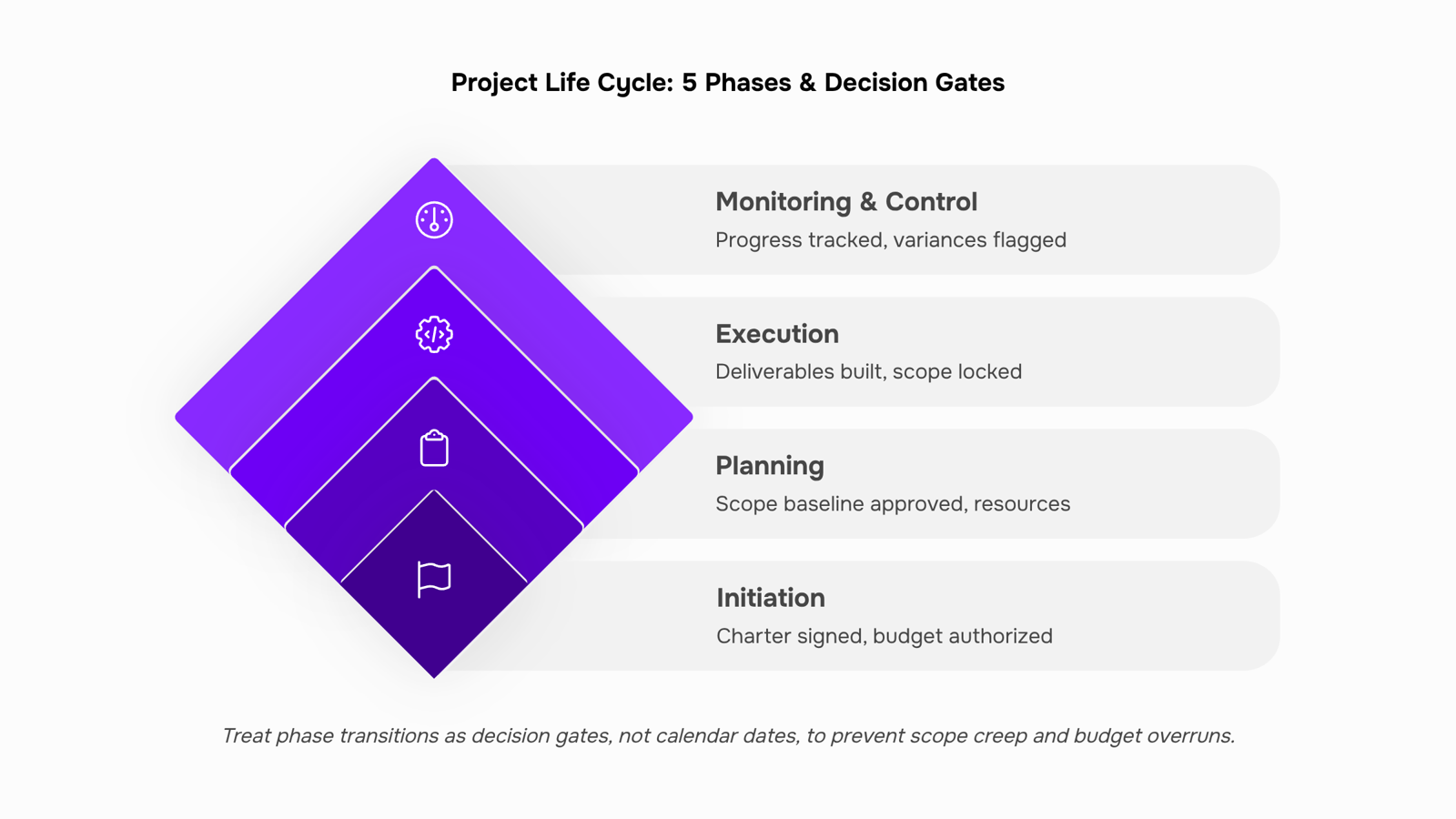
The 5 stages of the project life cycle
Each stage of the project life cycle in project management has a distinct job. Miss that job, and the next stage inherits the damage.
Initiation is where the project gets its mandate. You define the business case, identify stakeholders, and document high-level scope in a project charter. For IT teams, this is also where client sign-off authority gets established — who can approve changes, and who can't. The transition risk here is moving into planning before that authority is clear. When it isn't, scope changes in week six have no owner, and the budget absorbs the cost.
Planning converts the mandate into a working blueprint: task breakdown, resource allocation, timeline, risk register, and budget baseline. This is the stage where engineer allocation decisions get made, and where most IT projects quietly set themselves up for overruns. PMI research consistently shows that projects skipping formal planning phases face significantly higher cost overruns than those that don't. The transition risk is treating the plan as a formality rather than a constraint. A plan nobody references is just documentation.
Execution is where the work happens: development sprints, vendor coordination, environment setup, client-facing deliverables. Scope creep enters here, usually through informal requests that bypass the change control process established in planning. The transition risk is letting small undocumented changes accumulate. Each one is minor; together they shift the project's scope without shifting the budget or timeline.
Monitoring and control runs in parallel with execution, not after it. You track actual progress against the plan, flag variances early, and make the call to adjust scope, timeline, or resources before a small gap becomes a missed deadline. For IT projects, this stage lives or dies on whether project milestones are tied to real decision points or just calendar dates. The transition risk is treating status updates as reporting rather than as triggers for action.
Closure is the stage most IT teams rush or skip. It includes final client acceptance, knowledge transfer, contract closeout, and a retrospective that feeds the next project. The transition risk is declaring the project done before the client formally accepts the deliverables. Without that sign-off, billing disputes and scope-creep claims follow the team into the next engagement.
Understanding how these project management phases connect to each other is different from knowing what each one contains. For a deeper look at how the stages interact in practice, the different stages of project management covers the sequencing logic in more detail.
Key milestones to set at each stage
Most teams treat milestones as calendar markers: a date arrives, a box gets checked, work continues. That framing is where projects quietly go off track. A milestone should function as a decision gate — a formal pause where your team confirms whether the conditions to proceed are actually met, not just whether time has passed.
Here's a short reference list of milestones that belong in each phase of the project life cycle in project management:
Initiation: Signed project charter, confirmed budget authority, stakeholder alignment documented
Planning: Approved scope baseline, resource assignments confirmed, risk register reviewed
Execution: Working prototype or first deliverable accepted, midpoint budget check passed
Monitoring and control: Variance thresholds reviewed, scope change requests resolved, client sign-off on any adjustments
Closure: Final deliverable accepted, lessons-learned session completed, project formally closed in your system
For IT teams specifically, the execution-to-monitoring handoff is where project milestones get skipped most often. Engineers ship a build, attention shifts to the next sprint, and no one formally confirms the deliverable was accepted before scope creep starts accumulating.
Tracking these gates inside Taro as epics with milestone checklists keeps each decision point visible to the whole team, so nothing advances until the gate is genuinely clear.
Best practices for navigating each stage without losing momentum
Five practices that keep momentum from dying at the handoff.
Lock the scope before execution starts: The planning-to-execution handoff is where IT projects bleed. Before any engineer writes a line of code, run a formal scope sign-off meeting with the client and document every agreed deliverable in writing. Any change after that point goes through a change request, not a Slack message.
Treat every phase exit as a go/no-go decision: A phase gate approach to managing stage transitions forces the team to answer three questions before moving forward: Is the current phase complete? Are resources confirmed for the next phase? Has the client approved the output? If any answer is no, the project stays in the current phase until it is.
Assign a named owner to every handoff: Transitions fail when everyone assumes someone else is driving. For each stage boundary in the project life cycle in project management, name one person responsible for confirming the gate criteria are met and for scheduling the kickoff of the next phase. One owner, one accountability.
Build your timeline around dependencies, not dates: Most slippage comes from scheduling tasks in parallel when they are actually sequential. When you build a project timeline with milestones and dependencies, map what must finish before each task can start. That single step surfaces the real critical path and stops the team from discovering blockers mid-sprint.
Start the next phase's planning before the current one closes. Waiting until execution ends to begin closure planning creates a two-week gap every time. Overlap planning by roughly 20 percent. If you build a repeatable planning process for each new project, that overlap becomes a standard checklist item rather than an afterthought.
Each practice targets a specific failure point. Together, they give you a way to manage project phases effectively without relying on heroics at the end.
Most teams manage project management phases across three or four disconnected tools. That fragmentation is where stage transitions break down: a milestone gets marked complete in one place, but the dependency blocking the next phase lives in a spreadsheet no one updated.
A connected workspace removes that gap. When your project timeline with milestones and dependencies lives in the same system as your task ownership, approval workflows, and completion forecasts, you see problems before they become delays. Taro's built-in forecasting flags when a phase is trending late, so you can act at the gate, not after the deadline passes.
For teams applying project planning best practices consistently, one workspace also means every new project inherits the same structure, not whatever the last PM happened to set up.
Project life cycle vs. project management process
The project life cycle in project management describes the shape of one project: the stages of the project life cycle from initiation through closure. The project management process is the repeatable method you apply across every project, sprint after sprint.
Dimension | Project life cycle | Project management process |
|---|
Scope | One project | All projects |
Focus | Phases and milestones | Methods and governance |
Output | Delivered work | Repeatable practice |
Changes per project | Yes | Rarely |
Think of the life cycle as the track and the process as how you train to run it. For a deeper look at how the two connect, the stages of project management breaks this down further.
Closing
The project life cycle isn't a compliance checklist — it's a control system that catches scope drift, budget overruns, and misaligned expectations before they become project failures. The real power lives in the transitions: treating handoffs between initiation and planning, planning and execution, and execution and closure as decision gates rather than calendar dates is what separates IT teams that deliver on time from those that don't.
When each phase has a formal gate — signed charters, approved baselines, documented sign-offs — your team moves through the cycle with momentum instead of friction. Taro structures these phases, sets milestone gates automatically, and forecasts completion without manual tracking overhead, so the framework taught here runs on its own. Start a free trial and wire up your first project's life cycle this week.
FAQ
What are the stages of the project life cycle in project management?
The five stages are initiation (mandate and charter), planning (blueprint and baseline), execution (development and delivery), monitoring and control (tracking and adjustments), and closure (acceptance and retrospective). Each stage has a distinct job; missing it creates damage the next stage inherits.
How does the project life cycle impact project planning?
A defined life cycle creates the structure where planning becomes a constraint, not a formality. PMI research shows projects with formal planning phases face significantly lower cost overruns than those that skip it, because scope gets locked before engineer allocation happens.
What are the key milestones in the project life cycle?
Critical milestones include signed charters (initiation), approved scope baselines (planning), accepted deliverables (execution), resolved change requests (monitoring), and formal client sign-off (closure). Each functions as a decision gate, not just a calendar date.
How do I manage each stage of the project life cycle effectively?
Treat phase transitions as formal gates where you confirm conditions are met before advancing. Establish clear sign-off authority in initiation, lock scope before planning ends, catch scope creep during execution through change control, and never declare closure until the client formally accepts deliverables.
What are the best practices for navigating the project life cycle?
Define scope and budget authority early, use phase gates as decision points not milestones, involve clients at structured checkpoints, track milestones as acceptance criteria not calendar dates, and build closure into the process rather than rushing it. Automate gate tracking so nothing advances without formal confirmation.


 Elena Petrova15 September 2026


