TL;DR: Most content on project management tasks lists them by phase and stops there. This one shows IT company owners how each task category creates a dependency on the next, and where handoffs break down when those connections aren't tracked. You'll get a clear map of the most common project management tasks, the failure points between them, and how a unified task structure prevents the most expensive ones.
What Project Management Tasks Actually Cover
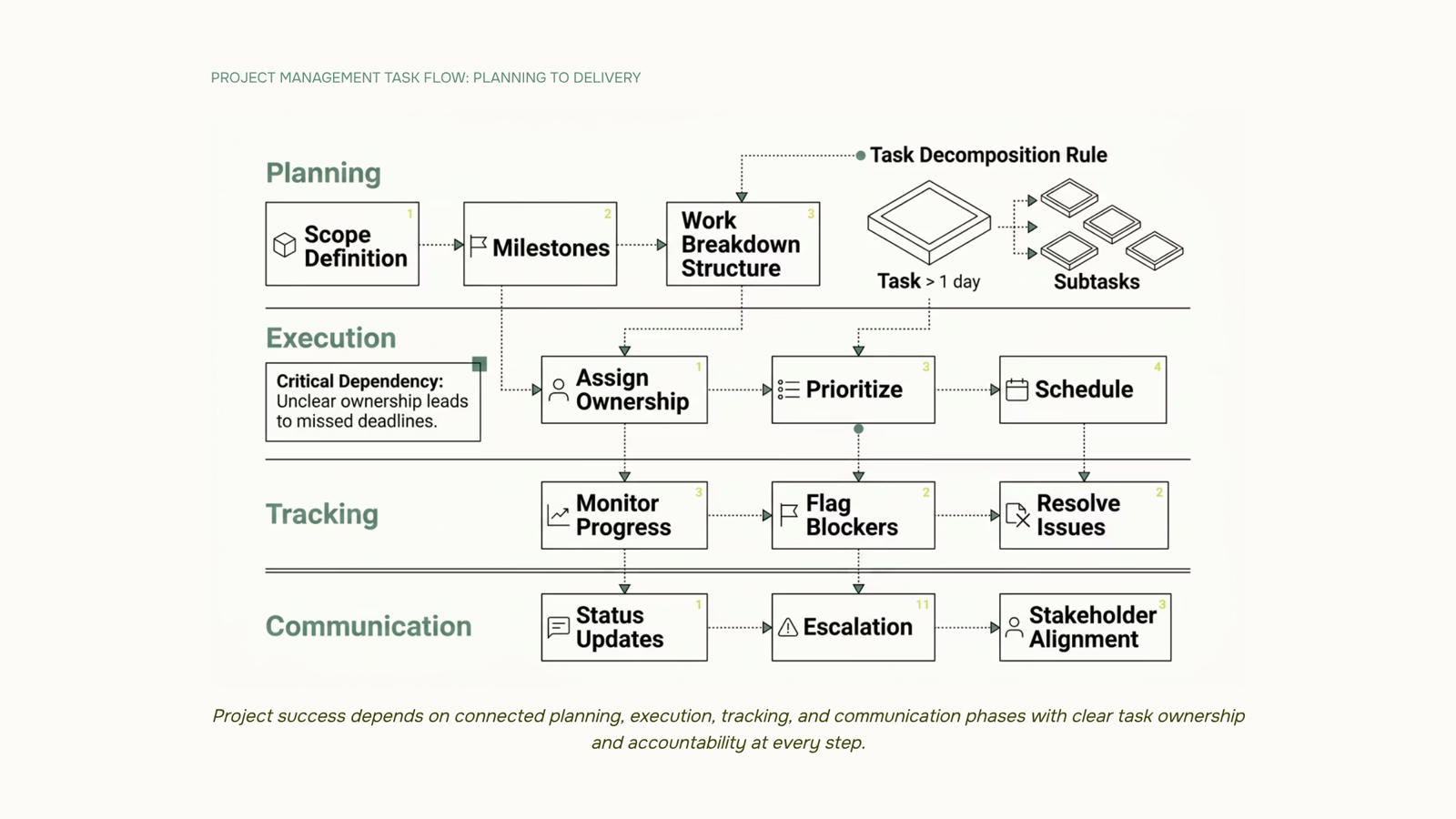
Project management tasks are the individual units of work that move a project from idea to delivery. Together, they form four functional categories that every project runs through, regardless of industry or team size.
Planning covers scope definition, milestone setting, and work breakdown.
Execution is where tasks get assigned, dependencies get sequenced, and work actually starts.
Tracking means monitoring progress against those project phases and milestones you set in planning. Communication runs across all three — status updates, blocker escalation, stakeholder reporting.
Most content on this topic lists these categories and stops there. The part that gets skipped is the dependency chain: what you do in planning directly determines whether execution and tracking are manageable or chaotic. A scope defined too loosely means tasks can't be assigned with clear ownership. Tasks without clear ownership are why most project tasks fail.
This is also where task and subtask structure matters. A project management task like "build user authentication" isn't executable as written. It needs to be broken into subtasks small enough for one person to own and complete within a defined window.
Understanding these four categories gives you a mental model for managing a project from start to finish without losing track of where work stands at any given moment.
Planning Tasks: Scope, Milestones, and Work Breakdown
Good planning isn't about filling out templates. It's about making decisions early enough that your team can execute without constant re-clarification.
Three project management tasks define this phase: scoping, milestone-setting, and building a work breakdown structure (WBS). Each one feeds the next, and skipping any of them creates a specific failure downstream.
Scope is the boundary of the project. It answers what's included, what's explicitly not included, and what "done" looks like. Without a written scope, teams routinely absorb work that was never budgeted or staffed, which is one of the leading reasons IT projects miss their deadlines. A scope document doesn't need to be long. It needs to be specific enough that a new team member could read it and know whether a given task belongs in this project.
Milestones are the checkpoints that tell you whether the project is on track before it's too late to adjust. Project phases and milestones should map to real deliverables, not calendar dates. "Week 4" is not a milestone. "Client approval of design mockups" is. In construction project management tasks, milestones often correspond to inspection sign-offs or permit stages — concrete events with clear pass/fail criteria.
Work breakdown structure is where scope becomes assignable work. You take the full project and decompose it into phases, then tasks, then subtasks small enough for one person to own. The rule most experienced project managers use: if a task takes more than a day to estimate confidently, it needs to be broken down further.
Rushing this step is where assignment gaps appear. If tasks are too broad, no one owns them clearly, and how task tracking works in practice breaks down before execution even starts.
Taro supports this with built-in phase and milestone creation, so your WBS structure carries directly into task assignment without rebuilding it in a separate tool.
How to Break Projects into Tasks and Subtasks That Actually Get Done
The hierarchy that makes projects executable follows four levels: project, phase, task, subtask. Skip a level and you get tasks that are too large to assign, too vague to track, and too easy to defer.
Here is what that looks like in practice. Take a website migration project. The project sits at the top. Below it, phases: discovery, content audit, build, QA, launch. Inside the build phase, tasks: "migrate product pages," "configure redirects," "set up analytics." Each of those tasks then breaks into subtasks: "export 200 product URLs," "map old slugs to new paths," "verify redirect rules in staging." That last subtask takes two hours, has a clear owner, and has a binary done/not-done state. That is the target.
The rule of thumb most experienced project managers use: if a task takes more than one day to complete, it needs subtasks. Anything over eight hours is too broad to assign cleanly, because the person doing it has no clear starting point and no way to signal partial progress. For construction project management tasks, the same principle applies at a different scale — a task like "frame second floor" needs to break into pour, cure, inspection, and frame before anyone can sequence the work.
What goes wrong when tasks stay too broad is predictable. No one owns the ambiguous middle. Progress stalls without a visible blocker. Deadlines slip not because the work is hard but because no one knows what "done" looks like at the task level. How do I break down a large task into smaller subtasks covers the decomposition mechanics in more detail.
Managing task and subtask management inside a single system — rather than across a spreadsheet and a separate tracker — keeps the hierarchy intact. When Taro connects project phases to individual subtasks in one view, nothing falls through the gap between planning and execution.
Assigning, Prioritizing, and Scheduling Tasks Across Your Team
Task creation is the easy part. The failure happens in the gap between "task exists" and "someone owns it with a real deadline."
The most common pattern in IT projects: a task gets added to the board, no one is explicitly assigned, and the team assumes someone else will pick it up. Research from PMI consistently shows that unclear ownership is one of the top reasons IT projects miss deadlines, not scope creep, not resource shortages.
To close that gap, every task that comes out of your hierarchy needs three things before it moves to execution:
A single owner: Not a team, not two co-leads. One person whose name is on it.
A priority level: High, medium, or low is enough. Without it, everything competes equally and nothing moves. Here's a practical way to set priority levels for tasks without turning it into a committee decision.
A hard deadline: "End of sprint" is not a deadline. A date is.
For scheduling across a team, work backward from your milestone dates. Assign high-priority tasks first, then fill in medium-priority work around them. If two high-priority tasks land on the same person in the same week, that's a resourcing conflict you need to surface now, not on Friday.
Project task tracking only works if ownership is unambiguous from the start. Tools like Taro handle task and subtask assignment inside a unified system, so ownership, priority, and deadlines are set in one place rather than scattered across email threads and spreadsheets.
Tracking Tasks and Monitoring Project Progress
Status meetings feel productive. They rarely are. A 30-minute sync to ask "where are we?" adds no forward motion if the answer lives in someone's head rather than a shared system.
Effective project task tracking separates monitoring from conversation. The goal is a live picture of completion percentage, upcoming milestones, and blockers, updated continuously, not reconstructed in a weekly call.
The most reliable signal isn't task count, it's milestone completion tied to actual task status. If your project has five phases, each milestone should map to a defined set of tasks. When those tasks close, the milestone closes. That chain gives you a progress forecast grounded in real work, not optimism. For a deeper look at the methods that make this work, what are the best methods for project tracking and monitoring covers the specific approaches worth building into your workflow.
Three monitoring inputs matter most during execution:
Completion rate vs. planned rate: Are tasks closing on the schedule set during planning, or is the gap widening?
Blocker age: A blocker flagged today is a risk. A blocker flagged five days ago with no resolution is a deadline problem.
Milestone drift: If a milestone slips by two days, the next one likely slips too. Catch it at the first sign, not the third.
Taro handles this through automated project tracking and milestone monitoring, so the status picture updates as tasks move rather than waiting for someone to file a report. Notifications fire when tasks go overdue or milestones fall behind, which means your first signal is a flag, not a missed deadline.
Assign and prioritize tasks well during planning, and monitoring becomes confirmation, not discovery.
The right tool for managing project management tasks isn't the one with the most features. It's the one that gives your team clear ownership without creating a second job just to maintain the system.
Five capabilities actually move the needle:
Task and subtask management: You need to break work into parent tasks and nested subtasks within the same view. If subtasks live in a separate list, they get missed. The practical rule: any task that takes more than a day should be broken down further.
Assignment with accountability: Every task needs one owner, not a shared team tag. Unclear ownership is one of the leading reasons IT projects miss deadlines, and most tools let you assign without enforcing that accountability.
Priority levels: Not just labels. Setting priority levels should change what surfaces first in a team member's queue, not just add a color tag.
Multiple views: List, board, and timeline views serve different moments. Use list for daily work, board for status, timeline for dependencies.
Progress tracking tied to task completion: Status meetings give you opinions. Project task tracking tied to actual task completion gives you data.
The tradeoff worth naming: feature-heavy tools add setup overhead that smaller IT teams rarely recover from. Lean tools cut that friction but often sacrifice visibility at the project level. The middle ground is a unified system where tasks, subtasks, and project-level dashboards share the same data source, so nothing needs to be manually synced.
Closing
The teams executing project management tasks consistently aren't juggling spreadsheets, chat tools, and separate trackers. They're running planning, execution, tracking, and communication inside one system where scope feeds milestones, milestones feed tasks, and tasks break into subtasks with clear ownership and hard deadlines. That connectivity is what prevents the handoff failures that kill most IT projects. Start by mapping your next project through those four functional categories — planning, execution, tracking, communication — and ask yourself where your team currently loses visibility between phases. That gap is where Taro's unified task and subtask structure, with built-in milestone tracking and project-based task auto-creation, closes the loop.
FAQ
What is the best way to organize and manage tasks within projects?
Use a four-level hierarchy: project, phase, task, subtask. Assign one owner per task, set priority levels, and attach hard deadlines. Track all of it in a single system so scope, milestones, and execution stay connected.
How can I break down projects into manageable tasks and subtasks?
If a task takes more than one day, break it into subtasks. Each subtask should take under eight hours, have a single owner, and have a clear done/not-done state. Work backward from your milestones to sequence the hierarchy.
What are the key features I should look for in a project task management tool?
Built-in phase and milestone creation, subtask hierarchy that stays intact through execution, one-click task assignment with ownership clarity, and priority/deadline visibility across the team in one view.
Can I assign, track, and prioritize tasks in a single project management system?
Yes. A unified system keeps ownership unambiguous, lets you assign high-priority tasks first and surface resourcing conflicts early, and prevents tasks from falling through gaps between planning and execution.
How do project management tasks differ across industries like construction versus software?
Milestones differ by deliverable type: software uses design approval and QA gates; construction uses inspections and permit stages. The four-level task hierarchy and ownership rules stay the same across both.


 Natalie Brooks14 September 2026


