TL;DR: Most guides on project feasibility define the study types and stop there. This one shows IT company owners the decision logic behind each stage, the specific questions that separate viable projects from expensive mistakes, and how to use AI-assisted planning tools to catch blockers before a project gets approved, not after it consumes three months of budget.
What is a feasibility test of a project?
A feasibility test of a project is a structured pre-approval assessment that determines whether a proposed project is viable before any budget is committed or resources are assigned.
It answers four questions: Can we build it? Can we afford it? Do we have the people and tools? Does it fit the business case? Project planning assumes the answer to all four is yes. A feasibility test earns that assumption.
For IT company owners, this distinction matters more than most guides acknowledge. Scoping ambiguity, resource contention across active sprints, and third-party API dependencies can sink a project that looked solid on paper. A project feasibility assessment surfaces those risks at the cheapest possible moment — before kickoff, not six weeks in.
According to PMI, poor requirements and inadequate pre-project scoping are consistently among the top drivers of IT project failure. Catching a flawed assumption in week one costs a conversation. Catching it in week eight costs a sprint.
Feasibility testing also feeds directly into project prioritization methods — you can't rank what you haven't assessed. And it creates the evidence base your risk mitigation plan needs to be specific rather than generic.
The next section walks through the six steps in sequence.
How to conduct a feasibility test of a project
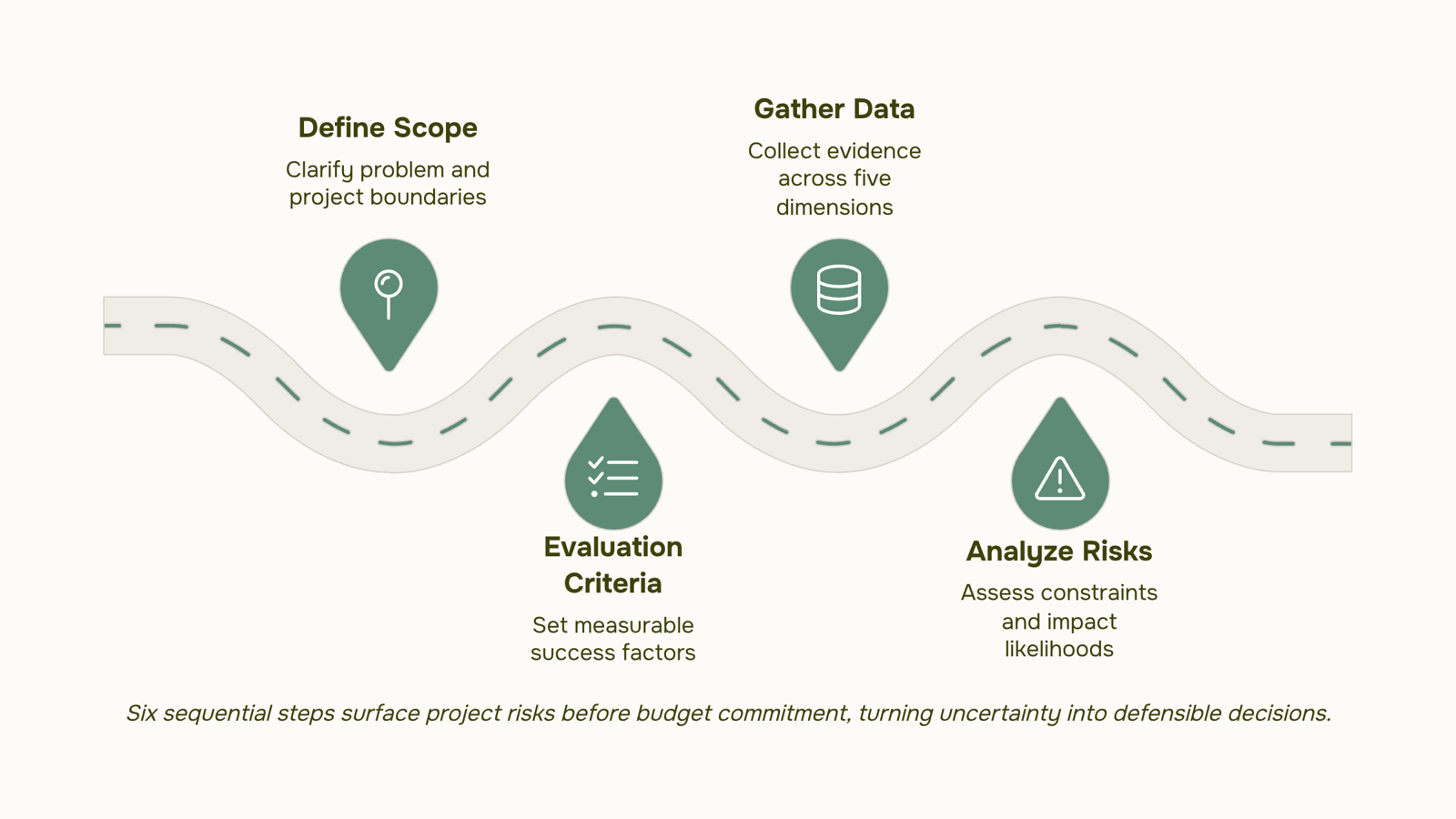
Conducting a feasibility test of a project follows a fixed sequence. Skip a step or reorder them and you'll miss dependencies that surface later as cost overruns or scope collapse. Here's the process, with an IT-specific example threaded through each step: a mid-size IT firm evaluating whether to build a custom client portal in-house.
Define the problem and scope: Write one sentence describing what the project solves and one sentence describing what it doesn't cover. For the portal project, that means specifying which client types it serves and explicitly excluding internal HR tooling. Vague scope is the leading cause of IT project failure, and tightening it here prevents the feasibility study from evaluating the wrong thing.
Identify evaluation criteria: Decide upfront what "feasible" means for your organization: budget ceiling, timeline, required integrations, compliance obligations. For the portal, that might be a $120K budget cap, a 6-month delivery window, and SOC 2 compliance. These criteria become your pass/fail thresholds in later steps.
Gather data across five dimensions: This is where the bulk of the work happens. You're collecting technical specs, cost estimates, staffing availability, timeline constraints, and regulatory requirements. The five dimensions get their own breakdown in the next section, but at this stage you're sourcing the raw inputs, not analyzing them yet.
Analyze risks and constraints: Map what could block delivery. For an IT project, that typically means resource contention across active sprints, third-party API dependencies, and integration complexity with legacy systems. A structured risk mitigation plan built at this stage gives you something concrete to act on, not just a list of worries.
Score and compare alternatives: If in-house build isn't feasible, what is? Off-the-shelf SaaS, a hybrid approach, a phased rollout? Use your criteria from step 2 to score each option. This is also where project prioritization methods help you weigh competing options against organizational capacity.
Document findings and make a go/no-go recommendation: The output is a written feasibility report with a clear recommendation. Teams using AI-assisted risk prediction can surface pattern-based risks that manual review misses, particularly useful when the project involves unfamiliar technology stacks.
Each step feeds the next. Treat them as a checklist, not a suggestion.
Key factors to assess during a project feasibility test
Each dimension of a project feasibility assessment targets a different failure mode. Treating them as a checklist rather than a connected analysis is where most teams go wrong.
Technical feasibility
Technical feasibility asks whether your current stack, team skills, and infrastructure can actually deliver what's scoped. For an IT team migrating a legacy ERP to a cloud-native system, this means confirming whether your engineers have hands-on experience with the target platform before the statement of work is signed, not after sprint one.
Financial feasibility
This dimension maps projected costs against available budget and expected return. Include licensing, integration work, and post-launch support, not just development hours. A common IT mistake: scoping only build costs and discovering that annual SaaS licensing fees flip the ROI negative in year two.
Operational feasibility
Operational feasibility tests whether your organization can absorb the change. A new client portal might be technically sound and financially viable, but if your support team lacks training bandwidth during the rollout window, adoption stalls. This is also where resource contention across active sprints surfaces, which is why pairing this dimension with your project prioritization methods matters.
Schedule feasibility
Schedule feasibility checks whether the timeline is realistic given team capacity, dependencies, and known constraints. For IT projects, dependency chains between third-party API integrations and internal development often compress timelines on paper while expanding them in practice. Build in buffer for vendor response times.
Legal and compliance feasibility
This dimension covers data residency rules, licensing terms, contractual obligations, and regulatory requirements like GDPR or SOC 2. An IT project that processes personal data across EU jurisdictions needs compliance sign-off before architecture decisions are locked, not during UAT. Surfacing these constraints early is core to any solid risk mitigation plan.
Running all five dimensions together is what makes a feasibility test of a project worth the time it takes.
How a feasibility test helps identify project risks early
Each feasibility dimension maps directly to a risk class you'd otherwise discover mid-sprint, when fixing it costs three times as much.
Technical feasibility surfaces integration risk. In an IT context, that means finding out whether your existing stack can support a new dependency before a developer spends two weeks wiring it up, only to hit an API version conflict. Financial feasibility catches budget risk: scope creep disguised as requirements. Operational feasibility exposes resource contention, the scenario where the same senior engineer is already allocated to two active sprints and can't absorb a third workstream. Scheduling feasibility flags timeline risk tied to external dependencies, vendor delivery windows, or regulatory review cycles that no internal sprint plan controls. Legal and compliance feasibility catches the risks that stop projects entirely, data residency requirements, licensing gaps, or procurement rules that invalidate a chosen vendor.
Running a feasibility test of a project before committing resources turns these risks from surprises into decisions. That's the practical value of early project risk identification: you're not eliminating uncertainty, you're moving it to a point in the timeline where it's still cheap to act on.
The steps involved in project planification determine when this analysis fits into your planning sequence, which matters because feasibility findings are only useful if they feed back into scope and resourcing before kickoff.
How to make the go/no-go decision after your feasibility test
Most feasibility guides stop at the analysis. They don't tell you how to turn findings into a decision you can defend in a room full of stakeholders.
Start by scoring each feasibility dimension — technical, financial, operational, timeline — on a simple three-point scale: viable, conditional, or not viable. If any single dimension lands on "not viable," that's a hard stop. If two or more land on "conditional," treat it as a soft no until the conditions are resolved.
Next, weigh those scores against business priority. A project with conditional technical feasibility but high strategic urgency might still proceed, provided you document the risk and assign a named owner to each open condition. This is where a risk mitigation plan becomes part of the go/no-go record, not an afterthought.
The output is a one-page recommendation: the score per dimension, the top two or three risks that remain, the conditions required before work starts, and a clear go, conditional go, or no-go call. That document is what you present to stakeholders.
For IT projects specifically, conditional approvals often hinge on resource availability across active sprints. Pairing your project feasibility assessment with project prioritization methods helps you sequence the decision against what's already in flight, so a "go" doesn't quietly cannibalize another delivery.
The right tools depend on where you are in the feasibility test of a project. Financial modeling (Excel, Google Sheets, or dedicated tools like Mosaic) handles cost and ROI estimates. Resource planning tools like Float or Teamdeck surface contention across sprints before it becomes a problem. For project prioritization methods, a scoring matrix in a spreadsheet is often enough at the feasibility stage.
Where most IT teams fall short is converting feasibility outputs into a structured baseline. A go/no-go recommendation sitting in a slide deck doesn't translate into sprint plans, ownership, or dependency maps. That's the gap Taro fills. Its project management features let you wire feasibility findings directly into a working project structure: milestones, assigned owners, and flagged risks that feed into a risk mitigation plan before the first sprint starts.
The study shouldn't end at the decision. It should become the foundation.
Common mistakes that make feasibility tests unreliable
Four errors consistently undermine a feasibility test of a project before analysis even begins.
Scoping too broadly turns the study into a wish list. If your scope includes every possible feature or integration, you cannot produce a reliable cost or timeline estimate.
Ignoring resource contention is the most common IT-specific failure. Engineers committed to active sprints cannot be double-counted as available for a new initiative. That gap alone distorts your project risk identification entirely.
Skipping dependency mapping means your feasibility study steps assume a clean execution path that rarely exists. Third-party APIs, legacy system migrations, and vendor timelines all create blockers that surface late and expensively.
Treating the study as a formality is the costliest mistake. Teams rush to a green light, skip the hard questions, and inherit problems that project prioritization methods cannot fix after the fact.
Each error is avoidable with structured inputs and honest constraints documented upfront.
Closing
A feasibility test of a project isn't a box to check before kickoff—it's the difference between approving work that delivers and approving work that drains budget. The six-step process surfaces technical blockers, resource conflicts, and compliance gaps when they're cheap to fix, not when they've already consumed three sprints. Once your feasibility findings are locked in, they need to live in a system your team actually uses during execution, not in a PDF that gets forgotten the moment the project starts. What's one project on your roadmap right now where you're unsure about resource availability or technical dependencies? That's your signal to run a feasibility test before committing the budget.
FAQ
How do I conduct a feasibility test of a project?
Follow six sequential steps: define scope, set evaluation criteria, gather data across technical/financial/operational/schedule/compliance dimensions, analyze risks, score alternatives, and document a go/no-go recommendation. Skip any step and you'll miss dependencies that surface later as cost overruns.
What are the steps involved in a feasibility study for a project?
Define the problem and scope, identify evaluation criteria, gather data across five dimensions, analyze risks and constraints, score and compare alternatives, then document findings with a clear recommendation. Each step feeds the next.
What are the key factors to consider when assessing project feasibility?
Evaluate technical feasibility (team skills and infrastructure), financial feasibility (total cost of ownership and ROI), operational feasibility (organizational absorption and resource availability), schedule feasibility (realistic timelines and dependencies), and legal/compliance feasibility (regulatory and contractual obligations).
Can a feasibility test help identify potential project risks?
Yes. Each feasibility dimension maps directly to a risk class: technical feasibility surfaces integration risk, financial catches scope creep, operational exposes resource contention, schedule flags timeline risk from external dependencies, and compliance catches blockers that stop projects entirely.
What tools can I use to perform a feasibility test of a project?
AI-assisted risk prediction tools can surface pattern-based risks that manual review misses, particularly for unfamiliar technology stacks. Once feasibility clears, project management platforms with built-in risk tracking convert findings into a structured baseline so insights don't get lost during execution.
What is the difference between a feasibility study and a project plan?
A feasibility study answers whether a project should be approved before any resources are assigned; a project plan assumes approval and details how work will be executed. Feasibility testing feeds project prioritization by providing the evidence base to rank competing initiatives fairly.


 Elena Petrova15 September 2026


