TL;DR: Most comparisons rank sales performance management software by feature count. This one evaluates tools against the operational failures that actually lose enterprise deals: slow lead response, opaque pipeline data, and manual routing that lets qualified prospects go cold.
Sales performance management software is the layer that sits between your CRM and your compensation platform. A CRM stores contacts and logs activities. Commission tools calculate payouts. Sales performance management software does something different: it measures whether your sales motion is actually working, identifies where it breaks down, and tells managers which levers to pull next.
For enterprise sales teams, that distinction matters. You likely already run 10+ tools across your revenue stack (Salesforce's 2024 State of Sales report puts the average at 10 tools per rep). The gap isn't data collection. It's interpretation. Enterprise sales performance management closes that gap by connecting quota attainment, pipeline velocity, rep behavior patterns, and forecast accuracy into a single operating view.
What this category covers:
Pipeline health scoring that goes beyond stage counts to flag deals stalling at specific points
Rep-level performance diagnostics comparing activity patterns against closed-won outcomes
Forecast modeling that accounts for historical slip rates, not just rep-submitted estimates
Lead-to-close cycle analysis showing where speed or quality degrades
It does not replace your CRM. It does not replace your commission engine. It reads from both, adds behavioral and outcome data, and produces the "why" behind your numbers. If you want to understand how sales CRM and performance management software overlap for IT teams, that distinction sharpens further when you layer in AI-driven lead scoring and automated task handling.
The Four Enterprise Failure Points This Software Must Fix
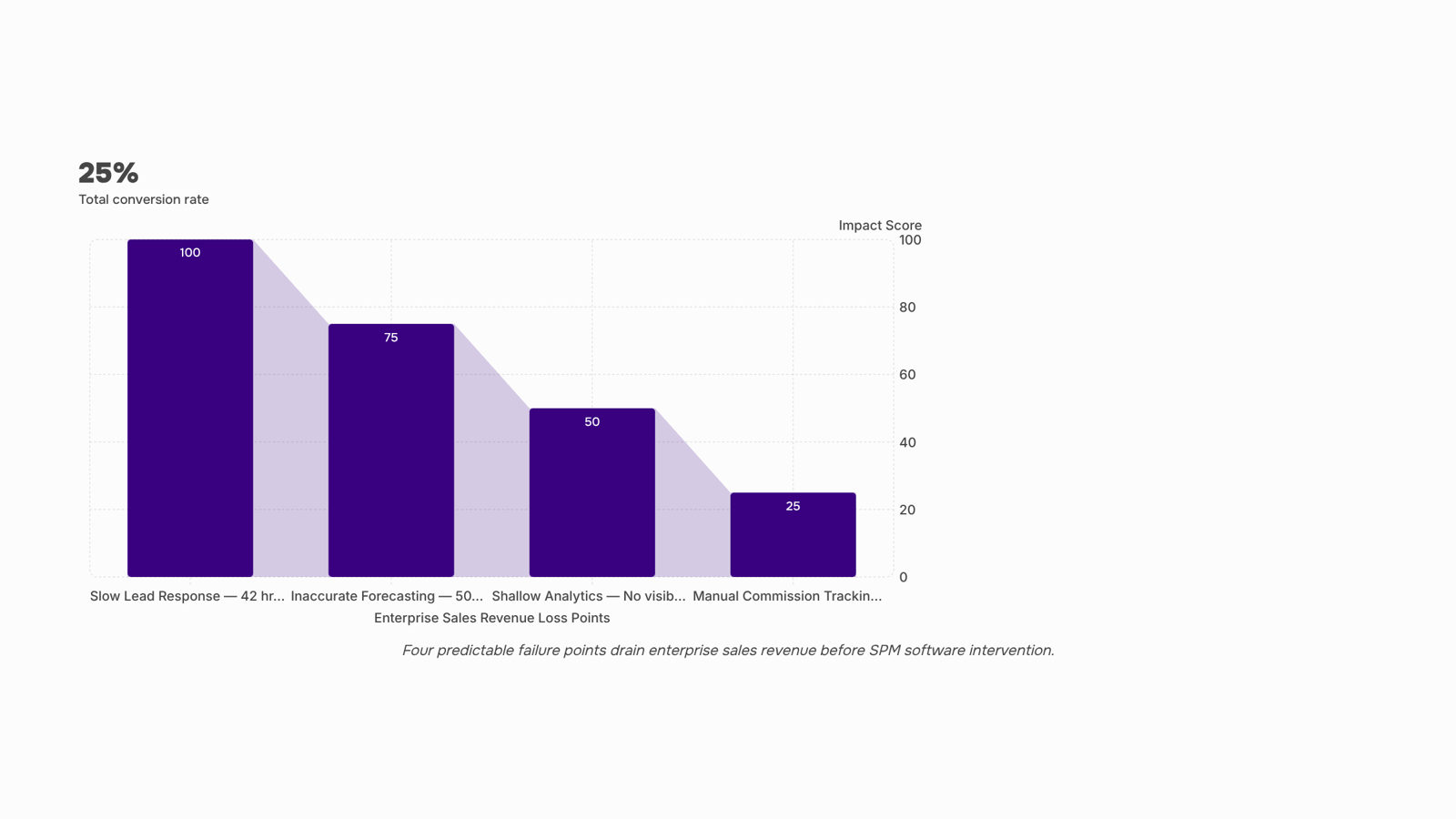
Enterprise IT sales teams bleed revenue at four predictable points. Understanding these failure points turns your software evaluation from a feature checklist into a diagnostic exercise.
Slow lead response: Most enterprise B2B teams average 42 hours to respond to an inbound lead (InsideSales/Harvard Business Review research). By then, the prospect has already talked to a competitor. The right platform captures and routes every lead the moment it appears, compressing that window from hours to minutes.
Inaccurate forecasting: CSO Insights data shows roughly 50% of enterprise forecasts miss their target by more than 10%. The root cause is usually reps self-reporting deal stage without objective signals. Software that ties AI lead management scoring directly to pipeline stage probability produces forecasts grounded in behavior, not optimism.
Shallow analytics: Dashboards that show quota attainment tell you what happened. They never tell you why. Real sales pipeline visibility means tracking conversion rates between stages, average deal velocity by segment, and rep-level activity ratios. Without that depth, coaching conversations stay anecdotal.
Manual commission tracking: When comp plans live in spreadsheets, disputes eat manager time and erode rep trust. Enterprises running 3-4 plan tiers with SPIFs and accelerators need automated calculation tied to closed-won data, not a finance team reconciling exports every pay period.
Most tools on the market solve one, maybe two of these. Commission platforms ignore lead routing. CRMs show pipeline but skip comp. The evaluation question is not "which tool has the most features" but "which platform connects all four failure points into a single feedback loop?" That connection, where a 0-to-100 composite lead score built from firmographic fit and engagement signals feeds forecasting accuracy, is what separates performance management software from another dashboard.
Most enterprise sales forecasts fail because they rely on a rep's gut feeling about deal stage rather than observable buyer behavior. When forecasting software pulls from real-time pipeline data instead of static CRM fields, accuracy improves because the inputs actually reflect what buyers are doing right now.
Here is the concrete mechanism. Sales performance management software connects three data layers into one forecast:
Real-time lead scoring assigns each opportunity a 0-to-100 composite lead score built from firmographic fit and engagement signals. A lead that opened your pricing page three times this week scores differently from one that went silent after a demo.
Stage-weighted probability updates automatically. Instead of a rep manually dragging a deal to "verbal commit," the system watches engagement velocity and adjusts win probability based on actual movement patterns across your pipeline.
Deal velocity calculation measures how fast opportunities move between stages relative to your historical average. A deal sitting 2x longer than normal in negotiation gets flagged and its contribution to the forecast drops.
The result is sales pipeline visibility that reflects reality, not optimism. When AI lead management feeds scoring data directly into your forecasting model, you stop relying on Friday afternoon pipeline calls where reps inflate numbers to avoid scrutiny.
For enterprise IT sales teams running 60+ concurrent opportunities, this matters. A system that captures and routes every lead the moment it appears ensures no opportunity enters the pipeline without a score, which means your forecast denominator is clean from day one.
The practical test: if your current tool can't tell you which deals changed probability this week and why, your forecast is a spreadsheet with extra steps.
Most feature lists read like a vendor's marketing page. Instead, score any enterprise sales performance management platform against the four failure points that actually kill deals: slow response, bad data, misrouted leads, and invisible pipeline gaps.
Priority 1: Speed-to-lead automation: The platform must capture and route leads in under five minutes. Harvard Business Review's research found that responding within five minutes makes you 100× more likely to connect than waiting 30 minutes. If the tool can't trigger instant assignment based on territory, deal size, or rep availability, it fails the first test. Look for a system that captures and routes every lead the moment it appears without manual intervention.
Priority 2: Scoring that feeds forecasting: A sales analytics platform is only useful if it produces a 0-to-100 composite lead score built from firmographic fit and engagement signals. That score should flow directly into pipeline stage probability, so your forecast reflects deal velocity rather than gut feel. Without this connection, you get the "spreadsheet forecast" problem where over half of enterprise forecasts miss by more than 10%.
Priority 3: Commission tracking software that ties payout to behavior: Commission visibility changes rep behavior. The platform should calculate variable comp in real time, show reps exactly where they stand against quota, and let managers model "what if" scenarios for SPIF programs without waiting on finance.
Priority 4: Integration density: Enterprise IT sales teams use an average of 10+ tools simultaneously. Your platform needs native connections to your CRM, email sequencer, and billing system. If it can't automate the manual tasks that drag down sales performance, reps will ignore it within a quarter.
Feature | What to verify | Red flag if missing |
|---|
Lead routing | Sub-5-minute assignment | Manual CSV imports |
Scoring model | Composite score with decay | Binary qualified/unqualified |
Commission calc | Real-time, rep-visible | Monthly batch from finance |
Integrations | Native CRM + email + billing | "We have an API" with no prebuilt connectors |
Score vendors against these four. Anything else is a nice-to-have.
Most sales analytics platforms drown you in activity data: calls logged, emails sent, meetings booked. These are vanity metrics. They measure motion, not progress.
Performance metrics tell you something different:
Lead-to-opportunity conversion rate (what percentage of inbound interest becomes a real deal)
Stage velocity (how many days a deal sits in each pipeline phase before advancing or dying)
Win rate by rep, segment, or lead source
The distinction matters because vanity metrics let underperformers hide behind volume. A rep making 80 calls a day looks busy. Stage velocity reveals they haven't moved a single deal past discovery in three weeks.
An enterprise sales performance management platform earns its cost when it calculates these metrics automatically from pipeline movement, not from manual rep input. That means the system needs to track when a lead enters each stage, how long it stays, and what action triggered the transition.
This is where lead data quality becomes the bottleneck. If your sales analytics platform ingests leads with incomplete firmographic data or inconsistent source tagging, conversion-rate calculations break down immediately. A system that assigns a composite lead score from firmographic fit and engagement signals gives your analytics layer clean inputs to work with, so stage velocity and conversion numbers actually reflect reality rather than data gaps.
Short answer: most sales performance management software handles commission reporting, not commission processing. The platform can show a rep that their Q2 attainment is 112% of quota and estimate payout based on plan rules. What it typically cannot do is run payroll, handle split credits across multi-touch deals, or manage SPIF clawbacks with audit-trail precision.
If commission accuracy is a hard requirement, look for:
Native support for tiered and accelerator-based comp plans, not just flat percentage calculations
Real-time sync with your HRIS or payroll system (Workday, ADP)
An audit log that finance can sign off on before payout
Commission tracking software built specifically for comp (CaptivateIQ, Spiff) will outperform a general SPM platform on edge cases every time. The tradeoff: you lose the unified view of pipeline health, lead scoring, and forecasting that a full SPM system provides.
For most enterprise IT teams, the practical move is pairing your SPM platform with a dedicated comp engine rather than expecting one tool to do both perfectly.
Most sales performance management software evaluates reps after deals close. That's too late if your pipeline data is stale or leads sat untouched for hours before assignment.
For enterprise IT teams, the four failure points that matter are: slow lead response, inaccurate forecasting, scattered tool data, and manual scoring. Here's how the strongest option addresses each:
Lio (WorksBuddy's AI lead management system) captures and scores leads the moment they arrive, routes them to the right rep instantly, and feeds AI-scored pipeline data into your sales forecasting software in real time. Your team sees where to focus energy before a deal goes cold, not after.
Leads assigned in seconds, not hours
AI scoring replaces gut-feel qualification
Pipeline and forecast data live in one view, not across five tabs
If you're evaluating sales CRM options or pipeline management tools, Lio connects across both workflows without adding another disconnected dashboard.
Closing
Enterprise IT sales teams lose deals at four predictable points: slow lead response, opaque pipeline data, manual routing, and invisible forecast gaps. The right sales performance management software doesn't just measure these failures—it eliminates them by connecting lead capture and scoring directly to pipeline velocity and forecast accuracy.
When your platform routes every lead within minutes and feeds real behavioral signals into your forecast model instead of rep estimates, your pipeline stops lying to you. See how Lio handles both problems simultaneously in your own pipeline.
FAQ
What is the best sales performance management software for enterprises?
The best platform connects all four failure points: instant lead routing, AI-powered scoring, real-time commission tracking, and behavioral forecasting. Lio captures and scores leads the moment they arrive, then feeds that data directly into pipeline probability and forecast accuracy—solving the speed and visibility gaps that cost enterprise deals.
How does sales performance management software improve sales forecasting?
It replaces rep gut feel with observable buyer behavior. Real-time lead scoring, stage-weighted probability, and deal velocity tracking create forecasts grounded in actual engagement signals, not optimism. This connection cuts forecast misses from 50% of enterprise teams down to actionable accuracy.
What features should I look for in a sales performance management platform?
Prioritize: sub-5-minute lead capture and routing, composite lead scoring (0-to-100) that feeds forecasting, real-time commission calculation tied to behavior, and deep integration density across your 10+ tool stack. Without these four, you're solving one problem while others stay broken.
Can sales performance management software help with commission tracking?
Yes. Automated commission calculation tied to closed-won data eliminates spreadsheet disputes, shows reps real-time quota position, and lets managers model SPIF scenarios instantly. This transparency changes rep behavior and saves finance teams hours every pay period.


 Elena Petrova15 September 2026


