TL;DR: Most articles on release planning define the term and move on. This one gives IT team leads a decision-by-decision sequence, from scoping features to setting update cadence, with a framework built to fit inside a single sprint cycle. You'll finish with a process you can run on your next release, not just a concept to think about.
What release planning is in software development
Release planning is the process of deciding what ships, when it ships, and who owns each step between now and the release date. It sits between your product roadmap and your sprint backlog — broader than a two-week sprint, narrower than a 12-month vision.
A sprint answers "what does the team build this week?" A release plan answers "what does the customer get next month, and is the team actually resourced to deliver it?" That distinction matters. Many IT teams running agile conflate the two, then wonder why features slip or QA gets handed a build with three days to test it.
The software release process typically covers four things: scope decisions (prioritizing which features make it into the release), timeline with milestones, capacity across dev and QA, and a clear definition of done. Without all four, you have a wish list, not a plan.
A release plan is also a living document. Most teams update it at the start of each sprint — sooner if scope changes or a dependency shifts. Using MoSCoW to gate what ships now versus later gives that update process a repeatable decision rule.
Why release planning matters for your team
A structured release plan does four things that ad-hoc scheduling can't.
Fewer missed deadlines: When every milestone has an owner, a date, and a defined scope, slippage becomes visible early, not the day before launch. Assigning the right people and capacity to each release milestone is what turns a calendar entry into a commitment.
Cleaner stakeholder alignment: Release management gives executives, clients, and dev leads a single source of truth. Everyone knows what ships, when, and why. Without it, you get three versions of the release timeline living in three different inboxes.
Reduced scope creep: Agile release planning forces the team to decide upfront what's in and what's out. Using MoSCoW to decide what ships in this release versus the next is one of the most effective ways to hold that line when stakeholders push for last-minute additions.
Faster dev-to-QA handoffs: When QA knows the release scope two weeks out, they write test cases in parallel with development. That overlap alone can cut handoff lag by several days on a typical two-week sprint cycle.
These outcomes compound. Teams that plan releases deliberately spend less time firefighting and more time shipping. The next section walks through exactly how to build that plan, step by step, starting with prioritizing which features make it into the release.
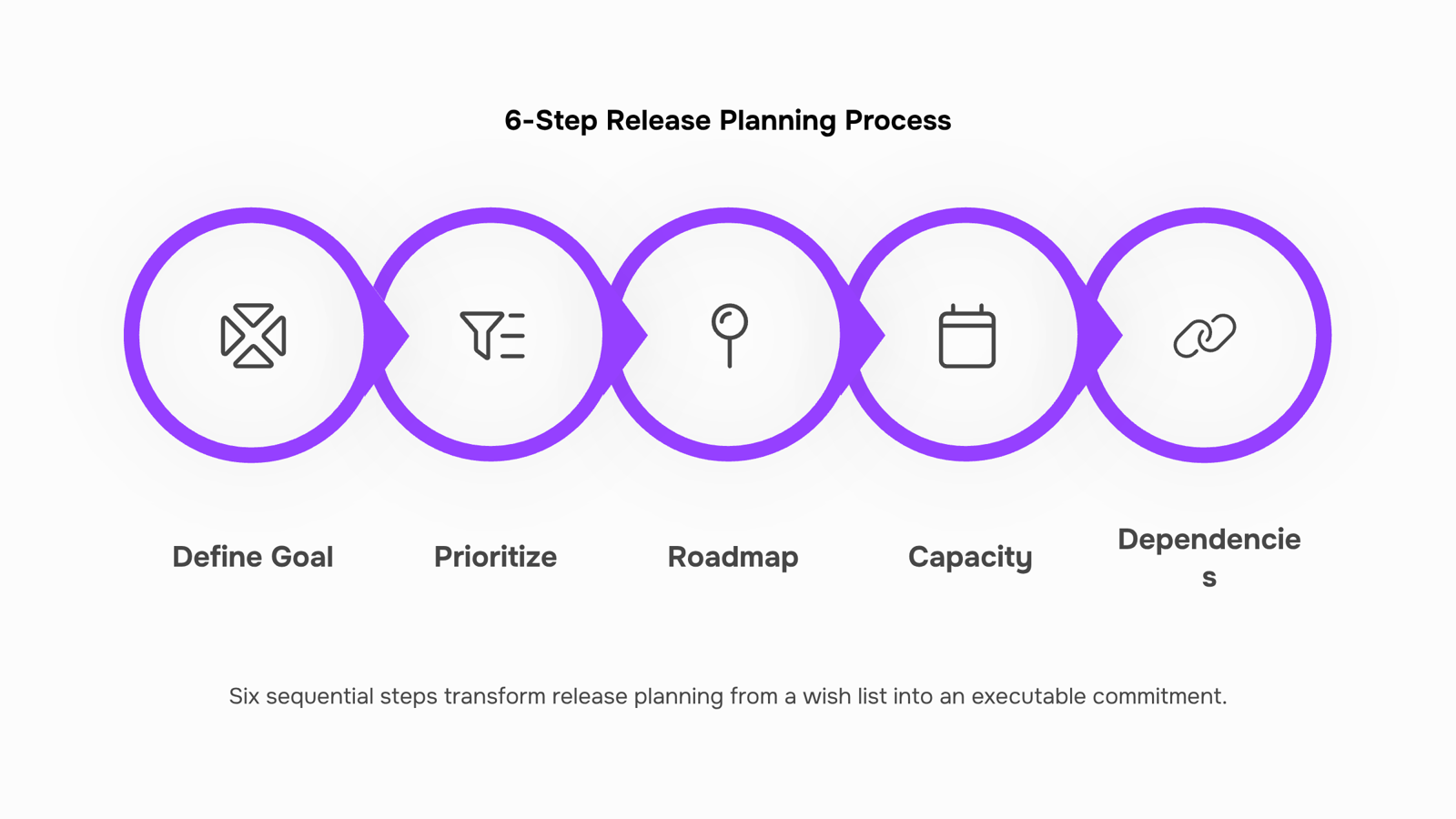
The 6 steps of an effective release planning process
Six steps won't save a release that starts without structure. Here's the sequence that actually works.
1. Define the release goal before touching the backlog
Start with one sentence that answers: what does this release need to accomplish for the business? Not a feature list, not a milestone date, a business outcome. "Enable enterprise customers to configure SSO without a support ticket" is a release goal. "Ship authentication improvements" is not. Every prioritization decision later traces back to this sentence, so getting it right here saves arguments in week three.
2. Prioritize what ships in this release versus the next
Once the goal is clear, pull the relevant backlog items and rank them by impact against that goal, not by who asked loudest. Using MoSCoW to decide what ships in this release versus the next gives you a disciplined way to separate must-haves from nice-to-haves before sprint planning starts, which is where most teams blur the line. A mid-size SaaS team running two-week sprints might find that only 60% of the originally scoped features qualify as Must Have once they apply this filter, which is exactly the kind of scope reduction that keeps releases on track.
3. Map the release to your product roadmap
A release plan that exists in isolation creates drift. Check that the features you're committing to align with how your release plan connects to the broader product roadmap before you lock scope. If the roadmap says Q3 is about infrastructure stability and your release is loading up on new UI features, that's a misalignment worth surfacing now, not during the retrospective.
4. Assign capacity and set realistic milestones
This is where agile release planning gets concrete. Map each work item to a sprint, account for known absences and parallel workstreams, and set milestone dates based on actual team velocity, not optimistic estimates. Assigning the right people and capacity to each release milestone is the step most teams rush, which is why releases slip in the final two weeks rather than at the start. If your team averages 40 story points per sprint and the release requires 160 points of work, you need four full sprints, not three with a crunch.
5. Identify dependencies and handoff points
List every external dependency: third-party APIs, design sign-offs, QA environment availability, legal review for data-handling changes. Then map the handoff sequence between dev and QA explicitly. "Dev completes feature X by end of sprint 2, QA begins testing sprint 3 day 1" is a handoff. "Dev finishes and QA picks it up" is not. Naming the handoff owner and the expected date cuts the ambiguity that causes the most friction in the software release process.
6. Decide which features make the release and document the cut line
Before the release ships, the team needs a documented cut line: features above it go, features below it move to the next release. This is different from the prioritization in step two, which sets intent. This step sets the final commitment. Prioritizing which features make it into the release gives you a framework for making that call without it turning into a negotiation session the week before launch. Document the decision, who made it, and why, so the next release planning cycle starts with institutional memory rather than a blank page.
The distinction between release planning and sprint planning matters here. Sprint planning answers "what does the team build this week?" Release planning answers "what does the customer get, and when?" Conflating the two is the most common reason agile teams end up with technically completed sprints and a release that still isn't ready.
How often to update your release plan
Two triggers should drive every update to your release plan: a fixed cadence and specific events.
Scheduled cadence means reviewing the plan at the start of each sprint. If your team ships monthly, that's roughly every two to four weeks. If you're on a quarterly cycle, a mid-quarter checkpoint prevents surprises from compounding. Treat these reviews the same way you treat sprint retrospectives: non-negotiable, time-boxed, and documented.
Event-based triggers are harder to ignore. Revisit the plan immediately when a key dependency slips, a stakeholder changes scope, or a critical bug surfaces late in testing. Waiting for the next scheduled review after any of those events is how release dates get missed.
For each review, check three things: whether the scope still matches what you're prioritizing for the release, whether resource assignments still hold, and whether the plan still aligns with your broader product roadmap. Taro surfaces these gaps automatically so your release management process doesn't depend on someone remembering to check.
Release planning vs. sprint planning: what's different
The two planning ceremonies serve different purposes, and mixing them up is one of the most common agile team mistakes.
Dimension | Agile release planning | Sprint planning |
|---|
Time horizon | 3–6 months (or a full release cycle) | 1–2 weeks |
Scope | Features, milestones, dependencies across the full release | Tasks and stories for a single sprint |
Ownership | Product owner, engineering lead, stakeholders | Scrum master and development team |
Output | Release roadmap with dates and milestones | Sprint backlog with committed work items |
Release planning sets the destination. Sprint planning maps the next leg of the journey. You need both, and neither replaces the other.
A practical way to think about it: if a decision affects what ships to customers and when, it belongs in release planning. If it affects what the team builds this week, it belongs in sprint planning.
For teams still figuring out the mechanics, sprint planning best practices covers the ceremony structure in detail. The short version: keep the two sessions separate, with separate agendas and separate owners.
Common mistakes that derail a release plan
Four mistakes show up repeatedly when the software release process breaks down.
Skipping dependency mapping is the most expensive one. Teams commit to a release date before anyone has checked which features block other features. One delayed API integration can cascade into three missed milestones.
Locking scope too early compounds the problem. When scope is frozen in week one, the team loses the flexibility to respond to what QA actually finds. A better approach: keep a ranked backlog and use MoSCoW to decide what ships in this release versus the next as late as the midpoint.
No named owner per milestone means every milestone is implicitly everyone's problem, which in practice means no one's. Assign a single accountable person per checkpoint, not a team.
Ignoring QA buffer time is where release planning most often fails quietly. QA gets whatever time is left after development overruns, which is rarely enough. Build the buffer in when assigning the right people and capacity to each release milestone, not after.
Scattered release plans — tasks in one tool, dependencies in a spreadsheet, QA timelines in someone's inbox — are where release management breaks down. Taro pulls your sprint backlog, milestones, task ownership, and dependency chains into one workspace, so the whole team sees the same picture without a coordination meeting to sync it.
That visibility matters most when scope shifts mid-sprint. Instead of manually updating three tools, you update once. If you're still working out what ships in this release versus the next, or how to assign capacity across milestones, those decisions belong in the same release plan, not scattered across tabs.
Closing
Release planning bridges the gap between your product vision and what ships next month. The six-step process—from defining the goal through documenting the cut line—turns a calendar entry into a commitment the whole team can execute against. The key is treating your release plan as a living document that updates every sprint, not a static artifact that goes stale in week two. Start by defining your release goal this week, then walk your team through the prioritization and capacity mapping steps. Once you see how much clearer handoffs become and how much easier it is to say no to scope creep, you'll wonder how you ever shipped without it.
FAQ
What is the release planning process in software development?
Release planning is the process of deciding what ships, when it ships, and who owns each step. It sits between your product roadmap and sprint backlog, covering scope, timeline, capacity, and definition of done.
How do I create an effective release plan for my project?
Follow the six-step sequence: define the release goal, prioritize features using MoSCoW, map to your product roadmap, assign capacity and milestones, identify dependencies and handoffs, and document the final cut line before launch.
What are the key components of a release planning strategy?
Scope decisions, timeline with milestones, capacity across dev and QA, and a clear definition of done. Without all four, you have a wish list, not a plan.
How often should I update my release plan during a project?
Review at the start of each sprint (every two to four weeks for monthly releases) and whenever scope changes or a dependency shifts. Treat it as a living document, not a static artifact.
What tools can I use for release planning and management?
A work management tool like Taro keeps your release plan, sprint tasks, backlog priorities, and team assignments in one workspace so the plan stays current and visible to the entire team.
What is the difference between release planning and sprint planning?
Sprint planning answers 'what does the team build this week?' Release planning answers 'what does the customer get next month, and is the team resourced to deliver it?' Conflating the two causes scope creep and missed deadlines.
Who owns the release plan on a software team?
The product lead or release manager typically owns the plan, but it requires input from dev leads, QA, and stakeholders. Each milestone and handoff should have a named owner to prevent ambiguity.


 Elena Petrova11 September 2026


