TL;DR: Most SAFe explainers stop at the configuration diagram and leave you to figure out the execution. This one breaks down what the Scaled Agile Framework actually does at the team, program, and portfolio level — including where coordination typically breaks down and what that costs your delivery timelines. You'll finish with a clearer picture of where structure helps and where it creates overhead.
What is the scaled agile framework?
The Scaled Agile Framework (SAFe) is a structured set of practices, principles, and competencies that helps large organizations apply Agile and Lean thinking across multiple teams simultaneously.
Standard Agile works well for a single team shipping a single product. SAFe was built for the moment that breaks down: when 8, 15, or 50 teams need to coordinate releases, share dependencies, and stay aligned to the same business goals without constant escalation to leadership.
Dean Leffingwell developed the framework in 2011 after observing that most enterprises couldn't scale Agile past the team level without losing the speed and clarity that made it useful in the first place. The result was a framework organized around Agile Release Trains (ARTs), which are groups of 50 to 125 people working toward a shared mission on a fixed cadence.
In practice, SAFe is used by IT departments, product organizations, and enterprise software companies that need to ship complex, interdependent systems. If you want to understand how SAFe differs from standard Agile at the team level, the distinction comes down to coordination overhead: SAFe adds structure specifically to manage what single-team Agile ignores.
The framework comes in four configurations, from Essential SAFe (the minimum viable starting point) up to Full SAFe for the largest enterprises. Most organizations start with Essential and expand only when the coordination problems genuinely require it.
The key principles of Agile Scrum methodology underpin all four configurations — SAFe extends them, it doesn't replace them.
What is the scaled agile framework used for?
The scaled agile framework (SAFe) is a structured system for running Agile practices across multiple teams simultaneously — without losing coordination or strategic direction.
Most organizations hit a wall when a single Scrum team grows into five, ten, or twenty. Priorities conflict. Teams ship features that don't connect. Deadlines slip because nobody owns the dependency between Team A's API and Team B's front end. SAFe was built to solve exactly that.
The three practical uses come down to:
Coordinating multiple Agile teams so they plan together, align on a shared cadence, and release in sync rather than in isolation
Aligning delivery to business strategy so what engineers build each quarter maps directly to outcomes the business is funding
Managing cross-team dependencies before they become blockers, using structured events like PI Planning to surface conflicts early
A typical SAFe implementation runs on a Program Increment (PI) of 8 to 12 weeks. Teams plan together at the start, execute in parallel sprints, and inspect at the end. That rhythm is what separates SAFe from ad-hoc scaling attempts.
If you want to understand how SAFe compares to standard Agile before going further, the differences between Agile and SAFe methodologies are worth reading first. The configurations that determine which version of SAFe fits your organization are covered in the next section.
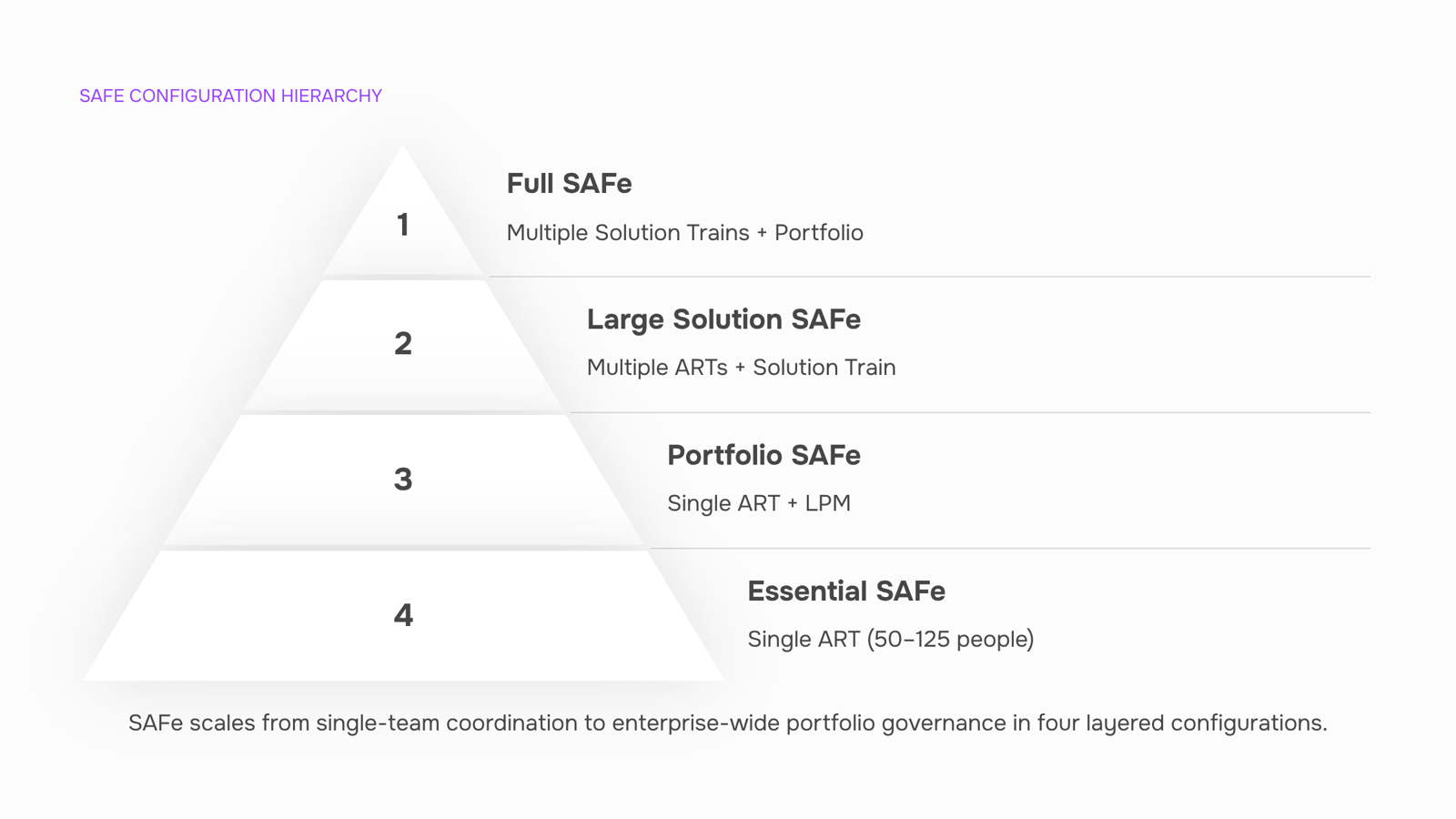
Key components of the scaled agile framework
SAFe ships in four configurations, each sized to a different organizational reality. Picking the wrong one is the most common reason SAFe rollouts stall before they produce results.
Essential SAFe
Essential SAFe is the entry-level configuration, covering a single Agile Release Train (ART) of 50–125 people. It gives you the core mechanics: PI Planning, team iterations, and a shared program backlog. Most organizations start here because it delivers visible coordination improvements without requiring an enterprise-wide restructuring. If you're new to the scaled agile framework, Essential SAFe is where the learning curve is lowest and the feedback loop is fastest.
Large Solution SAFe
Large Solution SAFe adds a Solution Train layer above the ART. It's designed for organizations building complex systems that require multiple ARTs working in concert, think defense programs, large financial platforms, or enterprise software with dozens of interdependent components. The key addition is the Solution Management and Solution Architect roles, which coordinate across trains without pulling everything up to portfolio level. Use this configuration when your delivery problem is cross-ART dependency, not strategy alignment.
Portfolio SAFe
Portfolio SAFe connects delivery to business strategy. It introduces Lean Portfolio Management (LPM), which governs how funding flows to value streams rather than to individual projects. This is where scaled agile framework kanban becomes operationally relevant: portfolio Kanban boards make work-in-progress visible at the investment level, so executives can see where capacity is allocated and where bottlenecks are forming. Teams that skip this layer often find that ARTs deliver efficiently but in the wrong direction.
Full SAFe
Full SAFe combines all three layers into one operating model. It's appropriate for enterprises running multiple Solution Trains under a single portfolio, typically organizations with thousands of practitioners across business units. The purpose of PI Planning in SAFe becomes especially critical at this scale, because it's the primary mechanism for keeping hundreds of teams pointed at the same quarterly objectives without requiring constant top-down intervention.
Most mid-sized IT organizations land at Portfolio SAFe. Full SAFe makes sense only when Large Solution complexity and Portfolio governance are both active constraints at the same time.
How does the scaled agile framework work?
SAFe runs on a repeating cycle built around the Program Increment (PI), typically an 8–12 week period that aligns every team to the same goals before a single sprint begins.
Here is how one full cycle moves in practice:
PI Planning: All Agile Release Train (ART) teams meet for two days to review the program vision, set team objectives, and surface dependencies. This is where cross-team coordination actually happens, not in Slack threads after the fact. The purpose of PI Planning in SAFe is to replace months of misaligned work with two days of structured commitment.
Sprint execution: Teams run 2-week sprints inside the PI. Each sprint has its own planning, review, and retrospective, following the same agile scrum principles that single teams use, just coordinated across the ART.
System Demo: At the end of each sprint, teams integrate their work and demonstrate a working system increment to stakeholders. This is not a team demo — it is an ART-level integration check.
Inspect and Adapt (I&A): At the PI's close, the full ART runs a structured retrospective and problem-solving workshop. Teams identify systemic issues and feed fixes into the next PI.
For IT company owners evaluating a SAFe implementation, this cadence is the practical core. Understanding how SAFe differs from standard Agile helps clarify why that structure exists at scale.
How SAFe differs from traditional Agile
Traditional Agile was designed for a single team shipping software in two-week sprints. SAFe takes that same iterative logic and restructures it for organizations running 50 to 125+ people across multiple teams simultaneously. The mechanics look similar on the surface; the coordination layer is entirely different.
The clearest way to see the gap is side by side:
Dimension | Traditional Agile | SAFe |
|---|
Team size | 5–10 people | 50–125+ across an Agile Release Train |
Coordination layer | Scrum Master per team | Release Train Engineer + System Architect |
Planning horizon | 2-week sprint | 8–12 week Program Increment |
Key roles | Product Owner, Scrum Master, Dev Team | Business Owners, RTE, Solution Train Engineer |
Cadence | Sprint Review every 2 weeks | System Demo + Inspect and Adapt every PI |
Tooling expectation | Jira, Trello, or similar | Jira Align, Rally, or SAFe-native tooling |
The practical difference shows up at the planning layer. A single Agile team aligns in a 30-minute standup. An Agile Release Train running the scaled agile framework aligns 100+ people across a two-day PI Planning event, producing a shared program board with cross-team dependencies mapped before a single sprint begins.
For IT company owners evaluating SAFe vs Agile: if your delivery bottleneck is cross-team dependency management rather than individual team velocity, SAFe addresses the right problem. Single-team shops rarely need it.
Benefits of using the scaled agile framework
Faster cross-team delivery: SAFe aligns multiple teams to a shared Program Increment (PI) cadence, typically 8–12 weeks. Dependencies get surfaced during PI Planning rather than mid-sprint, so work moves through the pipeline without the usual coordination delays.
Fewer dependency blockers: The Release Train Engineer role exists specifically to remove cross-team blockers before they stall delivery. Teams don't wait on each other; they negotiate dependencies upfront.
Aligned roadmaps: Portfolio-level planning connects business strategy to team-level execution. Every squad knows which business outcome their sprint work supports, which reduces the "why are we building this?" confusion that derails quarterly plans.
Predictable release cadence: Because all Agile Release Trains (ARTs) operate on synchronized iterations, stakeholders can forecast releases with real confidence. The benefits of agile software compound here: SAFe adds the coordination layer that pure Agile leaves to chance.
Reduced rework: Built-in inspect-and-adapt ceremonies catch misalignment at the PI boundary, not after a full quarter of wasted effort. Teams using the scaled agile framework SAFe consistently report shorter feedback loops between planning and correction.
How IT teams run SAFe in practice
Two scenarios show what SAFe implementation actually looks like at different scales.
A 50-person IT services firm running three Agile Release Trains (ARTs) uses PI Planning every 10 weeks to align squads across client delivery tracks. Each ART owns a product line. Dependencies get flagged in the planning board before a sprint starts, not discovered mid-iteration. The result: fewer emergency escalations, and a release cadence teams can actually commit to.
A 10-person product team scaling from 2 to 4 squads faces a different problem. Adding squads without structure creates ownership gaps fast. SAFe's Essential configuration gives them just enough scaffolding: a shared backlog, defined team boundaries, and a lightweight PI Planning rhythm that keeps both squads pointed at the same goals.
In both cases, the team-level execution layer is where SAFe either holds or falls apart. Sprint boards, scaled agile framework Kanban queues, and daily stand-up cadences need a single place to live. That's what Taro handles inside the WorksBuddy suite: sprint and Kanban work organized within a SAFe structure, so nothing slips between the ART and the squad.
For the differences between Agile and SAFe at the methodology level, that comparison is worth reading before you choose a configuration.
Closing
Once you understand what SAFe coordinates at each level—team sprints aligned to program increments, cross-ART dependencies surfaced in PI Planning, portfolio funding flowing to value streams—the next decision becomes clear: is your team-level execution visible enough to support that coordination? If sprints, Kanban boards, and task tracking live in silos or spreadsheets, SAFe's program-level visibility has nothing real to pull from. That's where execution tools like Taro step in—they become the work layer that feeds SAFe's coordination engine, turning structured planning into actual delivery momentum.
The framework only works when leadership can see what teams are actually building week to week. Start by mapping your current execution visibility: Can you see which tasks are blocking which teams? Do your sprints surface dependencies before they become crises? If the answer is no, your first move isn't to add SAFe layers—it's to wire up the execution foundation that SAFe depends on.
FAQ
What is the scaled agile framework used for?
SAFe coordinates multiple Agile teams on a shared cadence, aligns delivery to business strategy, and manages cross-team dependencies before they become blockers. It replaces ad-hoc scaling with structured Program Increments and PI Planning.
How does the scaled agile framework differ from traditional Agile?
Standard Agile works for single teams; SAFe adds structure to manage coordination across 50–125+ people. It introduces PI Planning, Agile Release Trains, and portfolio governance—layers that single-team Agile doesn't need.
What are the key components of the scaled agile framework?
The four configurations are Essential SAFe (single ART), Large Solution SAFe (multiple ARTs), Portfolio SAFe (strategy alignment), and Full SAFe (all three layers). Most mid-sized organizations start with Essential or Portfolio.
How can I implement the scaled agile framework in my organization?
Start with Essential SAFe and one Agile Release Train. Run PI Planning every 8–12 weeks, execute 2-week sprints, hold System Demos, and close with Inspect and Adapt. Expand configurations only when coordination problems genuinely require it.
What are the benefits of using the scaled agile framework?
SAFe eliminates misaligned work, surfaces dependencies early, reduces escalation overhead, and ties delivery directly to business outcomes. Teams ship faster because they coordinate upfront, not after conflicts emerge.
How does SAFe handle Kanban teams alongside Scrum teams?
SAFe integrates both: Scrum teams run sprints within the PI, while Kanban teams flow work continuously on the same cadence. Both participate in PI Planning and System Demo to stay coordinated with the ART.


 Elena Petrova15 September 2026


