TL;DR: Most content on sales and marketing alignment stops at "meet weekly and share a CRM." This piece goes further: it identifies the specific handoff failures that drop qualified leads before they ever reach a sales conversation, and shows IT company owners how to fix them with a defined qualification process, shared pipeline visibility, and clear ownership at every stage.
What is sales and marketing alignment?
Sales and marketing alignment is the operating state where both teams share the same revenue goals, agree on how leads are defined at each pipeline stage, and work from the same data.
That last part matters most. Alignment isn't a quarterly kickoff or a shared Slack channel. It's a set of agreed processes: a common definition of what makes a lead "qualified," a clear handoff point from marketing to sales, and reporting that both teams read the same way.
The core mechanism works in three layers:
Shared revenue goals mean both teams are measured on pipeline and closed revenue, not separate vanity metrics (marketing on traffic, sales on calls)
Shared lead definitions mean a marketing-qualified lead (MQL) and a sales-qualified lead (SQL) are written down, agreed upon, and enforced in the CRM
Shared pipeline visibility means neither team is flying blind on where deals stall or where leads go cold
Without those three layers, you get the most common failure mode in B2B sales: marketing hands off leads that sales ignores, and both teams blame the other.
Converting leads into sales becomes significantly harder when the two teams disagree on what a "good lead" even looks like. Most companies treat that disagreement as a people problem. It's actually a process gap, and it's measurable.
The next section names exactly what that gap costs.
Why sales and marketing misalignment costs IT companies revenue
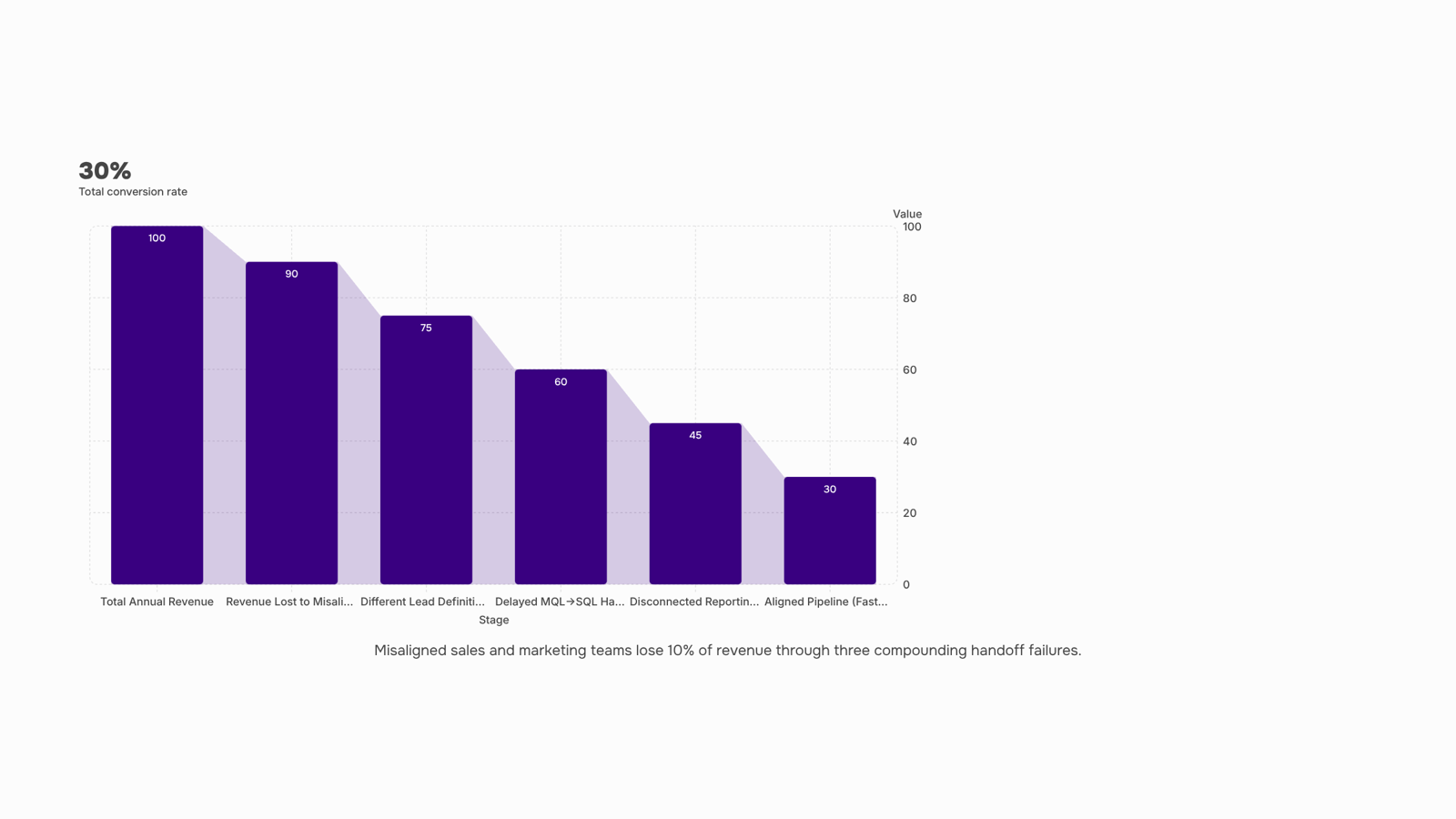
Misaligned sales and marketing teams don't just create friction — they destroy pipeline. Research from Forrester found that B2B companies lose an estimated 10% or more of annual revenue to misalignment between the two functions. For an IT company doing $5M a year, that's $500K quietly leaking out before anyone flags it.
Three failure points drive most of that loss.
Different lead definitions: When marketing scores a lead as ready and sales disagrees, the handoff stalls. The difference between a marketing qualified lead and a sales qualified lead is often where IT companies lose weeks of follow-up time — not because the lead was bad, but because no one agreed on what "ready" meant before the campaign launched.
Delayed MQL to SQL handoff: Speed matters more than most teams realize. When there's no defined handoff process, leads sit in a queue while interest cools. A broken lead qualification process means sales reps are often working leads that are days old instead of hours old.
Disconnected reporting: Marketing tracks clicks and form fills. Sales tracks deals closed. Neither team sees the full picture, so neither can diagnose why most leads don't convert even when pipeline volume looks healthy. You can't fix a gap you can't see.
Each failure point compounds the others. Fix one in isolation and the other two still drain the pipeline.
Why sales and marketing alignment is important for business success
When sales and marketing operate as separate functions with separate goals, the pipeline pays for it. Research from industry analysts suggests B2B companies lose a meaningful share of potential revenue each year to misalignment — deals that stall at handoff, leads that go cold, and forecasts that miss because neither team is working from the same numbers.
The business case for sales and marketing alignment comes down to five concrete outcomes.
Faster lead response: Aligned teams agree on handoff triggers in advance, so a qualified lead moves to sales within minutes, not days. Speed at this stage directly affects close rates.
Higher conversion rates: When both teams share a definition of what a good lead looks like, sales spends time on prospects that are actually ready to buy. Fewer wasted calls, more closed deals.
Shorter sales cycles: Marketing that understands what objections sales hears can address those objections in content before the first conversation. That pre-work compresses the time from first touch to signed contract.
Lower cost per acquisition: Shared revenue goals reduce duplicated spend. Marketing stops funding campaigns that generate volume without quality; sales stops chasing leads that were never a fit.
More accurate forecasting: A shared pipeline view means both teams are reporting on the same data. Leaders get forecasts they can actually plan around, not two versions of the truth.
Tracking these outcomes requires visibility into where contacts are in the pipeline at any given moment. Contact tracking software gives both teams a single source of record, which is a prerequisite for any of the above to work consistently.
How sales and marketing alignment works in practice
Sales and marketing alignment works as a system, not a standing meeting. Here is the sequence that makes it repeatable.
Agree on your ICP first: Before any lead touches a pipeline, both teams define who they are actually trying to win: company size, industry, tech stack, buying trigger. Without this, marketing optimizes for volume and sales complains about quality. Every other step depends on this one being locked in writing.
Define MQL and SQL thresholds together: An MQL is a lead that meets your profile and has shown enough intent to be worth nurturing. An SQL is one sales has reviewed and accepted as ready for a conversation. The difference between a marketing qualified lead and a sales qualified lead matters here because mismatched definitions are where most pipeline leakage starts. Set the scoring criteria in a shared document both teams sign off on.
Build a handoff protocol for the MQL to SQL handoff: Specify what information must travel with the lead (pages visited, content downloaded, company size confirmed), who receives it, and within what timeframe. A lead that sits uncontacted for 24 hours is a lead that is cooling. The lead qualification process should be documented as a checklist, not a verbal agreement.
Set shared KPIs: Marketing owns MQL volume and quality score. Sales owns SQL acceptance rate and conversion to opportunity. Both teams own pipeline contribution and revenue sourced from marketing. When most leads don't convert even when pipeline volume looks healthy, shared KPIs surface the exact stage where the breakdown is happening.
Track which marketing KPIs to monitor for alignment on a weekly cadence, not quarterly. Problems compound fast when the review cycle is too slow.
Sales and marketing alignment best practices
Five practices that move sales and marketing alignment from intention to habit:
Document your ICP and MQL/SQL thresholds in one shared file, then version-control it.
When criteria change, both teams see the update simultaneously. This removes the "we didn't know the definition changed" excuse that quietly kills pipeline. If you need a starting point, a shared framework for qualifying sales leads covers the core criteria.
Run a weekly 30-minute pipeline review with both teams in the room.
Not a status update — a working session where leads stuck at MQL get a decision: advance, recycle, or disqualify. This single habit surfaces why most leads don't convert even when pipeline volume looks healthy faster than any quarterly audit.
Define the handoff protocol in writing, including what happens when a lead misses a threshold. Ambiguity at the MQL-to-SQL boundary is where deals stall. See the difference between a marketing qualified lead and a sales qualified lead for a clear boundary to work from.
Automate lead routing against agreed criteria rather than relying on manual review.
Lio applies your MQL/SQL thresholds at the moment a lead qualifies, routes it to the right rep, and logs the handoff — so the lead qualification process runs consistently whether your team is at capacity or not.
Tie both teams to shared revenue metrics, not siloed activity counts.
Track which marketing KPIs to track when measuring alignment alongside sales cycle length so neither team can hit their number while the other misses.
How to measure sales and marketing alignment
Sales and marketing alignment can absolutely be measured — and if you're not tracking it, you're guessing at where the pipeline breaks.
Four metrics give you the clearest picture:
MQL-to-SQL conversion rate: The percentage of marketing-qualified leads that sales accepts as sales-qualified. A low rate signals that the difference between a marketing qualified lead and a sales qualified lead isn't agreed on in practice. Track it in your CRM by stage transition.
Lead response time: How quickly sales contacts a new MQL after the handoff. This is one of the sharpest indicators of MQL-to-SQL handoff friction. Track it as the average time between lead creation and first sales activity.
Pipeline contribution by channel: Which marketing channels produce deals that actually close, not just leads that enter the funnel. This ties marketing activity directly to shared revenue goals. Pull it from closed-won data filtered by lead source.
Sales cycle length: Aligned teams tend to run shorter cycles because leads arrive better qualified. If most leads don't convert even when pipeline volume looks healthy, cycle length often tells you why.
Pair these with the right marketing KPIs and you have a dashboard that shows misalignment before it costs you pipeline.
Closing
Sales and marketing alignment isn't a nice-to-have meeting cadence—it's a revenue protection mechanism. The teams that win define their ICP once, lock in their MQL and SQL criteria in writing, and enforce those definitions through process, not goodwill. That enforcement is where most companies fail. They agree on paper and then revert to old habits because no one is watching the handoff. The fastest way to close that gap is to automate the moment a lead meets your SQL criteria. Lio assigns qualified leads the instant they hit your agreed threshold, so the alignment your teams define actually runs in practice instead of getting lost in someone's inbox. What's your current MQL-to-SQL handoff time, and how many leads are sitting in that queue right now?
FAQ
Why is sales and marketing alignment important for business success?
Misaligned teams lose 10% or more of annual revenue to handoff failures, stalled leads, and disconnected reporting. Alignment compresses sales cycles, raises conversion rates, and gives leadership forecasts they can actually plan around.
What are the benefits of aligning sales and marketing teams?
Faster lead response, higher conversion rates, shorter sales cycles, lower cost per acquisition, and accurate forecasting. All five outcomes depend on both teams working from the same lead definitions and pipeline data.
How can I improve sales and marketing alignment in my organization?
Lock your ICP and MQL/SQL thresholds in a shared document both teams sign off on, build a documented handoff protocol with timeframes, set shared KPIs, and track them weekly. Automation removes the manual delays that cause handoff failure.
Can sales and marketing alignment be measured and tracked?
Yes. Track MQL volume and quality, SQL acceptance rate, conversion to opportunity, and time from MQL to SQL contact. Weekly reviews surface breakdowns faster than quarterly reviews; shared pipeline visibility lets both teams see where deals stall.


 Elena Petrova15 September 2026


