TL;DR: Most agency rank tracker guides compare features and stop there. This one gives IT company owners running SEO agencies a five-pillar decision matrix — the TRACK Framework — with specific benchmark thresholds for each pillar so you can audit your current tool against a concrete standard and know exactly where it's costing you scale.
What an agency rank tracker actually does differently
A standard rank tracker answers one question: where does this URL rank today? An agency rank tracker tool answers a different set of questions entirely: which clients are losing ground before they notice, which accounts are ready to expand, and how do you surface that information to 20 clients without 20 separate manual exports.
The distinction shows up in four concrete ways. First, multi-client architecture: agency tools organize keywords, reports, and alerts by client account, not by project. Second, white-label reporting that goes out under your brand, not the software vendor's. Third, anomaly detection that flags a client's drop before they email you about it. Fourth, how AI-powered rank tracking works under the hood matters here too, because modern agency tools now track your presence in AI-generated answers alongside traditional SERP positions.
That last point is no longer optional. A growing share of Google searches return AI Overviews, and clients will ask whether they appear in them.
Solo tools are built for one operator checking one site. Agency-grade tools are built for account management at scale, where the cost of a missed signal is a churned client.
The TRACK Framework: five pillars of an agency-grade rank tracker
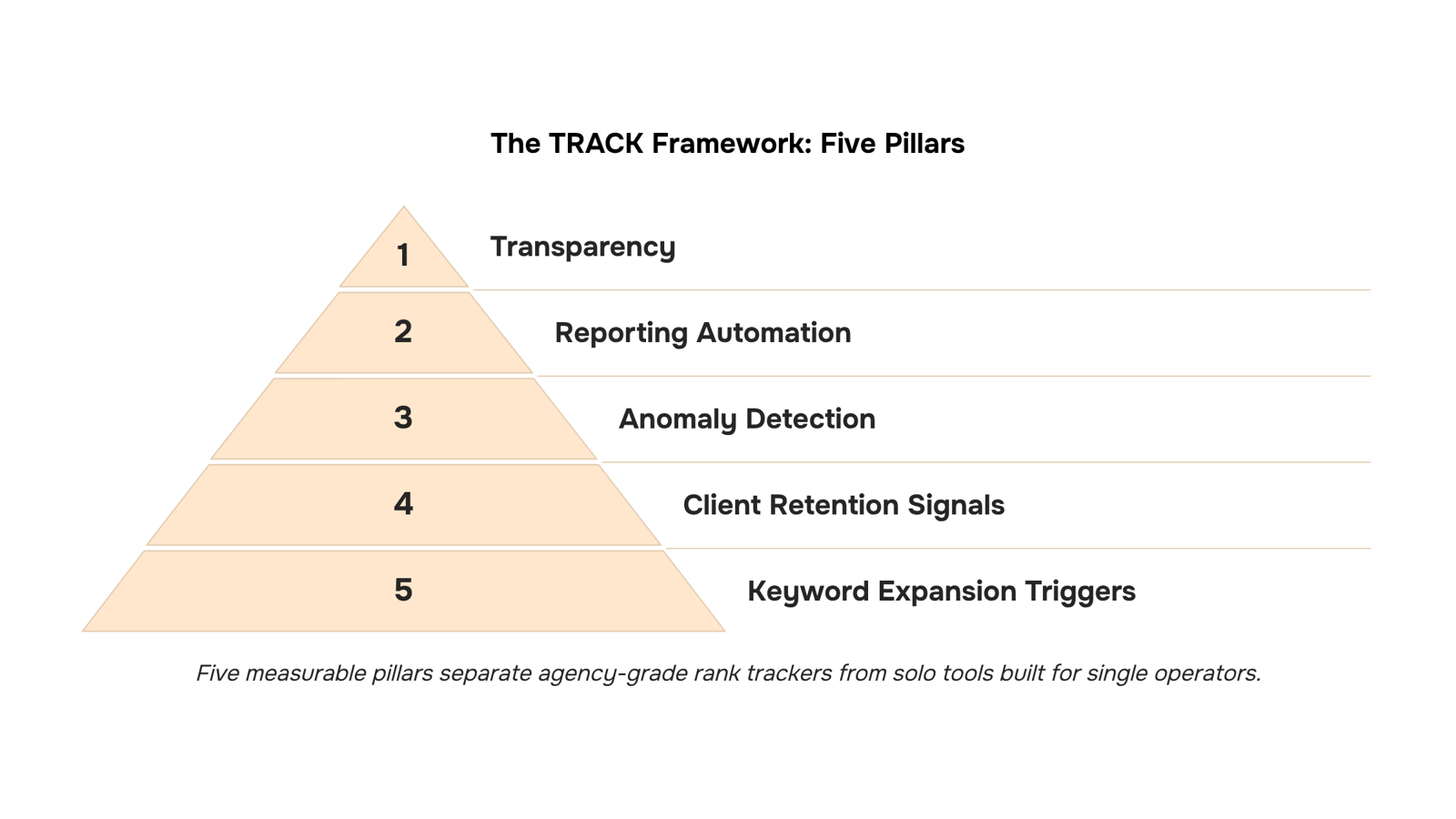
The TRACK framework gives you five measurable pillars to audit any agency rank tracker software against. If a tool misses one, you'll feel it in your operations within 90 days.
Transparency means every client can see exactly how rankings are measured, on what device, from what location, and on what schedule. The benchmark: clients should be able to access a live dashboard without emailing you. If they can't, your account managers are fielding status requests instead of doing strategy work. Single-position numbers are also less reliable than they appear, so understanding how variance gets smoothed matters before you promise clients a specific number.
Reporting automation is where most agency rank trackers lose ground. The benchmark: zero manual exports per client per month. Scheduled white-label reports should fire on a fixed cadence, with threshold-triggered alerts going out the moment a keyword moves outside an agreed band. The next section covers the specific workflow mechanics in detail, but the audit question here is simple: does your current tool send reports, or do you send reports?
Anomaly detection separates a spreadsheet from a real agency rank tracker tool. A SERP can shift overnight from a Google update, a competitor's paid push, or a site migration error. The benchmark: your tool should flag a drop of 5 or more positions within 24 hours, not on your next weekly pull. How AI-powered rank tracking works under the hood explains why rule-based alerts alone miss the pattern; the better systems model expected volatility by keyword type before firing an alert.
Client retention signals are the pillar most agency rank trackers ignore entirely. Ranking data predicts churn before the client says anything. The benchmark: your tool should surface accounts where average position has declined for three or more consecutive weeks, so you can schedule a proactive call rather than receive a cancellation notice.
Keyword expansion triggers turn a rank tracker into a growth tool. When a keyword cluster breaks into the top 10, that's a signal to brief supporting content, not just log the win. The benchmark: your tool should flag keywords within 3 positions of a page-one threshold automatically. For agencies tracking AI-generated answer coverage alongside traditional rankings, monitoring presence in AI-generated answers adds a second expansion layer that standard SERP tools miss entirely.
Run your current stack against these five benchmarks. The gaps you find are the gaps your clients are already noticing.
How automated rank reporting cuts account manager workload
Manual reporting is where account manager hours go to die. Agency analytics research puts the average at roughly five hours per client per month spent pulling rank data, formatting it, and writing commentary. At ten clients, that's a half-time role doing nothing but report assembly.
Good agency rank tracker software removes that work through three specific mechanisms.
Scheduled delivery replaces the pull-and-format cycle. You configure the report once, set the cadence (weekly, bi-weekly, or monthly), and the system sends it. No manual trigger, no template hunting.
White-label delivery means the report lands in the client's inbox under your brand, not the tool's. That matters because it protects the relationship and removes the "what software is this?" conversation.
Threshold-triggered alerts are where the real workload reduction happens. Instead of reviewing every account every week, you review only the accounts where something changed. Set a rule: if any tracked keyword drops more than five positions in seven days, flag it. Your account managers see a short list of exceptions, not a wall of dashboards.
The practical result: an account manager running fifteen clients can triage the week's ranking activity in under thirty minutes. The rest of the time goes to strategy and client calls, not spreadsheet maintenance.
For teams also tracking presence in AI-generated answers, the same alert logic applies to LLM citation drops.
Using ranking drops as client churn-risk signals
Not every ranking drop is a crisis. But certain drop patterns reliably precede a client cancellation conversation, and an agency rank tracker gives you enough lead time to intervene before that call happens.
The patterns that predict churn are specific. A client losing 3 or more positions on their top 5 revenue keywords within a 14-day window is a warning sign. A sustained decline across 60% or more of tracked keywords over 30 days is a stronger one. A single catastrophic drop, say 15+ positions overnight, almost always triggers an immediate "what are we paying for" email. Single-position numbers are less reliable than they appear, so tracking movement across a keyword cluster matters more than watching one vanity term.
The lead time question is practical. Most clients take 2 to 4 weeks from noticing a decline to raising a cancellation conversation. That window is your intervention window. Threshold-triggered alerts from your agency rank trackers compress your response time from "we noticed last month" to "we noticed yesterday."
The retention response belongs inside the tracking workflow, not outside it. When an alert fires, the account manager gets a templated brief: which keywords dropped, by how much, probable cause (algorithm, competitor movement, technical), and a proposed recovery action. That brief goes to the client before they ask.
Proactive communication on a drop is the single most effective churn-prevention move most agencies aren't doing systematically.
How rank tracking connects to AI answer engine optimization
Traditional rank tracking stops at position 1. That's a problem in 2025, because a significant share of Google searches now return AI Overviews — and ranking in position 3 while getting cited in an AI Overview often drives more clicks than ranking in position 1 without one.
Any agency rank tracker tool that ignores LLM citation data is giving clients an incomplete picture. Agencies now need to monitor two parallel surfaces: traditional SERP positions and AI answer appearances. These don't always move together. A page can drop from position 2 to position 6 and simultaneously gain an AI Overview citation — net result for the client is positive, but a position-only report makes it look like a loss.
What this requires from your agency rank tracker software is structured citation monitoring alongside keyword position data, so you can map content gaps to both surfaces at once. That's where rank tracking connects directly to content planning: when a page loses an AI citation, that's a signal to update the source content, not just build links.
Platforms like Ranko are built to handle both layers — tracking traditional rankings and AI answer engine optimization signals in one workflow, so agencies can plan content interventions with full SERP visibility. For a deeper look at how AI reshapes measurement, this SERP signal framework is worth reading alongside this one.
ROI of switching to an AI-powered agency rank tracker
The ROI case for switching agency rank tracker tools comes down to three numbers: hours recovered, clients retained, and revenue surfaced.
AgencyAnalytics reports that SEO account managers spend roughly 10 hours per month on manual client reporting. Across a five-client book, that's a half-time employee's output consumed by copy-paste work. AI-powered agency rank trackers cut that to under two hours by automating data pulls, anomaly flags, and white-label report generation.
Churn is the harder number to see until it's too late. Clients rarely say "I left because I didn't understand my rankings." They say "I didn't see the value." Automated visibility alerts, sent before the client notices a drop, change that conversation from damage control to proactive partnership.
The upsell signal is subtler. When competitor position tracking across all monitored topics shows a client losing ground in a category you're not yet covering, that's a scoped expansion conversation, not a cold pitch.
Add daily AI mention tracking across ChatGPT, Claude, and Perplexity and you're surfacing value most agencies aren't even measuring yet.
Structuring multi-client keyword tracking at scale
Most agencies start with a flat keyword list per client. That works at five clients. At twenty, it collapses.
Structure your tracking around three layers: client tier, keyword intent, and update frequency. Tier-one clients (your highest-revenue accounts) get daily tracking on branded and high-intent commercial terms. Tier-two clients get weekly sweeps on informational and mid-funnel keywords. Below roughly 500 monthly searches, the crawl cost rarely justifies daily pulls — move those to weekly or drop them entirely.
Within each client workspace, tag keywords by page type, funnel stage, and campaign. That tagging logic is what lets you generate a meaningful report in minutes rather than rebuilding filters every time.
One threshold worth setting early: if a single client exceeds 300 tracked keywords, audit for duplication before adding more. Bloated lists inflate costs and dilute the signal.
For agencies also tracking your presence in AI-generated answers, apply the same tier logic — daily monitoring for priority clients, weekly for the rest.
Closing
The TRACK Framework gives you a concrete way to audit whether your current rank tracker is built for agency scale or just bolted onto a solo tool. Transparency, Reporting automation, Anomaly detection, Client retention signals, and Keyword expansion triggers are the five pillars that separate tools that reduce workload from tools that add to it. Score your current tracker against each pillar—if you're missing one, you're already losing account manager hours and client retention signals. Ranko is built to meet all five. Take five minutes to see how your stack stacks up against the framework, then explore Ranko's feature set to see what closing the gaps looks like.
FAQ
How can an agency rank tracker benefit my SEO agency?
An agency rank tracker automates client reporting, surfaces churn risk before clients cancel, and flags growth opportunities automatically. Account managers spend less time pulling data and more time on strategy and retention calls.
What features should I look for in an agency rank tracker?
Look for multi-client architecture, white-label reporting, anomaly detection within 24 hours, churn-risk signals, and keyword expansion triggers. Use the TRACK Framework to audit any tool against these five benchmarks.
Can an agency rank tracker help with client reporting?
Yes. Scheduled white-label reports eliminate manual exports, threshold-triggered alerts reduce review time to 30 minutes per week, and clients access live dashboards without emailing you.
How accurate are agency rank trackers in monitoring keyword rankings?
Accuracy depends on how the tool smooths variance and models expected volatility by keyword type. Modern tools that track AI-generated answers alongside SERP positions give you a more complete picture than single-position numbers alone.
How many clients can one agency rank tracker handle before it slows down?
A true agency-grade tool scales to hundreds of clients without performance degradation. The bottleneck is usually your account manager workload, not the software—automated reporting and alerts keep that manageable at scale.
What is the difference between an agency rank tracker and a white-label rank tracker?
An agency rank tracker is built for managing multiple client accounts with multi-client dashboards and automated reporting. A white-label tool is the same software resold under your brand. Most modern agency trackers include white-label reporting as a standard feature.


 Natalie Brooks14 September 2026


