TL;DR: Most articles on estimated time of completion hand you a formula and move on. This one shows IT company owners which inputs corrupt estimates before work starts, how to use historical sprint and task data to calibrate future ones, and the specific signals that tell you a live estimate needs updating before a deadline slips.
What estimated time of completion actually means
Estimated time of completion (ETC) is your best current forecast of when a project will finish, given what you know right now. It's a living number, not a fixed promise.
That distinction matters because teams routinely confuse ETC with three related terms:
Deadline: a contractual or business constraint, set externally. You don't calculate it; you're given it.
Due date: a target, often internal, that may or may not reflect actual capacity.
ETA (estimated time of arrival): borrowed from logistics, sometimes used interchangeably with ETC, but typically describes a single deliverable rather than a full project scope.
ETC sits above all three. It's the output of your project time estimation process, combining scope, resource availability, task dependencies, and historical velocity. When those inputs change, your ETC should change with it.
Most teams treat their first estimate as permanent. That's where accuracy breaks down. A well-managed ETC gets recalculated at each sprint boundary or major milestone, using real data rather than the original assumption.
To do that well, you need to pull actual task duration data from past sprints and see a live forecast of your actual completion date as work progresses.
What happens when your ETC is wrong
A wrong estimated time of completion doesn't just shift a date on a calendar. It triggers a chain of real costs that compound fast.
The most visible consequence is delayed revenue. When a project slips two weeks, the client invoice moves with it. For IT company owners running fixed-fee contracts, that gap comes directly out of cash flow. For time-and-materials work, scope creep that wasn't estimated correctly turns into write-offs or uncomfortable conversations about change orders.
Client trust erodes faster than most teams expect. One missed deadline is a data point. Two is a pattern. The consequences of underestimating project time rarely stay internal: clients start adding buffer to their own plans, pulling you out of the critical path, or quietly shopping alternatives.
Team burnout is the cost that doesn't show up in a project report. When the original estimate was too tight, the team absorbs the gap through overtime and context-switching. That pressure compounds across sprints until project deadline accuracy becomes a morale problem, not just a planning problem.
The fix starts before the project kicks off. Break your project into tasks with owners, priorities, and dependencies so your estimate reflects actual work, not assumptions. Then pull actual task duration data from past sprints to ground your numbers in history. Once the project is running, identify which stages are stalling your timeline before a small slip becomes a missed delivery.
What throws off your estimate before you even start
Most project time estimation problems are baked in before anyone opens a planning doc. These are the four factors that corrupt your numbers at the input stage.
Scope ambiguity is the most common. When requirements are vague ("build a client portal"), every team member mentally pictures a different product. That gap turns into unplanned work mid-sprint, which no initial estimate accounts for. Before you run any numbers, break your project into tasks with owners, priorities, and dependencies so the scope is concrete, not assumed.
Optimism bias is quieter but just as damaging. Most people estimate how long work takes when everything goes right. It rarely does. A task that takes two hours under ideal conditions takes four when a Slack thread needs resolving first.
Resource availability gets treated as 100% when it's rarely above 60-70% once you account for meetings, context switching, and support requests. Estimating a 40-hour task against a developer who has 20 available hours is a structural error, not a judgment call.
Dependency chains are where single-task accuracy becomes irrelevant. One blocked handoff cascades. You can identify which stages are stalling your timeline before they do, but only if dependencies are mapped upfront.
A fifth factor worth naming: no historical baseline. Teams that can't pull actual task duration data from past sprints are guessing from memory, which is systematically optimistic. The factors affecting estimated time of completion compound each other, so controlling even two or three of them meaningfully improves your project time estimation accuracy.
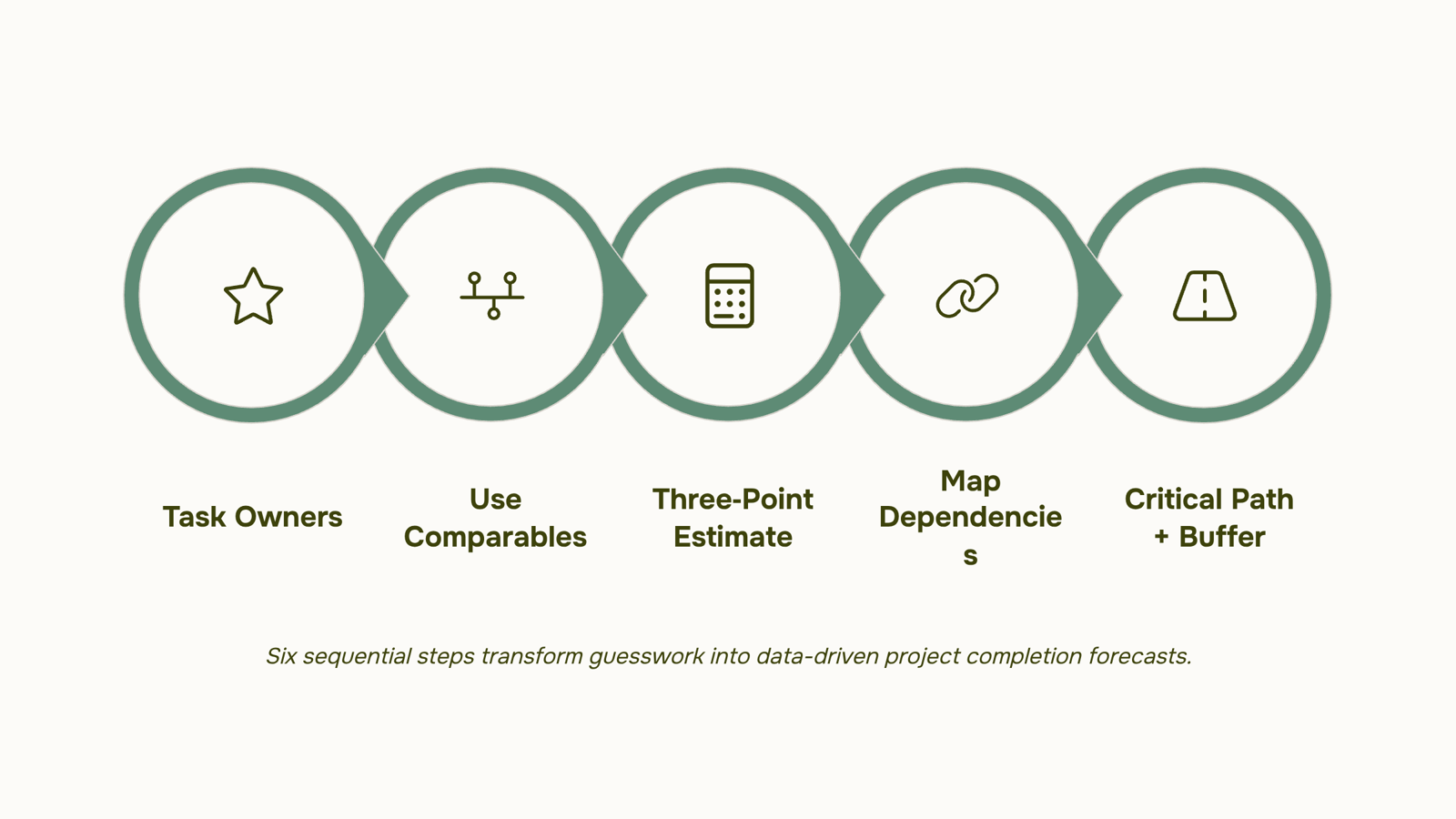
How to estimate project completion time in 6 steps
Here is the six-step framework for getting to a reliable estimated time of completion.
Break the project into tasks with owners and dependencies: Start at the work level, not the milestone level. A task like "build API integration" is estimable. "Complete backend phase" is not. Break your project into tasks with owners, priorities, and dependencies before you touch a single number. If you can't assign an owner to it, it's not a task yet — it's still a category.
Pull historical data from comparable work: This is where most teams guess instead of measure. Go back to your last two or three similar projects and find actual cycle times: how long did a task of this type actually take, not how long someone said it would. Pull actual task duration data from past sprints to replace gut feel with a real baseline. If your team has never tracked time at the task level, your first estimate will be rough — budget a 30–40% contingency and start tracking now so the next one isn't.
Apply three-point estimation to uncertain tasks: For any task where historical data is thin or the scope is genuinely new, use three-point estimation: assign an optimistic duration (O), a most likely duration (M), and a pessimistic duration (P). The weighted average is (O + 4M + P) / 6. This single formula reduces the anchoring effect that makes single-point estimates so consistently wrong. Run it on your five to ten highest-uncertainty tasks, not every line item.
Map dependency chains before you sum durations: Adding up task durations gives you total effort, not elapsed time. A ten-day project where tasks run in parallel might finish in four days. The same project with sequential dependencies might take fourteen. Identify which tasks block others, then build your critical path — the longest chain of dependent tasks determines your floor for how to estimate project completion accurately.
Sum the critical path, then apply a structured buffer: Once you have your critical path duration, add a buffer based on project risk, not instinct. A low-complexity internal project with a known team might need 10–15% padding. A project with external vendors, new technology, or regulatory review warrants 25–35%. Name the buffer explicitly in your estimate so stakeholders know it's there and why.
Document your assumptions in writing: Every estimate rests on assumptions: this person is available four days a week, this vendor delivers on time, this scope doesn't expand. Write them down. When the estimate slips, you'll know whether reality changed or the original assumption was wrong — and that distinction matters for how you recalibrate. See a live forecast of your actual completion date against your documented baseline to catch drift before it becomes a missed deadline.
Running these six steps takes most teams 60–90 minutes for a mid-size project. Taro can automate the forecasting layer once your tasks and time data are in one place, but the framework itself works on a spreadsheet. The discipline matters more than the tool.
How often you should update your estimate
A good estimate goes stale the moment something changes. The question is knowing which changes actually matter.
Update your estimated time of completion when any of these triggers hit:
Scope changes: a new requirement lands, or a deliverable gets cut. Either shifts your remaining work volume immediately.
Resource changes: someone leaves the project, a dependency team misses a handoff, or capacity drops due to competing priorities.
Sprint boundary: at the close of every sprint, compare planned vs. actual velocity. If the gap is more than 15-20%, recalculate.
Two-week default: if none of the above apply, update anyway. Two weeks is the longest a project deadline accuracy claim should go unchallenged.
Between triggers, the estimate isn't a static document. Pull actual task duration data from past sprints to check whether your assumptions still hold, and see a live forecast of your actual completion date so you're not relying on a number someone calculated in week one.
The goal with updating project estimates isn't precision for its own sake. It's giving your team and stakeholders enough lead time to act before a slip becomes a miss.
Common mistakes that make estimates useless
Most estimation failures trace back to the same handful of habits, not bad judgment.
Single-point estimates with no range: Saying "this takes five days" treats one scenario as the only scenario. Three-point estimation (optimistic, most likely, pessimistic) consistently produces more accurate estimated time of completion forecasts than single-point methods. If you're not giving stakeholders a range, you're giving them false confidence.
Ignoring non-project time: Meetings, support tickets, onboarding, and context-switching eat 30–50% of a developer's week. Estimates that assume eight productive hours per person per day are wrong before the sprint starts. Pull actual task duration data from past sprints to see what your team's real capacity looks like.
Skipping dependency mapping: One blocked task delays every task downstream. Break your project into tasks with owners, priorities, and dependencies before you commit to a deadline.
Never revisiting assumptions: An estimate made at kickoff reflects what you knew then. Scope shifts, team changes, and discovered complexity all invalidate it. Project time estimation is not a one-time event.
Where to track and forecast completion in one place
Spreadsheets force you to recalculate your estimated time of completion every time scope shifts. A work management tool removes that burden by pulling live data automatically. Taro's time tracking lets you pull actual task duration data from past sprints, so your next estimate starts from real numbers. Its completion analysis lets you see a live forecast of your actual completion date as work progresses, without manual math. Project completion forecasting stops being a Friday ritual and becomes a continuous signal.
Closing
Getting your estimated time of completion right means controlling scope upfront, grounding your numbers in historical data, and treating your estimate as a living forecast that updates when reality changes. The six-step framework works whether you're running it manually in a spreadsheet or wiring it into your project workflow. If your team is tired of recalculating estimates by hand every sprint, Taro's completion analysis feature does Steps 3 and 6 for you automatically, pulling historical task data and flagging when a live estimate needs updating before a deadline slips. Start by mapping one project's critical path this week and see where your current estimate sits against the data.
FAQ
How do I accurately estimate the time of completion for a project?
Break work into tasks with owners and dependencies, pull actual cycle times from past projects, apply three-point estimation to high-uncertainty tasks, map your critical path, add a structured buffer, and document assumptions in writing. Update the estimate at each sprint boundary using real progress data.
What factors affect the estimated time of completion?
Scope ambiguity, optimism bias, actual resource availability (typically 60–70%, not 100%), dependency chains, and lack of historical baseline data. These four factors corrupt estimates before work starts and compound each other.
Can I use historical data to improve my estimated time of completion?
Yes. Pull actual cycle times from your last two or three similar projects instead of guessing from memory. If you've never tracked time at the task level, budget 30–40% contingency on your first estimate and start tracking now.
How often should I update my estimated time of completion?
Recalculate at each sprint boundary or major milestone using real progress data. Treat your ETC as a living forecast that changes when scope, resource availability, or dependencies shift, not a fixed promise.
What are the consequences of underestimating the time of completion?
Delayed revenue, eroded client trust, team burnout from overtime and context-switching, and for fixed-fee contracts, direct cash flow impact. One missed deadline is a data point; two becomes a pattern that damages your reputation.
What is the three-point estimation formula and when should I use it?
Weighted average of (Optimistic + 4×Most Likely + Pessimistic) / 6. Use it on your five to ten highest-uncertainty tasks where historical data is thin or scope is genuinely new, not on every line item.
How is estimated time of completion different from a project deadline?
A deadline is a contractual or business constraint set externally. ETC is your forecast of when work will actually finish, based on scope, resources, and dependencies. They rarely align without active management.


 Elena Petrova15 September 2026


