TL;DR: Most SaaS sales content covers funnel stages and stops there. This one goes deeper: the operational gaps that slow response times, lose warm leads, and break handoffs between marketing and sales. IT company owners get a concrete set of strategies they can wire into their existing workflow today.
What software as a service sales actually means
Software as a service sales is the process of selling subscription-based software where the customer pays recurring fees, typically monthly or annually, to access a product hosted in the cloud. No perpetual license. No one-time handoff.
That structure changes everything about how you sell. In traditional software sales, the deal closes and the relationship largely ends. In the SaaS sales process, closing is the starting point. A customer who churns in month four was never really won.
This matters practically for IT company owners because your revenue compounds when customers stay and contracts expand, but it evaporates just as fast when they don't. Churn risk lives inside every deal you close, which means your sales motion has to account for fit, onboarding readiness, and long-term value, not just signature date.
Building the pipeline that feeds your sales team looks different here too. The buyer relationship doesn't end at contract, and the sales team that treats it that way will consistently outperform the one that doesn't.
How SaaS sales differs from traditional software sales
The core difference comes down to what you're actually selling. Traditional software is a one-time transaction: the buyer pays, gets a license, and the relationship largely ends there. SaaS is a subscription, which means the sale never fully closes.
That distinction reshapes four things in your SaaS sales process:
Dimension | Traditional software | SaaS |
|---|
Pricing model | One-time license fee | Monthly or annual recurring revenue |
Sales cycle | Longer upfront, then dormant | Shorter to first close, continuous renewal |
Buyer relationship | Transactional, post-sale handoff | Ongoing, tied to product adoption |
Churn risk | Near zero after purchase | Present every renewal cycle |
In traditional sales, a closed deal is revenue banked. In SaaS vs traditional software sales, a closed deal is the start of a retention problem. A customer who doesn't adopt the product cancels at renewal, and that cancellation erases the revenue you already counted.
This also changes how you build pipeline. Building the pipeline that feeds your sales team looks different when you need volume, velocity, and fit simultaneously, not just volume.
The practical implication: your sales team needs to qualify for long-term fit, not just short-term budget. A buyer who's a poor fit will churn regardless of how well the deal was closed.
Key challenges that stall SaaS deals
Four problems account for most stalled SaaS deals.
Slow lead response is the most common. Most B2B SaaS buyers expect a reply within an hour of their first inquiry. Teams that respond after 24 hours lose a significant share of those conversations before they start. If your pipeline feels thin, building the pipeline that feeds your sales team is worth reading before you adjust lead response time SaaS workflows.
Long nurture cycles create a second gap. SaaS buyers research for weeks before talking to sales, and most teams lack the sequencing to stay relevant across that window without manual effort.
Multi-stakeholder buying slows decisions further. A typical mid-market SaaS deal involves three to six approvers, each with different objections. One champion is rarely enough to close.
Churn risk priced into the deal is the least obvious problem. Buyers know they can cancel, so they commit cautiously. That hesitation shows up as delayed signatures and extended trials. Understanding which channels bring in the highest-quality SaaS leads matters here, because low-fit leads churn faster and make buyers in your target segment more skeptical.
The SaaS sales strategies in the next section address each of these directly.
Best strategies to increase SaaS sales in 2026
Five strategies that address the problems above, in order of where deals most commonly break.
1. Cut lead response time to under five minutes
Speed is the single biggest lever in software as a service sales. Most teams find that responding within five minutes of a first inquiry converts at a rate three to four times higher than responding an hour later. Set up automated routing so the right rep gets notified the moment a form is submitted, a trial is started, or a demo is requested. If your team is spread across time zones, automated acknowledgment messages keep the prospect warm until a human follows up. Getting this right is foundational to any SaaS sales strategy that actually closes.
2. Build a structured multi-stakeholder sequence
A SaaS deal rarely closes with one person. Map the buying committee early: economic buyer, technical evaluator, end-user champion. Each needs different content. The economic buyer wants ROI and risk reduction; the technical evaluator wants security docs and integration specs; the champion needs talking points to sell internally. Create separate email sequences for each role rather than sending one generic nurture. A 30-person IT services firm that did this cut their average deal cycle from 90 days to 55.
3. Automate the nurture work your reps skip
Long nurture cycles break down because reps deprioritize prospects who aren't ready to buy this week. Automate the middle of the funnel: send case studies at day 7, a competitor comparison at day 14, a pricing FAQ at day 21. This keeps your product visible without requiring rep time. For the tasks that slow your team down, automating the repetitive tasks that slow your sales team down covers the tooling side in detail.
4. Qualify on fit before investing in demos
Demos are expensive. A 45-minute call with a prospect who can't buy wastes rep time and distorts your pipeline. Add a two-question qualification step after sign-up: company size and current tooling. Route only qualified leads to a demo call; send the rest to a self-serve onboarding track. This alone can improve demo-to-close rates by 20 to 30 percent for most mid-market SaaS teams.
5. Build churn signals into the sales handoff.
The deal doesn't end at signature. Reps who hand off accounts without flagging risk factors (single user, no integration, no success plan) create churn within 90 days. Document two or three adoption milestones during the sales process and pass them to the customer success team at handoff. If you're also thinking about which channels bring in the highest-quality SaaS leads, lead quality at the top of the funnel directly affects churn at the bottom.
These five strategies work together. Fix lead response time first, then build the multi-stakeholder sequence, then automate the gaps in between.
The right SaaS sales tools don't just organize your pipeline — they remove the manual work that slows deals down between stages.
Three categories matter most for a connected sales motion:
Lead management captures, scores, and routes inbound leads before a rep ever touches them. Without it, leads sit in a shared inbox while response time climbs past the point where conversion is likely. Lio handles this automatically: it captures leads from your web forms and routes them to the right rep based on rules you set, so no inquiry goes cold waiting for someone to notice it.
Email automation keeps prospects moving between stages without requiring a rep to write every follow-up manually. Evox handles sequences triggered by lead behavior — a demo request fires a confirmation, then a pre-call prep email, then a post-call summary — without anyone managing the queue.
Workflow automation closes the gaps between those two layers. When a lead is qualified in Lio, Revo can automatically create a proposal task, assign it to the right team member, and set a due date. Nothing falls through because no one remembered to do it manually.
These three categories work best when they're connected. A lead captured in one tool should trigger actions in the next without a manual handoff. That's where most SaaS sales automation setups break down — each tool runs in isolation.
For a broader look at what fits a smaller sales team, SMB sales tools for small businesses covers the tradeoffs by team size.
How to measure whether your SaaS sales strategy is working
Four metrics tell you whether your SaaS sales process is actually working.
Lead response time is the fastest signal. Most B2B SaaS teams should aim to follow up within five minutes of a first inquiry. Past an hour, conversion rates drop sharply.
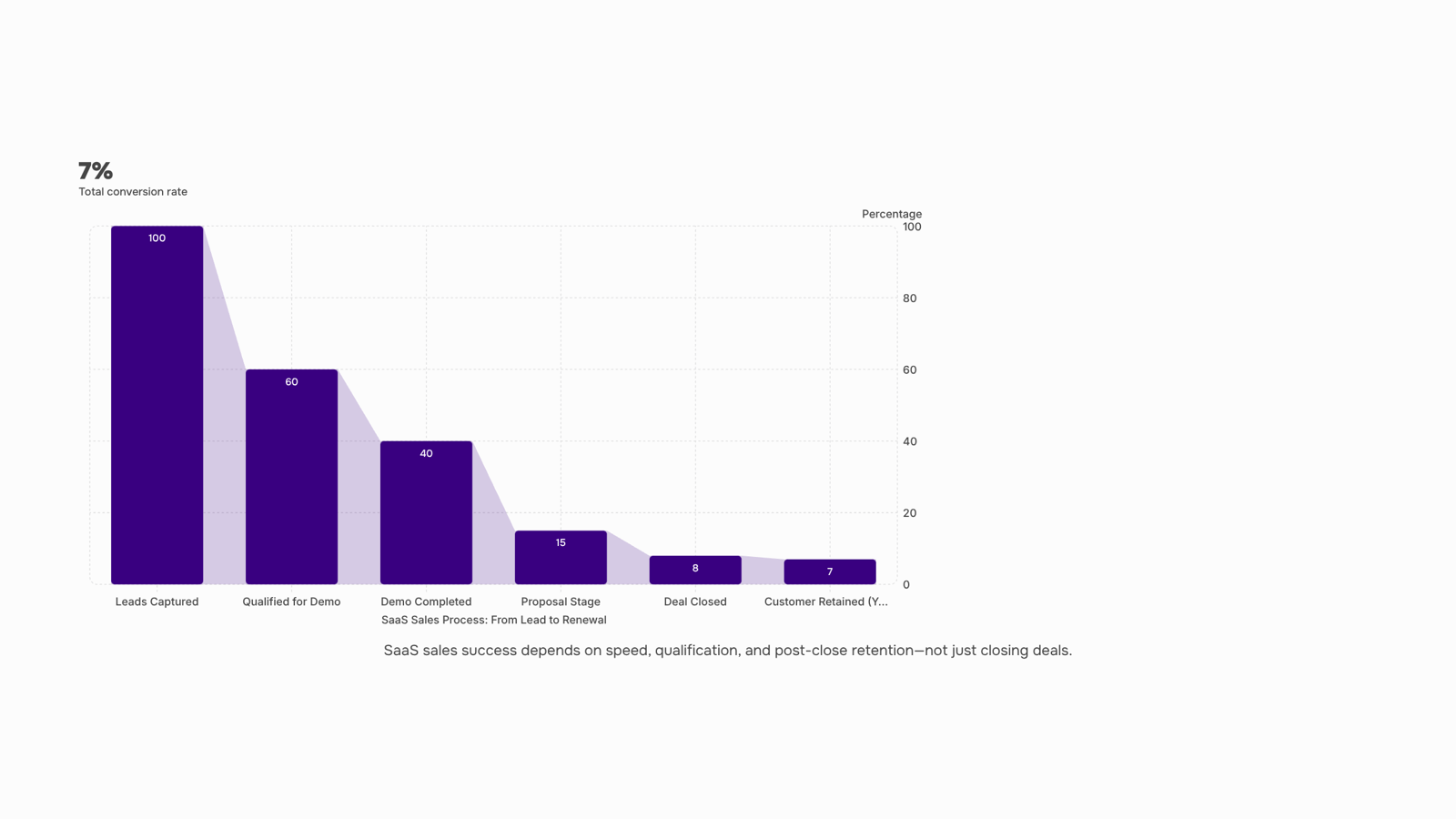
Stage-by-stage conversion rate shows where your SaaS sales strategies break down. If 60% of leads enter discovery but only 15% reach a proposal, the problem is qualification, not closing.
Churn rate is the metric most IT company owners check too late. Annual churn above 10% usually means the sales team is closing the wrong accounts, not that the product is failing.
Average contract value (ACV) tells you whether your deal mix is shifting toward higher-value segments over time.
Track all four together. A rising ACV with rising churn means you are landing bigger accounts but losing them. A low response time with a flat conversion rate means speed is not the bottleneck.
For a deeper look at how these numbers connect upstream, measuring SaaS lead generation success covers the full funnel view.
Common mistakes that cost SaaS teams deals
Four mistakes show up repeatedly in software as a service sales, and each one is fixable once you name it.
Treating SaaS like a one-time sale:
The deal doesn't close at contract signature. Expansion, renewal, and referral all depend on what happens after.
Ignoring onboarding as a sales function:
Onboarding is where churn starts or stops. A rep who hands off and disappears leaves revenue on the table.
Manual lead routing:
Poor lead response time in SaaS is a direct conversion killer. Automating the repetitive tasks that slow your sales team down is the fastest fix most teams skip.
No follow-up sequence:
A single email after a demo is not a sequence. SaaS sales automation means five to seven structured touches mapped to buyer behavior, not rep memory.
Run through this list before you audit your metrics.
Closing
Speed, structure, and automation are the three pillars that separate SaaS teams that grow from those that plateau. Most teams have the people and the product—what they lack is the operational backbone that keeps warm leads from going cold, gets the right message to the right stakeholder, and flags churn risk before it costs you a customer. The gap between a 90-day deal cycle and a 55-day one isn't better salespeople; it's better process. The question isn't whether you need to fix these problems—it's whether you'll fix them this quarter or let your pipeline stay thin while your team works twice as hard for the same result. Ready to see how automation closes that gap? Start with a quick walkthrough of how Lio captures and assigns leads instantly, so your team spends time selling instead of chasing.
FAQ
Q. What is software as a service sales?
A. Software as a service sales is selling subscription-based software where customers pay recurring monthly or annual fees to access a cloud-hosted product. Unlike traditional software, the relationship doesn't end at signature—closing is the starting point, and churn risk lives inside every deal.Q. How does SaaS sales differ from traditional software sales?
A. Traditional software is a one-time transaction; SaaS is an ongoing subscription. SaaS deals require continuous buyer engagement, qualification for long-term fit (not just budget), and churn management at every renewal cycle.Q. What are the key challenges in software as a service sales?
A. Slow lead response (buyers expect replies within an hour), long nurture cycles without proper sequencing, multi-stakeholder buying with conflicting objections, and churn risk that makes buyers commit cautiously and extend trials.Q. What are the best strategies for software as a service sales?
A. Cut response time to under five minutes, build role-specific sequences for buying committees, automate nurture workflows, qualify on fit before demos, and flag churn signals at handoff to customer success.Q. What are the most effective software as a service sales tools?
A. Lead management tools that capture, score, and route inbound leads automatically before a rep touches them. These remove manual work and keep response times below the conversion threshold.Q. How do I increase sales for my software as a service company?
A. Fix lead response time first, then build structured sequences for multiple stakeholders, automate the middle funnel, qualify rigorously before demos, and pass adoption milestones to customer success to prevent churn.Q. How fast should a SaaS sales team respond to a new lead?
A. Within five minutes. Teams that respond in under five minutes convert at three to four times higher rates than those responding after an hour. Automated routing ensures leads reach the right rep instantly.


 Elena Petrova15 September 2026


