TL;DR: Most competitor topical map guides start with keyword research and treat your rivals as an afterthought. This one shows IT company owners how to reverse-engineer a competitor's full topical authority structure from public signals, then apply a scored decision matrix to identify which content gaps are worth owning before the competition closes them.
What a topical map actually is (and why it drives SEO authority)
A topical map is the full set of subjects a website has covered, organized into clusters where a central pillar page links to supporting articles that each answer a narrower question. Search engines use this structure to judge whether a site has genuine depth on a subject or just scattered posts that happen to share a keyword.
Topical authority is what you earn when your cluster is complete enough that Google treats your domain as a reliable source for an entire subject area, not just one page. Sites with that signal tend to rank faster on new content because the domain's existing structure vouches for it.
The practical implication: publishing ten tightly connected articles on a narrow subject usually outperforms publishing fifty loosely related ones. Depth beats breadth, consistently.
This is why reverse-engineering a competitor's topical map SEO footprint is a faster starting point than building a content strategy from a blank keyword list. Your competitor has already run the experiment. Their indexed pages, internal linking patterns, and SERP presence show you which clusters drove authority and which gaps they left open.
You can group extracted keywords into clusters around a central pillar once you know what the competitor's map actually contains, which the next section covers.
Three public signals that reveal a competitor's topical strategy
You don't need a paid tool to see how a competitor has structured their topical authority SEO play. Three free signals give you most of what you need.
XML sitemaps. Append /sitemap.xml to any domain. Most CMS platforms (WordPress, Webflow, HubSpot) generate one automatically. What you're looking for is folder depth: /blog/category/subcategory/slug tells you exactly how granular their content architecture goes. A competitor with 400+ indexed blog URLs organized into tight subfolders has almost certainly built deliberate topic clusters, not a random publishing calendar.
The site: operator. Run site:competitor.com/blog "keyword" in Google. This SERP footprint analysis surfaces which subtopics they've covered, how many pages they've dedicated to each, and which angles they repeat (repetition signals they're targeting a cluster, not a single keyword). Run five to ten variations on your core topic and you'll see the shape of their content map in under 20 minutes.
Internal link anchors. Open three to five of their top-ranking posts and scan the anchor text on every internal link. Anchors like "enterprise project management" or "resource allocation for remote teams" are not chosen randomly. They're the exact sub-topics the site is reinforcing as related to the pillar. This is the signal most competitor content analysis guides skip entirely.
Once you have these three data sets, you can track up to ten competitor websites by topic and group extracted keywords into clusters around a central pillar without starting from a blank keyword list.
How to cluster a competitor's URLs into topic pillars and sub-topics
URL segmentation is where competitor content analysis shifts from data collection to strategy. You have a raw list of URLs. The goal now is to sort them into pillar clusters and the sub-topics that feed each one.
Start with folder structure. A URL like /blog/email-marketing/subject-line-tips tells you the pillar (email-marketing) and the sub-topic (subject-line-tips) without any tool. Scan the first path segment across your full URL list and group by that segment. Most mid-market competitors reveal four to eight distinct pillars this way.
Where folder structure is flat (everything lives under /blog/), shift to slug patterns. Slug tokens that repeat across ten or more URLs usually signal a pillar. "saas-onboarding," "customer-retention," "product-led-growth" appearing repeatedly in slugs are pillar signals, not coincidences.
Internal link anchors are the third signal, and the most honest one. When a competitor links to a URL using the same anchor phrase from fifteen different posts, that URL is a pillar page, regardless of what the folder says. You can group extracted keywords into clusters around a central pillar once you have these anchors mapped.
After clustering, score each pillar by URL count and estimated depth. A pillar with two supporting sub-topics is thin. One with twelve is defended. That gap score is what drives topical map creation priority.
Tools like Ahrefs or Screaming Frog export the raw data. You can also track up to ten competitor websites by topic to keep the segmentation current as competitors publish. The next step turns this cluster map into a scored decision matrix.
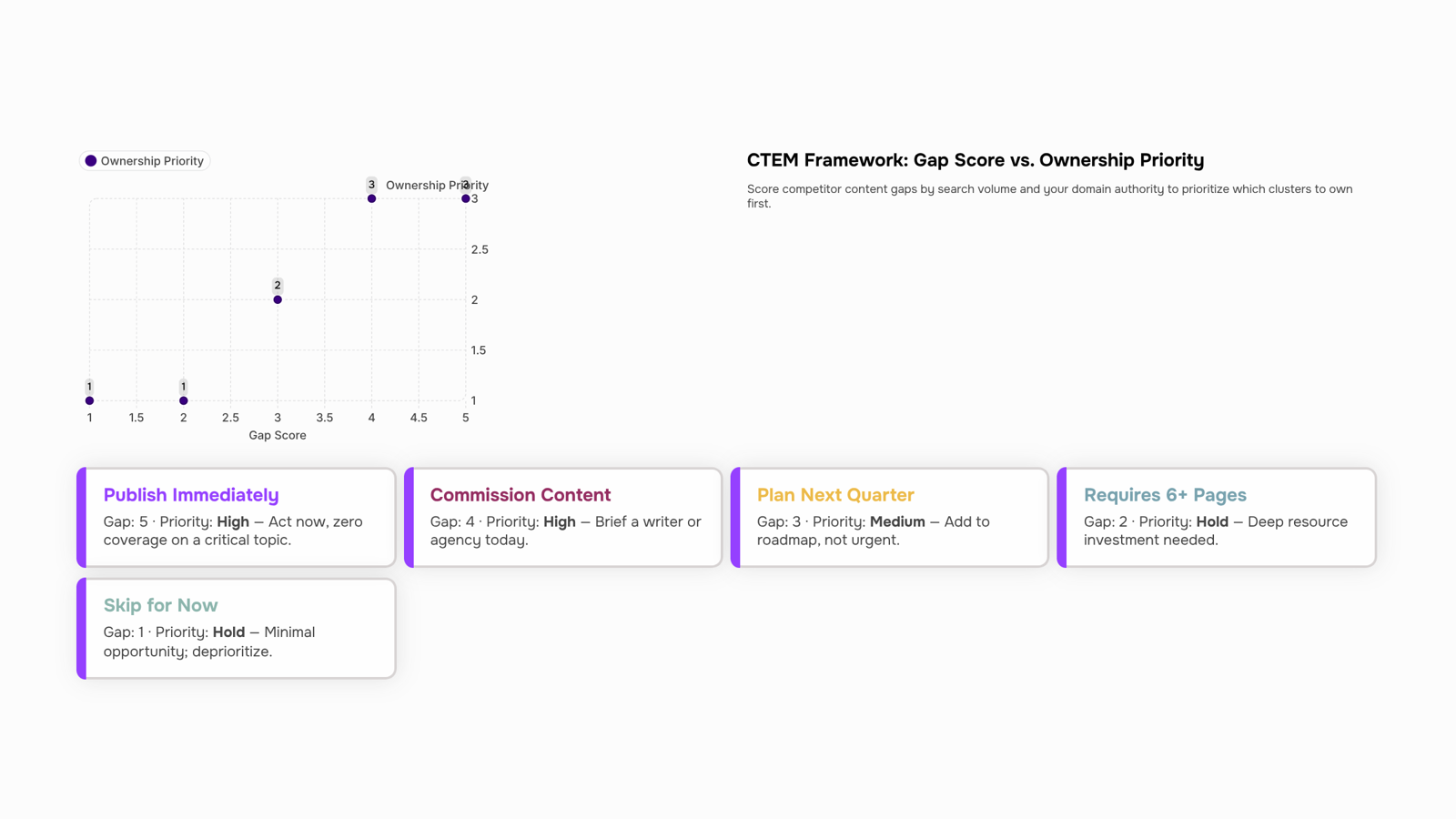
The CTEM Framework: score topical gaps and set ownership priority
The CTEM Framework turns the URL clusters you built in the previous step into a prioritized publishing queue. Here is how the matrix works.
Four columns. One decision.
Map every competitor content cluster across these four dimensions:
Cluster name: the pillar topic and its supporting sub-topics (e.g., "CRM onboarding" with five supporting pages)
Ranking signal: current SERP position for the cluster's head term, plus estimated monthly search volume
Gap score: a 1–5 rating based on whether you have zero coverage (5), partial coverage (3), or strong existing content (1)
Ownership priority: High, Medium, or Hold, set by crossing gap score against your domain's existing authority in that cluster
A gap score of 4 or 5 with a High ownership priority means you group extracted keywords into clusters around a central pillar and commission content immediately. A gap score of 2 with a Hold means the competitor owns that cluster deeply and you would need six or more supporting pages before a pillar page has any realistic chance of ranking.
Worked SaaS example. Suppose your competitor has 14 pages clustered around "SaaS churn reduction," ranking at position 3 for the head term (roughly 2,400 monthly searches). You have one blog post touching the topic, no internal links pointing to it, and no pillar page. Gap score: 5. Ownership priority: High. That cluster goes to the top of your content gap analysis backlog, not because it is easy, but because the structural gap is large and the traffic reward is documented.
Run the same scoring pass for every cluster you extracted. A mid-market SaaS site typically surfaces eight to fifteen scoreable clusters from a single competitor. Track up to ten competitor websites by topic and the matrix scales without adding proportional manual work.
Once every cluster has a score and a priority, turn your prioritized gap list into a ranked 90-day publishing plan so ownership assignments have deadlines, not just labels.
This is what separates a competitor topical map SEO workflow from a one-time audit. The CTEM gives each gap a number, and each number a next action.
Manual topical map extraction typically takes two to four days: crawling a competitor's site, tagging pages by cluster, scoring gaps, and prioritizing what to publish next. Three prompt patterns compress that into a single working session.
Prompt 1: Cluster extraction: Feed a competitor's sitemap URL into ChatGPT or Claude with this instruction: "Group these URLs into topical clusters. For each cluster, name the implied pillar topic and list the subtopics covered." You get a rough cluster map in under two minutes. Cross-reference it against your own site architecture to spot the gaps.
Prompt 2: Gap scoring: Take the clusters from Prompt 1 and run: "Score each cluster by search intent density (informational, commercial, transactional) and flag which subtopics appear in the competitor's cluster but not in mine." This is the input your CTEM needs for the Gap Score column.
Prompt 3: Ownership prioritization: Paste your scored gap list and ask: "Rank these gaps by estimated time-to-rank given a new domain covering this topic for the first time. Flag quick wins under 90 days." This feeds directly into your publishing sequence.
Where AI prompts produce the raw structure, Ranko handles the ongoing signal layer. Its competitor tracking feature lets you track up to ten competitor websites by topic, then group extracted keywords into clusters around a central pillar automatically. From there, you can turn your prioritized gap list into a ranked 90-day publishing plan without rebuilding the spreadsheet each quarter.
This is the workflow most AI content strategy guides skip: not just finding gaps, but wiring competitor content analysis into a repeatable system that runs without manual resets.
Building your own topical map from competitor gaps vs. starting from scratch
The gap-first approach wins when your publishing bandwidth is limited. Instead of building a keyword list from scratch, you start with a competitor's proven structure — topics they've already validated through rankings — and find where their coverage breaks down. That's the core of a content gap analysis: not what to write, but what they missed that you can own.
Building from scratch makes sense when you're entering a new market with no established competitors, or when your positioning is genuinely differentiated enough that their topical map doesn't reflect your audience. For most IT company owners competing in defined niches, that's rare.
The gap-first method is faster because the hard clustering work is already done. You group extracted keywords into clusters around a central pillar rather than deriving those pillars from raw keyword data, which cuts the strategy phase from weeks to days. From there, you turn your prioritized gap list into a ranked 90-day publishing plan instead of debating where to start.
For teams building topical authority SEO systematically, the gap-first method also compounds: each piece you publish reinforces a cluster your competitor left incomplete, not a standalone page with no structural support.
Common mistakes that make competitor topical analysis useless
Four mistakes consistently turn competitor topical analysis into busywork.
Copying clusters without scoring difficulty: A gap on your competitor's map is not automatically winnable. If the cluster sits behind high-DR domains with strong internal linking, publishing into it blind wastes months. Score every gap against keyword difficulty, your site's current authority, and realistic time-to-rank before you commit.
Ignoring internal linking depth: A competitor's SERP footprint analysis reveals not just what they cover, but how tightly those pages link to each other. Isolated pages rank slower. Before you group extracted keywords into clusters around a central pillar, map the linking structure you'll need to support them.
Treating all gaps as equal: Not every unclaimed topic moves the needle. Gaps with no search demand, no buyer intent, or no connection to your pillar pages belong at the bottom of your list, not the top.
Skipping recrawl cadence: Competitors publish continuously. A topic cluster strategy built on a six-month-old crawl is already stale. Set a fixed recrawl schedule, then turn your prioritized gap list into a ranked 90-day publishing plan that updates as the map shifts.
Closing
Reverse-engineering your competitor's topical map gives you a head start that building from scratch cannot match. You see which clusters already drive authority, which gaps they've left open, and exactly how deep you need to go to compete. The CTEM Framework turns that intelligence into a scored, prioritized publishing queue—no guesswork, no scattered content, just clear ownership assignments tied to real traffic opportunity. Start this week by running the three public signals (sitemaps, site: operator, internal anchors) on your closest competitor. Once you have that cluster map, you'll know whether your next ten pieces of content should defend your existing pillars or attack their gaps.
FAQ
What is the role of topical maps in SEO?
Topical maps show search engines you have genuine depth on a subject, not just scattered posts. Google treats sites with complete topic clusters as authoritative sources, causing new content to rank faster because the domain's structure vouches for it.
How can I create a topical map for SEO purposes?
Extract your competitor's URLs using sitemaps and the site: operator, cluster them by folder structure and internal link anchors into pillar groups, then score each cluster's gap against your existing content. Use the CTEM Framework to prioritize which clusters to own first.
What are the benefits of using topical maps for SEO?
Topical maps eliminate scattered publishing, accelerate ranking velocity on new content, and reveal which content gaps are worth closing before competitors do. Depth in one cluster outperforms breadth across fifty loose topics.
How do topical maps improve website structure and content organization for SEO?
Topical maps organize content into intentional clusters where a pillar page links to supporting articles that answer narrower questions. This structure signals to Google that your site has authority on an entire subject area, not just individual keywords.
What tools can I use to create and optimize topical maps for SEO?
Free tools include Google's site: operator and XML sitemaps. Paid options like Ahrefs and Screaming Frog export URL data at scale. Ranko automates competitor tracking and cluster grouping so you see gap maps in one session instead of one week.
How do you score topical gaps to decide which clusters to target first?
The CTEM Framework rates each cluster on gap score (1–5, based on your existing coverage) and crosses it against your domain authority to set ownership priority. Gap score 4–5 with High priority goes to your backlog first; gap score 2 with Hold means the competitor owns it too deeply.
How does reverse-engineering a competitor's topical map differ from building one from scratch?
Reverse-engineering uses public signals to see which clusters already drive authority and which gaps competitors left open, giving you a tested starting point. Building from scratch starts with a blank keyword list and requires you to run the experiment yourself.


 Elena Petrova11 September 2026


