TL;DR: Most articles on sales process steps hand you a numbered list and assume the rest is obvious. This one ties each step to a specific rep action, a qualification signal, and an automation trigger — so IT sales teams can build a process that runs consistently without depending on memory or heroic follow-up. You'll leave with a framework you can wire up this week.
What the sales process is (and why steps matter)
A sales process is a repeatable sequence of defined actions your reps follow to move a lead from first contact to closed deal. A sales funnel describes how leads flow in aggregate — it's a measurement view. The sales process is what your reps actually do, step by step, on each individual deal.
The distinction matters because funnels show you where deals drop off. Named B2B sales process steps tell you why, and give you something to fix.
Without defined steps, two reps working the same lead list will run completely different plays. One follows up three times; another sends one email and moves on. One qualifies budget on the first call; another discovers late in the deal that there isn't one. That inconsistency is where revenue leaks — and it compounds across every rep on your team.
Named steps also create accountability. When each step has a clear exit signal (a booked meeting, a confirmed budget, a signed proposal), managers can spot exactly why leads drop off between qualification and close instead of guessing.
The sections below map each of the core sales process steps to the specific rep action and the signal that marks it complete.
The 7 core sales process steps, matched to rep actions
Each step below is paired with the specific rep action that moves the deal forward and the signal that tells you the step is done. That pairing is what most breakdowns skip, and it's where deals quietly die.
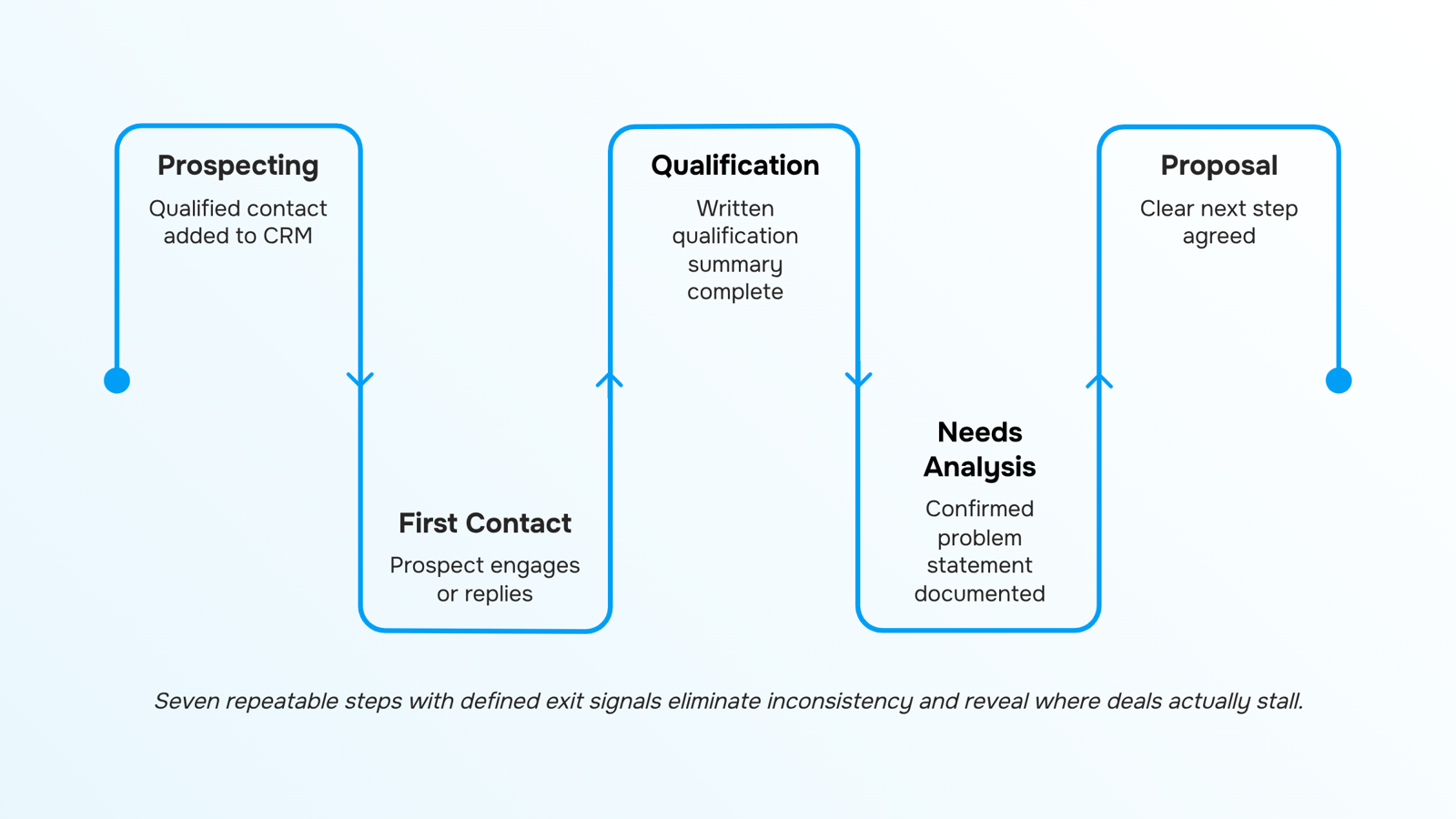
1. Prospecting: The rep identifies companies that fit your ICP (ideal customer profile) by firmographic criteria: industry, headcount, tech stack, and budget range. Completion signal: a qualified contact with a verified email or direct dial is added to the CRM.
2. First contact and outreach: The rep sends a personalized first message, either cold email, LinkedIn, or phone, referencing a specific pain point relevant to that prospect's role. Completion signal: the prospect has replied, accepted a call, or engaged with the message in a trackable way. Tracking leads through each stage of your pipeline keeps this step from becoming a black box.
3. Qualification: The rep runs a structured discovery call using a framework such as BANT (Budget, Authority, Need, Timeline) or MEDDIC. The goal is to confirm the prospect has a real problem, the authority to buy, and a realistic timeline. Completion signal: a written qualification summary is logged in the CRM. If the prospect fails qualification, they exit the pipeline here, not at proposal stage.
4. Needs analysis and discovery: The rep digs deeper into the specific workflow, technical, or revenue problem the prospect is trying to solve. This is where IT company owners often surface integration requirements, compliance constraints, or budget approval chains that will affect the close. Completion signal: a documented problem statement the prospect has confirmed in their own words.
5. Proposal or demo: The rep presents a tailored solution, not a generic deck. For IT services, this typically means a scoped statement of work or a live demo mapped to the pain points surfaced in step four. Completion signal: the prospect has reviewed the proposal and given a clear next step, even if that next step is "we need to involve procurement." This is where why leads drop off between qualification and close becomes a practical concern.
6. Objection handling and negotiation: The rep addresses pricing, scope, timing, or competitive objections with prepared responses, not improvised ones. Completion signal: all named objections are resolved and the prospect has verbally agreed to move to contract.
7. Close and handoff: The rep sends the contract, confirms signatures, and documents the agreed scope before passing the account to delivery or onboarding. Completion signal: signed contract on file, kickoff meeting scheduled.
These seven effective sales process steps give every rep the same map. Automating the repetitive steps in your sales process, particularly outreach sequences at step two and follow-up triggers at step six, is where teams recover the most time without changing the underlying structure.
How to build your own sales process in 4 steps
Building a sales process that actually holds up means four things: knowing what you have, defining when a deal moves forward, assigning clear ownership, and setting up a pipeline that reflects reality.
Step 1: Audit your current pipeline: Pull your last 30 closed deals, won and lost. Map every action your team took from first contact to decision. You're looking for gaps where deals stalled and steps where no one knew who was responsible. This is your baseline. If you want to understand why leads drop off between qualification and close, the audit usually shows it clearly.
Step 2: Define exit criteria for each stage: A stage without an exit condition is just a label. For each step in your B2B sales process, write one sentence: "This deal moves forward when X happens." X should be observable, not subjective. "Prospect confirmed budget" is an exit criterion. "Feels interested" is not.
Step 3: Assign ownership at every handoff: Most deals die at transitions, not inside stages. Decide who owns each step and who hands off to whom. Document it. If two people think they own the follow-up, no one does.
Step 4: Build the pipeline to match your process, not the other way around: Most teams configure their CRM around default stages and then try to fit their actual sales process steps to close more deals into whatever the tool gave them. Reverse that. Define your stages first, then configure. Tracking leads through each stage of your pipeline becomes far simpler when the stages reflect how your team actually sells.
Once this is running, the next question is which steps to hand off to automation and which need a rep. That distinction matters more than most teams expect.
Where to automate and where to keep a human in the loop
Automation wins at volume and speed. Human judgment wins at trust and nuance. The mistake most IT sales teams make is drawing that line in the wrong place.
These sales process steps are safe to automate:
Lead capture and routing: Form fills, chatbot conversations, and inbound email responses can trigger instant CRM entry and lead scoring without a rep touching anything.
Initial follow-up (first 5 minutes): Speed matters more here than personalization. Research consistently shows that leads contacted within minutes convert at significantly higher rates than those reached hours later.
Nurture sequences: Multi-step email campaigns based on behavior (opened, clicked, visited pricing page) keep leads warm without rep time. Evox handles this by triggering the next email based on what a lead actually does, not just a fixed timer.
Meeting reminders and no-show follow-ups: Routine, templated, and easy to automate.
These steps require a human:
Discovery calls: A rep needs to hear what the prospect isn't saying. No sequence catches hesitation in a voice.
Negotiation: Pricing conversations involve context, relationship history, and judgment calls that automation gets wrong consistently.
Closing: The final "are we moving forward?" needs a person behind it. Automated close attempts read as pressure, not partnership.
The practical rule: automate anything that benefits from speed or consistency, and keep humans on anything that benefits from listening. When you learn how to automate sales process steps correctly, you free reps to spend more time on the three conversations above, which is exactly where deals are actually won or lost.
Common mistakes that stall deals at each step
Four mistakes show up repeatedly across effective sales process steps, and each one is tied to a specific stage.
Slow lead response happens at the capture stage. Responding to an inbound lead within five minutes versus 30 minutes can increase qualification rates by up to 21 times, according to InsideSales research. Most IT sales teams respond in hours, not minutes, and the deal cools before it starts.
Skipping qualification happens right after initial contact. Reps move straight to demo without confirming budget, authority, or timeline. The result: a polished demo delivered to someone who cannot buy. Understanding why leads drop off between qualification and close usually traces back to this single gap.
No defined next step after the demo is where most sales process steps to close more deals fall apart. The call ends without a booked follow-up, and the lead goes cold waiting for a proposal that arrives four days late.
Over-relying on manual follow-up during nurture extends your cycle unnecessarily. Automating the repetitive steps in your sales process frees reps to focus on the stages that actually require judgment.
Sales process steps vs. sales funnel: what is the difference
These two frameworks describe the same commercial reality from opposite angles, and conflating them is one of the more expensive planning mistakes an IT sales team can make.
The sales funnel is buyer-facing. It maps how a prospect moves from awareness to decision, measured in conversion rates and drop-off percentages at each stage. It tells you where buyers are.
The sales process steps are rep-facing. They define the specific actions your team takes to move a deal forward — qualifying, demoing, handling objections, closing. They tell you what your reps do next.
Dimension | Sales funnel | B2B sales process steps |
|---|
Perspective | Buyer journey | Rep actions |
Measured by | Conversion rate per stage | Activity completion, deal velocity |
Primary user | Marketing and leadership | Account executives, SDRs |
Output | Pipeline visibility | Repeatable close behavior |
Failure signal | High drop-off at one stage | Reps skipping steps inconsistently |
You need both. The funnel shows you where deals stall. The process tells you why — and what to fix. If your funnel shows 60% of deals dying after demo, your process is missing a defined next step at that exact stage.
For a deeper look at how the two frameworks connect in practice, structuring a marketing and sales funnel that actually converts covers the handoff between marketing stages and rep-owned steps.
Closing
Your sales process is only as consistent as your weakest step. When reps skip qualification, miss budget conversations, or lose track of follow-ups, deals don't just slow down — they vanish. The framework above gives you a map, but the real win comes when you automate the repetitive steps that don't require human judgment: lead capture, initial routing, and nurture sequences. That frees your reps to spend time on what actually closes deals — discovery, objection handling, and negotiation. Start by auditing your last 30 closed deals. Map where deals actually stalled. Then ask yourself: which of those stalls were caused by a rep forgetting to follow up, and which were caused by a rep not asking the right question? The first is a process problem. The second is a training problem. Fix the process first.
FAQ
What are the most effective sales process steps for my business?
Start with the seven core steps: prospecting, first contact, qualification, needs analysis, proposal, objection handling, and close. Then audit your last 30 deals to see where your team actually stalls — that's where your process needs customization.
How can I optimize my sales process steps to close more deals?
Define clear exit criteria for each stage so deals don't stall in limbo. Assign ownership at every handoff. Automate lead capture, initial follow-up, and nurture so reps focus on qualification and negotiation, where human judgment drives closes.
What are the typical sales process steps for B2B sales?
Prospecting, first contact, qualification using a framework like BANT, needs analysis, proposal, objection handling, and close. Each step has a specific rep action and a completion signal that tells you when to move forward.
How can I automate my sales process steps using AI tools?
Automate lead capture, scoring, and routing to eliminate manual data entry. Use email sequences for initial follow-up and nurture. Keep discovery, qualification, and negotiation with reps — those require judgment and build trust.
What are the key sales process steps to focus on for improving customer engagement?
Qualification and needs analysis are where engagement deepens. If you confirm budget and authority early and document the prospect's problem in their own words, objection handling and close become far simpler.
What is the difference between a sales process and a sales funnel?
A sales funnel shows how leads flow in aggregate and where they drop off. A sales process is the repeatable sequence of actions each rep takes on every deal — it's the 'why' behind the funnel leaks.
How do I know when a lead is ready to move to the next step?
Each step has a completion signal: a qualified contact added to CRM, a prospect reply, a written qualification summary, a confirmed problem statement, a reviewed proposal, resolved objections, or a signed contract. Without these signals, leads stall.


 Elena Petrova11 September 2026


