TL;DR: Most articles treat organizational strategy and operations strategy as separate topics. This one shows IT company owners exactly where the two must connect, where they typically break apart, and what a working handoff between them looks like in practice. You'll leave with a clear framework for keeping daily operations aligned with the direction your company is actually heading.
What organizational strategy actually means
Organizational strategy is the directional layer that answers one question: where is this business going, and why? It defines the markets you compete in, the outcomes you're building toward, and the trade-offs you're willing to make to get there. Every other decision — who you hire, which tools you buy, how you structure teams — sits beneath it.
The key elements of organizational strategy typically include a clear mission, a defined competitive position, long-term goals, and the resource allocation logic that connects ambition to budget. Most articles list these as generic bullets. The more useful framing is to tie each element to a work outcome: your competitive position determines which capabilities you fund; your long-term goals set the ceiling for strategic goals and tactical objectives.
The part most strategy frameworks skip is the execution gap. Organizational strategy stops being useful the moment it lives only in a slide deck. Connecting OKRs and KPIs to daily tasks is where strategy either takes hold or quietly dies. That handoff — from directional intent to operational reality — is exactly what the next section addresses.
How operations strategy differs from organizational strategy
The simplest way to separate these two is by asking a different question at each level. Organizational strategy answers "where are we going and why?" Operations strategy answers "how do we run well enough to get there?"
That distinction plays out across four dimensions:
Dimension | Organizational strategy | Operations strategy |
|---|
Scope | Whole company, all functions | Specific function or delivery system |
Time horizon | 3 to 5 years | 90 days to 12 months |
Ownership | C-suite and board | Department heads and team leads |
Success metrics | Market position, revenue growth, NPS | Cycle time, utilization, error rate |
Scope is where most confusion starts. Organizational strategy sets the direction for every function simultaneously. Operations strategy is scoped to a particular system: how your support team handles tickets, how your dev team ships releases, how your finance team closes the books. Neither is more important. One without the other breaks.
Time horizon matters because the decisions look different. A three-year market positioning call and a 90-day capacity plan require different data, different owners, and different review cadences. Mixing them in the same planning meeting is a reliable way to produce neither.
Ownership is the dimension IT company owners most often get wrong. When the leadership team owns operations decisions that department heads should own, strategy execution stalls at the handoff. When department heads set their own direction without anchoring to organizational strategy, you get teams optimizing locally while the company drifts.
For a sharper view of where strategic goals and tactical objectives diverge in practice, that distinction maps directly onto the difference described here.
Why the gap between the two strategies costs IT teams
Misalignment between organizational strategy and operations strategy rarely announces itself. It shows up as a sprint that delivers work nobody asked for, a hiring plan that doesn't match the service roadmap, or three teams solving the same problem independently.
The cost compounds fast. Research from MIT Sloan found that fewer than 10% of well-formulated strategies are effectively executed, and the breakdown almost always happens at the handoff point between leadership direction and day-to-day operations. For IT company owners, that handoff is where deadlines slip, budgets overrun, and engineers burn out chasing shifting priorities.
The pattern is consistent: organizational strategy sets a destination, but without an operations strategy wired to it, no one agrees on the route. Decisions made at the top take weeks to reach the teams doing the work. By then, the context has changed.
This is the execution gap, and it's not a people problem. It's a structural one. Traditional planning approaches make it worse by treating strategy as a document rather than a live system that operations teams can actually act on.
Key elements every effective organizational strategy needs
Five components show up in every organizational strategy that actually gets executed, not just presented.
Strategic intent defines where the business is going and why. Without a clear destination, operations teams make local decisions that feel rational but pull in different directions. The outcome: duplicated work and missed deadlines, exactly the misalignment cost covered above.
Prioritized goals with measurable outcomes separate strategy from aspiration. If you can't connect each goal to a metric your team tracks weekly, it won't survive contact with a busy quarter. Connecting your OKRs and KPIs to daily tasks is where most IT company owners find the biggest gap.
Resource allocation decisions are where organizational strategy gets honest. Which teams get headcount, budget, and tooling? Vague priorities become real when money moves.
Role clarity and ownership determine whether strategy executes or stalls. The people, process, and technology framework gives a structured way to assign accountability across all three layers, not just the human one.
Operational handoff triggers are the element most strategy frameworks skip entirely. A strategy needs defined moments when a decision moves from planning into workflow, with a named owner and a deadline. Without this, the gap between strategic goals and tactical objectives stays a gap.
Audit your current organizational strategy against these five. If any element is missing, that's where execution breaks first.
Six steps to align organizational strategy with operations
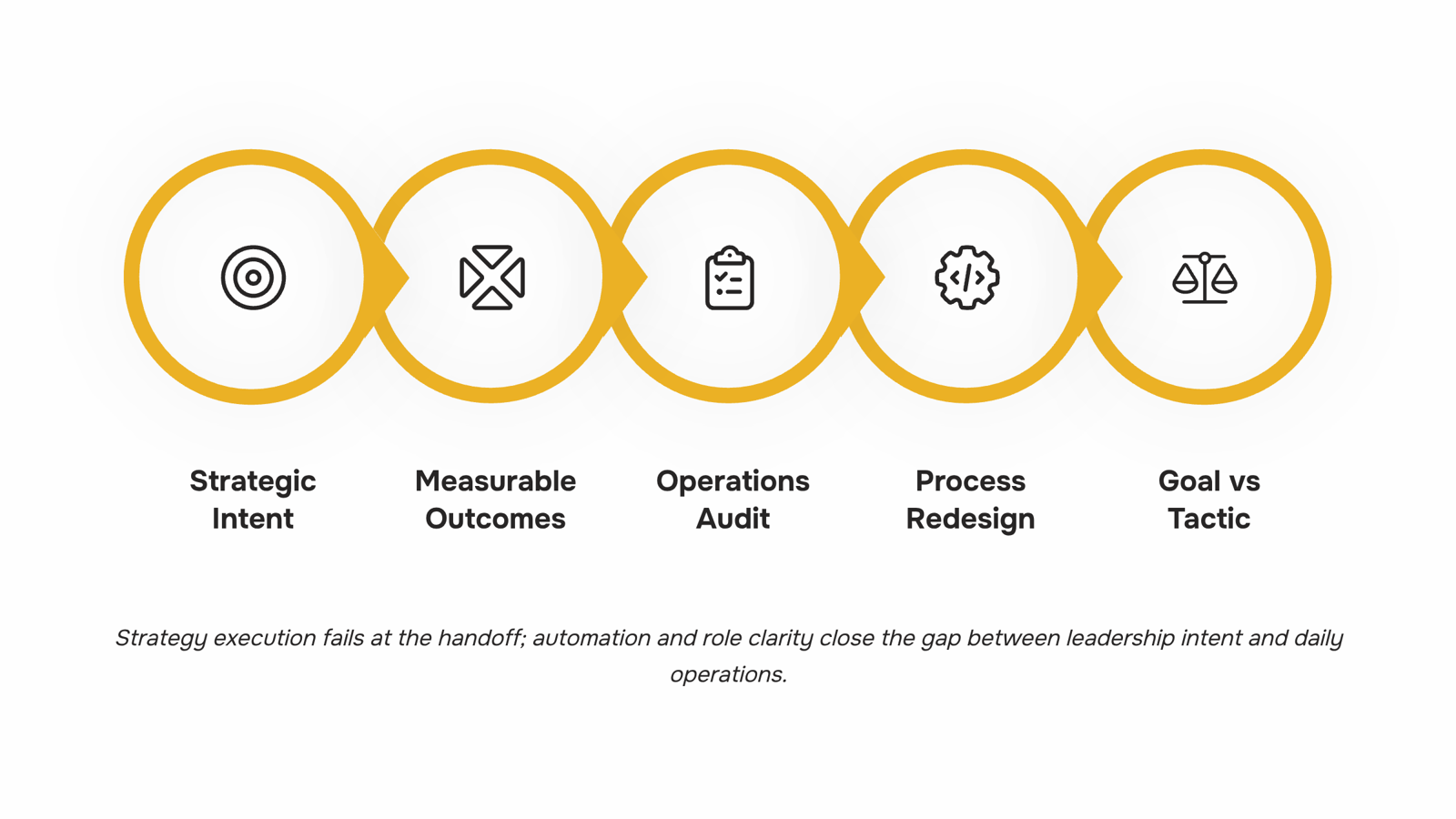
Set your strategic intent in one sentence. Before any operational work begins, your leadership team needs a single, unambiguous statement of where the organization is going and why. If you can't write it in one sentence, the strategy isn't clear enough to execute. This is the foundation of how to create an organizational strategy that actually holds up under pressure.
Translate intent into measurable outcomes. A direction without a number is a wish. Map your strategic intent to three to five outcomes with specific targets and deadlines, then check that each one connects to a team or individual who owns it. Connecting your OKRs and KPIs to daily tasks is where most of this translation work happens.
Audit your current operations against those outcomes. Walk your existing workflows and ask one question: does this activity move us toward one of the five outcomes, or not? Anything that doesn't map to a strategic outcome is either a candidate for elimination or a sign that your outcomes list is incomplete. This audit is where the execution gap becomes visible.
Redesign the processes that don't align. Once you know what's misaligned, rebuild those processes around the people, process, and technology framework rather than patching them. Assign a process owner, define the inputs and outputs, and document the steps before touching any tooling. Redesigning without documentation just moves the confusion downstream.
Distinguish strategic goals from the tactical work that delivers them. This is the step most teams skip. The difference between strategic goals and tactical objectives matters here because confusing the two causes teams to optimize the wrong thing. A strategic goal might be "reduce delivery cycle time by 30%." The tactical objective is "cut handoff lag between sales and delivery to under 24 hours."
Automate the operational handoff so strategy doesn't stall. Strategy execution fails most often at the moment a decision needs to become a task. Automating the handoff between strategic decisions and operational workflows removes the manual step where context gets lost and urgency fades. Workflow automation here isn't about replacing judgment. It's about making sure the judgment your leadership team already made actually reaches the people doing the work, on time, every time.
Each step builds on the last. Skip step three and step six becomes a faster way to do the wrong things.
How to communicate your organizational strategy to your team
Most strategy communication fails at the middle layer. Executives understand the direction. Frontline staff follow daily tasks. The people in between, team leads and department heads, often carry neither enough context nor enough clarity to connect the two.
Three methods close that gap:
Translate strategy into role-level outcomes. Don't share the slide deck. Share what the strategy means for each team's quarterly priorities. The difference between strategic goals and tactical objectives matters here: one sets direction, the other tells people what to do Monday morning.
Run a monthly strategy pulse, not just a quarterly all-hands. A 20-minute sync where team leads report on one metric tied to a strategic priority keeps the organizational strategy visible between planning cycles. Connecting your OKRs and KPIs to daily tasks gives you a practical structure for this.
Make ownership explicit in writing. Every strategic initiative needs a named owner, a success metric, and a review date. Without that, the people, process, and technology framework breaks down at the process layer.
Communication isn't a one-time announcement. It's a system you run alongside execution.
Where workflow automation fits into strategy execution
The gap between a strategic decision and its effect on daily operations is rarely a planning failure. It's a handoff failure. Someone has to manually translate the new priority into updated tasks, reassigned workflows, and changed approval chains, and that step gets skipped or delayed.
Workflow automation removes that dependency. When your operations strategy shifts, automated triggers can update task routing, notify the right teams, and adjust process sequences without a manager manually pushing each change through.
Revo handles this layer inside WorksBuddy, connecting strategic decisions to operational workflows through a drag-and-drop builder. For a deeper look at where this is heading, see the latest trends in workflow automation.
Closing
The gap between organizational strategy and operations strategy isn't a failure of planning—it's a failure of handoff. When your leadership team sets direction but operations teams don't have a clear, connected workflow to act on it, strategy becomes a document instead of a system. The six-step alignment framework above closes that gap by making strategy executable at every level.
The real work starts after alignment happens. Keeping strategy and operations connected requires automation that removes the manual follow-through—the status checks, the rework, the context-switching that kills execution momentum. Revo automates the operational layer so your existing tools talk to each other and your workflows stay wired to your strategy without constant manual intervention. See how it connects your current stack to the operations your strategy actually requires.
FAQ
What are the key elements of an effective organizational strategy?
Strategic intent (one clear sentence of direction), measurable outcomes tied to metrics, resource allocation decisions, role clarity with named owners, and operational handoff triggers that move strategy into workflow.
How can I create an organizational strategy that drives business success?
Follow the six-step alignment framework: set intent in one sentence, translate it to measurable outcomes, audit current operations against those outcomes, map each outcome to a workflow, assign ownership with deadlines, and lock in a review cadence. Success depends on the handoff between leadership direction and day-to-day execution.
How can I communicate my organizational strategy to my team?
Start with one clear sentence of strategic intent, then show how each team's operations connect to it. Tie organizational goals to specific workflows and metrics your teams track weekly, not just annual presentations. Make strategy a live system, not a document.
What happens when organizational strategy and operations strategy are not aligned?
Misalignment causes duplicated work, missed deadlines, shifting priorities, and burnout. Research shows fewer than 10% of well-formulated strategies execute effectively, and the breakdown almost always happens at the handoff between leadership direction and operations.
How often should you review and update your organizational strategy?
Review organizational strategy quarterly against market conditions and competitive shifts, but keep the core intent stable for 12 to 24 months. Operations strategy (how you run daily work) should be reviewed every 90 days and adjusted based on execution data.


 Elena Petrova15 September 2026


