TL;DR: Most business process reengineering guides describe phases without telling you what each one produces. This one walks IT company owners through the exact sequence, from diagnosing which processes are worth reengineering to locking in automation after the redesign, with a concrete output at every step so you always know when to move forward.
What is business process reengineering?
Business process reengineering (BPR) is the practice of fundamentally redesigning core workflows from scratch to achieve dramatic improvements in cost, speed, or quality, rather than making incremental tweaks to what already exists.
The distinction matters. Incremental process improvement asks "how do we do this better?" BPR asks "should we be doing this at all, and if so, how would we design it if we were starting today?" Michael Hammer and James Champy formalized this framing in their 1993 book Reengineering the Corporation, defining BPR as "the fundamental rethinking and radical redesign of business processes to achieve dramatic improvements in critical measures of performance."
That radical scope is also why BPR fails as often as it succeeds. The methodology works when leadership commits to genuine process redesign, not a rebranded version of what came before.
This article walks through the six sequential steps of a BPR initiative, naming the concrete deliverable each step produces. Before mapping those steps, it helps to understand how processes are modeled visually, since that skill underpins the diagnostic and redesign phases. If your goal is identifying which processes are worth reengineering first, the framework for spotting automation candidates covers that selection logic in detail.
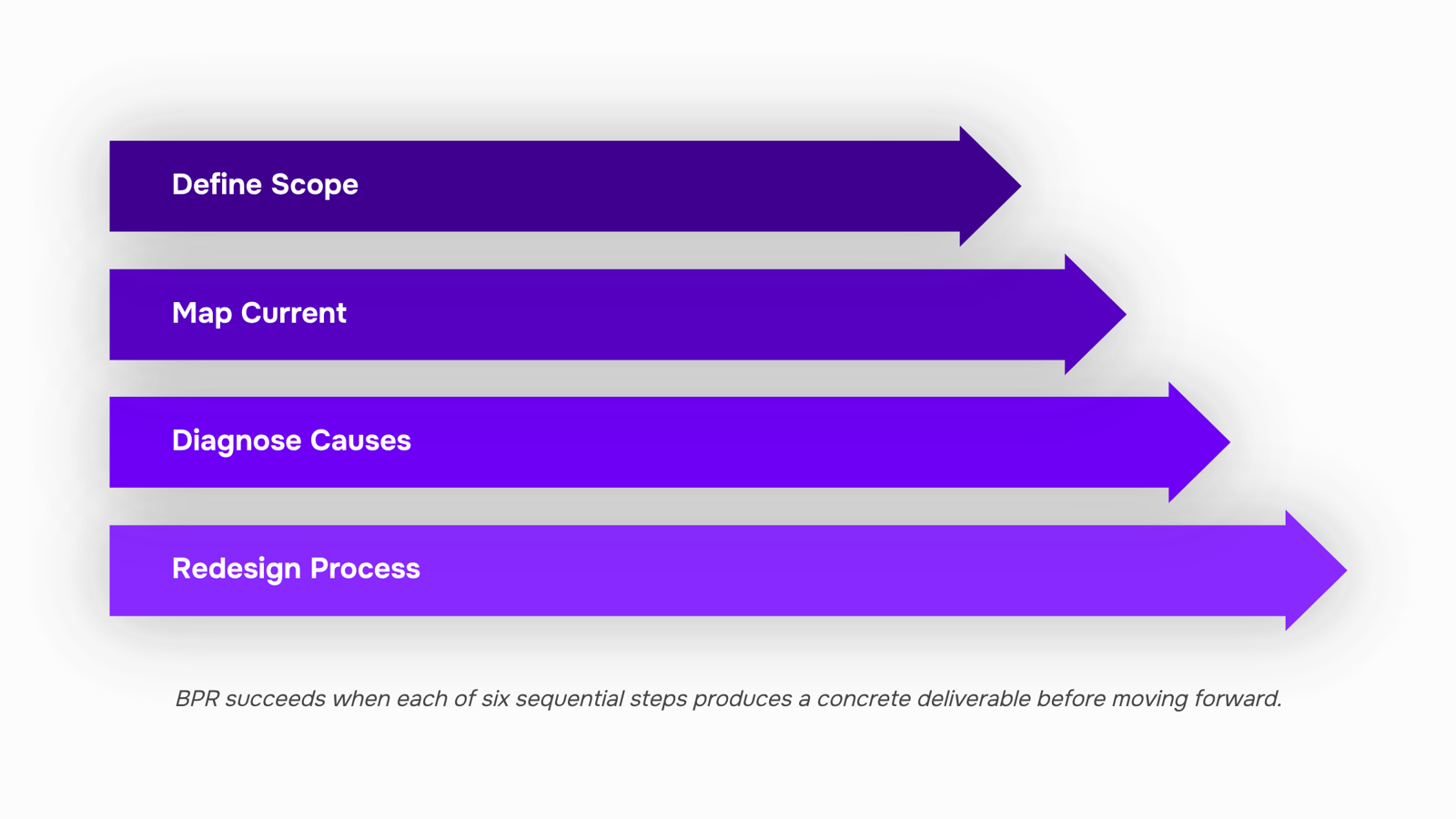
The step-by-step process for business process reengineering
Each step below names the concrete deliverable you should have in hand before moving to the next one.
Define scope and objectives. Pick the process you're targeting and write down what "better" looks like in measurable terms: cycle time, error rate, cost per transaction. The deliverable is a one-page scope document that names the process, the owner, and the success metric. Without this, redesign conversations drift into opinion.
Map the current state: Document every handoff, decision point, and system touchpoint in the existing process. Business process modeling is the standard method here, using swim-lane diagrams or BPMN notation to make the flow visible. The deliverable is a current-state map your whole team can read and challenge.
Diagnose the root causes: Identify where time, money, or quality is actually lost, not where it feels lost. Interview the people doing the work, pull system logs, and time each step. The deliverable is a prioritized list of failure points with evidence, not assumptions.
Redesign the process: This is the core of business process reengineering: you're not patching the old flow, you're rebuilding it around the outcome you defined in step one. Question every step that exists only because "that's how we've always done it." The deliverable is a future-state process map with roles, triggers, and decision rules clearly assigned. The people, process, and technology framework is useful here for checking that your redesign accounts for all three dimensions, not just the workflow logic.
Identify automation opportunities: Once the redesigned flow is clean on paper, mark which steps are repetitive, rule-based, and high-volume. Those are your automation candidates. The deliverable is a prioritized automation shortlist. Identifying which processes are ready for automation before you build anything saves significant rework later.
Implement, measure, and adjust: Roll out the new process in a controlled environment first. Measure against the metrics from step one within 30 to 60 days. The deliverable is a performance report that confirms whether the redesign hit its targets or needs a second pass. For teams using no-code tooling, Revo's visual workflow builder can wire up the automated steps without waiting on a development queue.
This process improvement methodology only works if each step produces a real artifact. Phases without deliverables are just meetings.
How business process reengineering improves operational efficiency
Each BPR step connects directly to a measurable operational outcome — which is what separates genuine business process reengineering from a documentation exercise.
When you map current-state processes in step one, you expose where handoffs stall and where duplicate work inflates cost. Teams that skip this step redesign around symptoms, not causes. The diagnostic phase typically reveals three to five redundant approval layers in a standard IT service workflow.
Redesigning for the ideal state (step three) is where speed gains become concrete. Eliminating unnecessary handoffs cuts cycle time. Consolidating approval steps reduces error rates because fewer people touch a transaction before it closes.
Step five, where workflow automation gets wired in, compounds those gains. Automating rule-based tasks — ticket routing, status updates, invoice triggers — removes the manual lag that erodes efficiency after redesign. The intersection of people, process, and technology is where operational efficiency either holds or collapses.
The final measurement step closes the loop. Without tracking cycle time, error rate, and throughput before and after, you cannot distinguish a real improvement from a process that merely looks cleaner on paper.
Most teams find that the biggest efficiency gains come from steps three and five together: redesign removes structural waste, automation prevents it from returning. Neither works as well in isolation.
The right tool depends on where you are in the process redesign sequence, not on which one sounds most sophisticated.
Process mapping (BPMN diagrams or swimlane charts) belongs at the diagnosis stage. You draw the current state first, then annotate every handoff, delay, and redundancy. Without a visual map, redesign decisions are guesswork.
Root cause analysis, specifically the 5 Whys or Ishikawa diagrams, comes next. Once the map exposes a bottleneck, you need to confirm whether the cause is a system constraint, a skills gap, or a policy decision. Treating symptoms instead of causes is how BPR initiatives fail to hold.
Value stream analysis strips each step down to a single question: does this add value for the client, or does it exist for internal convenience? Steps that survive this filter stay; the rest get cut or consolidated during redesign.
Workflow automation platforms enter after the redesigned process is validated on paper. Automating a broken process just produces broken outputs faster. Once the logic is clean, tools that connect your ticketing system, CRM, and billing layer can execute handoffs without manual intervention. For a practical starting point on wiring these up, building an efficient business process workflow covers the sequencing in detail.
Simulation and pilot testing closes the loop. Run the redesigned process against a subset of real work before full rollout. This catches edge cases the map missed and gives you a baseline to measure the BPR steps against.
Benefits and challenges of business process reengineering
Benefits for IT teams
Faster delivery cycles: Eliminating redundant approval layers typically cuts ticket-to-resolution time, giving engineering teams more capacity without adding headcount.
Clearer process ownership: BPR forces explicit ownership assignment. Every redesigned workflow has a named accountable role, which reduces the "who handles this?" delays that slow IT operations daily.
Measurable operational efficiency gains: Because BPR starts from a clean baseline rather than patching existing steps, improvements are quantifiable. Teams can benchmark before and after using the same process maps they built during diagnosis.
Better automation fit: Processes redesigned from scratch are structured for automation from day one. That makes identifying which processes to automate significantly easier once redesign is complete.
Common challenges
Scope creep: BPR initiatives expand quickly when stakeholders add adjacent processes mid-project. Mitigation: define a hard scope boundary in the charter before diagnosis begins, and require a formal change request to expand it.
High failure rate: Research consistently places BPR failure rates between 50 and 70 percent, most often due to under-resourced change management rather than flawed process design. Mitigation: budget change management as a first-class workstream, not an afterthought.
Resistance from technical staff: IT engineers often view process redesign as a threat to established workflows. Mitigation: involve senior engineers in the redesign phase early, covered in detail in the next section.
Tool-to-process mismatch: Teams sometimes select automation platforms before the redesigned process is stable. Review the people, process, and technology framework before committing to tooling.
How business process reengineering affects organizational culture
Business process reengineering doesn't just change how work gets done — it changes who does what, and that shift lands hard in IT teams where roles are often tied to specific manual processes.
The most common resistance pattern is ownership anxiety. When a developer or ops lead has spent years managing a workflow, process redesign can feel like a demotion rather than an improvement. Name this directly in your kickoff. Explain what the role looks like after the change, not just what disappears.
Role changes during BPR typically fall into three categories:
Tasks that get automated and removed from the person's plate entirely
Tasks that shift to a different team or function
Tasks that expand because the person now owns a broader, redesigned process
The third category is where you retain talent. Frame the redesign around it.
People, process, and technology need to move together — stalling on the people side while the technical redesign proceeds is the most common reason BPR implementations slow down in the final stretch. Run change communication in parallel with process mapping, not after it.
For teams identifying which workflows to redesign first, this guide on selecting processes for automation helps prioritize where culture friction will be lowest.
Closing
Business process reengineering only delivers results when each step produces a real artifact — a scope document, a current-state map, a prioritized failure list, a redesigned workflow, an automation shortlist, and finally a performance report. Skip the deliverables and you've got a documentation exercise, not a transformation.
Once your redesigned process is locked in and validated, the remaining work is execution: replacing manual handoffs with automated triggers. That's where most teams stall — they have a beautiful future-state map but no way to wire it into their existing systems without a six-month dev queue. What's your biggest bottleneck right now: getting the redesign map clean, or turning it into working automation?
FAQ
What is the step-by-step process for business process reengineering?
Six sequential steps: define scope and objectives, map current state, diagnose root causes, redesign the process, identify automation opportunities, then implement and measure. Each step produces a concrete deliverable before moving forward.
What are the benefits and challenges of business process reengineering?
Benefits include dramatic cuts to cycle time, error rates, and cost per transaction. The challenge: BPR fails when leadership commits to documentation instead of genuine redesign, or when automation gets wired into a broken process.
How does business process reengineering impact organizational culture?
BPR requires teams to question "that's how we've always done it" — which demands psychological safety and leadership buy-in. Resistance peaks when people see automation as job threat rather than relief from manual work.
What tools and techniques are used in business process reengineering?
Process mapping (BPMN, swimlanes), root cause analysis (5 Whys, Ishikawa), value stream analysis, workflow automation platforms, and pilot testing. Start with mapping; automate only after redesign is validated.
How long does a business process reengineering project typically take?
Diagnosis through redesign typically takes 4–8 weeks. Measurement happens 30–60 days post-rollout. Full impact takes 90–180 days depending on complexity and automation scope.


 Elena Petrova11 September 2026


