TL;DR: Most rank trackers tell you a position dropped. This one shows IT company owners how to track keyword rankings with AI in a way that surfaces cause, not just movement, using a four-level Rank Intelligence Maturity Model to assess whether your current tooling is reporting history or driving decisions.
What AI-powered keyword rank tracking actually means
Traditional rank trackers answer one question: where does your page sit in the results? That's position reporting. AI-powered rank tracking answers a harder question: why did that position change, and what's likely to happen next?
The distinction matters because position alone is increasingly unreliable as a performance signal. A page can hold rank 3 while losing clicks to an AI Overview sitting above it. Another page can drop from rank 5 to rank 8 and see traffic increase because a featured snippet disappeared. Position moved; the story is more complicated.
AI-powered rank tracking connects position data to the conditions that explain it. That means monitoring SERP feature composition, competitor movement, click-through rate shifts, and, critically, how often your content gets cited in AI-generated answers from ChatGPT, Perplexity, or Google AI Overviews. That last signal barely existed two years ago. Now it runs parallel to traditional rankings as a separate visibility channel.
Understanding how AI rank tracking processes SERP signals under the hood shows why the architecture is different from a faster crawler. It's a diagnostic layer, not a speed upgrade.
The next section covers exactly which signals AI monitors beyond position changes, and why keyword rank monitoring built on position data alone gives you an incomplete picture.
What AI analyzes beyond your position number
Position number tells you where you landed. It doesn't tell you why traffic dropped, why a competitor surged, or whether you're even visible in the formats searchers actually use.
When you track keyword rankings with AI, the system watches several signals simultaneously. CTR trends reveal when your rank held but your title lost relevance to shifting query intent. SERP feature tracking flags when a featured snippet, People Also Ask box, or AI Overview displaced organic results above the fold, pulling clicks away from positions 1 through 3 entirely. How AI Mode changes what your rank tracker must measure covers exactly why this matters for modern rank tracking accuracy.
Competitor movement is another layer most traditional tools miss. A position drop that coincides with a specific competitor gaining a featured snippet is a different problem than a broad algorithm update. Tracking competitor rank movement alongside your own shows how side-by-side signal comparison sharpens diagnosis.
The signal that almost no traditional tracker captures at all is AI citation frequency. If ChatGPT, Perplexity, or Google AI Overviews are pulling answers from a competitor's page instead of yours, your organic position is irrelevant for that query. Daily AI mention tracking across ChatGPT, Claude, Perplexity, and Gemini treats this as a first-class ranking signal, not an afterthought.
For a deeper look at how these signals connect, see the full SERP Signal Framework behind rank tracking accuracy.
The Rank Intelligence Maturity Model
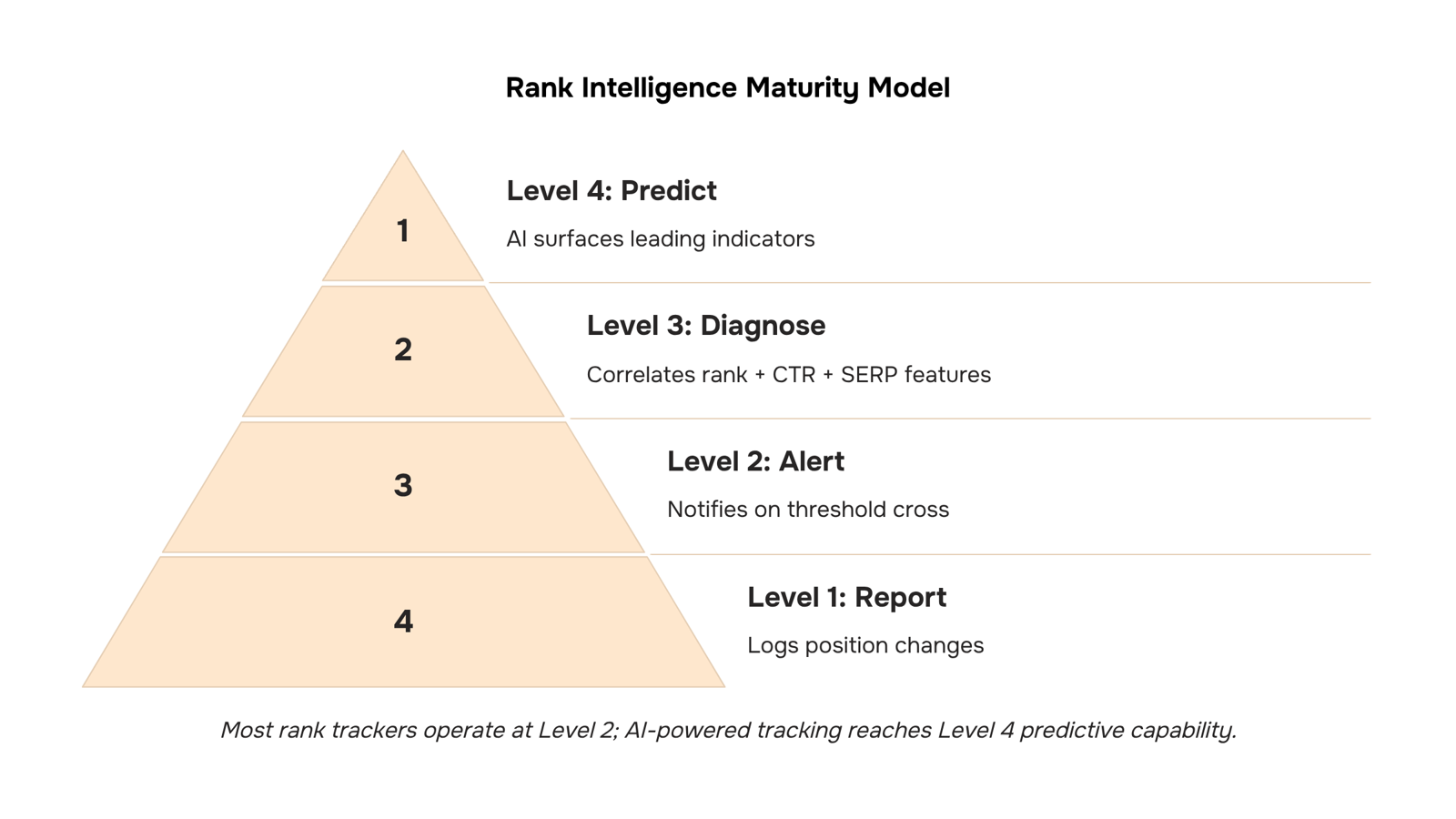
Most teams sit at Level 1 without knowing it. They pull a rank report, see a position drop, and open a support ticket. The Rank Intelligence Maturity Model gives you a way to classify where your current tooling actually sits — and what capability you need to close the gap.
The four levels are Report, Alert, Diagnose, and Predict.
Level | Name | What it does | What it misses |
|---|
1 | Report | Logs position changes on a schedule | No context: why did it move? |
2 | Alert | Notifies you when rank crosses a threshold | No root cause; reactive by design |
3 | Diagnose | Correlates rank shifts with CTR, SERP feature changes, and competitor movement | Tells you what happened, not what comes next |
4 | Predict | Uses AI-powered rank tracking to surface leading indicators before traffic drops | Requires structured signal ingestion and model training |
Most rank trackers ship at Level 2. They alert you to a drop after it costs you traffic. Level 3 is where rank tracking accuracy starts to matter: you need CTR data, SERP feature shifts, and — increasingly — AI citation frequency from platforms like ChatGPT and Perplexity alongside traditional position data. Understanding how AI Mode changes what your rank tracker must measure explains why Level 2 tooling is structurally blind to these signals.
Level 4 is where answer engine optimization enters the picture. A predictive system doesn't just watch your rankings — it watches competitor rank movement, SERP feature volatility, and AI citation patterns simultaneously, then flags which keywords are at risk before the drop registers. That's a different product category from a rank report.
To understand the signal architecture that separates Level 3 from Level 4, the full SERP Signal Framework behind rank tracking accuracy covers the mechanics in detail.
Use this model as a diagnostic: match your current tool to a level, then identify the one capability gap between where you are and where you need to be.
How to track keyword rankings with AI in 5 steps
The framework below assumes you already know which keywords matter. If you don't have that list yet, start there before configuring any tracking.
Connect your keyword set to a tracking environment: Import your target keywords into your rank tracking tool, segmented by intent cluster (informational, commercial, transactional) and by page. Tracking "cloud managed services" alongside "what is a managed service provider" as a single flat list produces noise, not signal. Segment first, then track. This segmentation also determines which volatility alerts are worth your attention later.
Select the right signals beyond raw position: Position alone tells you where you rank, not whether that rank is working. Before your first data pull, decide which signals you'll monitor alongside position: organic click-through rate, impressions, featured snippet ownership, and AI citation frequency across tools like ChatGPT, Perplexity, and Google AI Overviews. How AI rank tracking processes SERP signals under the hood explains why each of these signals behaves differently from raw position data.
Set a rank tracking cadence that matches keyword volatility: High-competition informational keywords in 2025 can shift multiple positions within a single day. Daily monitoring makes sense for those. Branded terms and low-competition long-tails don't need the same frequency — weekly pulls are enough. Matching your rank tracking cadence to actual volatility cuts alert fatigue and keeps your team focused on real movement.
Connect rank changes to content actions: When a keyword drops, the next question is why. Pull the SERP for that keyword and check what changed: did a competitor gain a featured snippet, did an AI Overview appear, or did Google swap in a different page format? The full SERP Signal Framework behind rank tracking accuracy gives you a structured way to diagnose this. For competitor movement specifically, tracking competitor rank movement alongside your own in Ranko surfaces which competing pages gained ground and what content changes preceded that shift — so you're responding to evidence, not guessing.
Build a weekly review loop: Raw data without a review cadence becomes a dashboard nobody checks. Set a fixed weekly slot to review rank movement against your content calendar: which pages moved, which content went live that week, and whether the two correlate. How AI Mode changes what your rank tracker must measure is worth reading before you finalize this loop, since AI Mode results require a different measurement lens than standard organic positions.
The goal when you track keyword rankings with AI is to close the gap between seeing a number and knowing what to do with it.
Metrics to track alongside keyword position
Position is one signal. Alone, it can't tell you whether a traffic drop came from a ranking slide, a SERP layout change, or your content losing an AI Overview citation it held last month.
The metrics worth tracking alongside position:
Impressions and click-through rate from Google Search Console. A stable rank with falling CTR usually means a featured snippet or AI Overview pushed your result below the fold.
SERP feature ownership: which features your URL holds (snippet, People Also Ask, image pack) and when you lose them. Understanding how SERP signals interact shows why this matters more than raw position on volatile queries.
AI citation frequency: how often ChatGPT, Perplexity, and Google AI Overviews cite your content. This is the answer engine optimization signal most rank trackers ignore entirely. Daily AI mention tracking across those four platforms gives you a parallel visibility number that position data never captures.
When you track keyword rankings with AI, these three signals together replace the single-number dashboard with a diagnostic view. A position drop paired with rising AI citations reads very differently from a position drop paired with zero citations.
How often you should monitor keyword rankings
Your rank tracking cadence should follow two variables: SERP volatility and revenue exposure.
For high-competition informational keywords, daily monitoring is the floor. SERPs in those categories shift frequently enough that a weekly check leaves you diagnosing problems after traffic has already dropped. For stable, low-competition terms, weekly is sufficient.
A practical decision rule: if a keyword drives leads or pipeline, monitor it daily. If it's informational with no direct conversion path, weekly works. If it's brand-adjacent, monthly is fine.
This matters more now because position alone no longer tells the full story. AI Mode changes what your rank tracker must measure, including featured snippet ownership and AI citation frequency, which shift on their own schedule regardless of your organic position.
AI rank tracking vs. traditional rank trackers
The difference between the two approaches isn't speed — it's what the output actually tells you.
Dimension | Traditional tracker | AI-powered rank tracking |
|---|
Signal breadth | Position + search volume | Position, AI citation frequency, SERP feature presence |
Diagnosis depth | Reports the drop | Identifies why (content gap, competitor move, AI Overview displacement) |
Cadence | Weekly or on-demand | Daily, with volatility alerts |
Content action output | None | Specific rewrite or targeting recommendations |
Traditional trackers tell you a number changed. AI rank tracking tells you what to do next. For IT teams managing dozens of pages, that distinction determines whether you fix the right problem or chase the wrong one.
When you track keyword rankings with AI, citation signals from ChatGPT, Perplexity, and Google AI Overviews become part of the picture — something traditional measurement frameworks weren't built to capture.
Closing
You now have a framework to assess where your current rank tracking sits and what capability closes the gap to predictive monitoring. The Rank Intelligence Maturity Model isn't about adopting new tools for their own sake — it's about recognizing that position alone stopped being enough the moment AI Overviews and answer engines entered the SERP. Level 4 tracking surfaces leading indicators before traffic drops, not after. The question isn't whether you need to move beyond position reporting. It's whether you're ready to act on signals that predict rank movement before it happens. If your team is ready to stop reacting to rank drops and start preventing them, explore Ranko's AI-powered rank tracking features or start a free trial to see how Level 4 monitoring works in practice.
FAQ
How do I check my keyword rankings across search engines?
Import your keyword list into a rank tracker, segment by intent and page, then set a monitoring cadence that matches keyword volatility. Daily tracking for high-competition terms, weekly for branded or low-competition keywords. AI-powered trackers also pull SERP feature data and competitor positions alongside your own.
What factors influence keyword ranking positions in Google?
Content relevance, backlink authority, and page experience remain core. But SERP feature composition, AI Overview presence, and whether answer engines cite your content now run parallel to traditional rankings as separate visibility signals that directly impact clicks.
How often should I monitor keyword rankings for my website?
Match cadence to volatility. High-competition informational keywords shift multiple positions daily, so daily monitoring makes sense. Branded terms and low-competition long-tails need only weekly checks. Mismatched cadence creates alert fatigue without improving decisions.
What signals does AI analyze beyond a position change?
CTR trends, SERP feature shifts (featured snippets, People Also Ask, AI Overviews), competitor movement, and AI citation frequency across ChatGPT, Perplexity, and Google AI. Position alone misses why traffic actually dropped.
How is AI rank tracking different from a standard rank tracker?
Standard trackers report position changes after they happen. AI-powered trackers correlate position with CTR, SERP features, and competitor signals to diagnose why, then use leading indicators to predict rank drops before traffic falls. That's the jump from Level 2 to Level 4 monitoring.
Should I track AI citation frequency alongside traditional keyword rankings?
Yes. If ChatGPT or Perplexity cite a competitor instead of you, your organic rank is irrelevant for that query. AI citation frequency is now a first-class ranking signal, not optional data.


 Ryan Mitchell14 September 2026


