TL;DR: Most articles on project phases hand you a definition list and call it done. This one gives IT team leads a working map of what to execute at each phase boundary, where handoffs actually break down, and how to maintain momentum across the full lifecycle without turning into a bottleneck yourself.
What project phases actually are
Project phases are the named, sequential stages that a project moves through from start to finish. Each phase has a defined purpose, a set of activities, and a clear exit point before the next stage begins. That structure is what separates a managed project from a running list of tasks.
Tasks are individual units of work. Milestones are fixed points that mark progress. Phases are the containers that hold both, giving your team a shared mental model of where the project stands at any given moment. Confusing these three is one of the most common reasons scope creeps quietly past anyone's notice.
Phase structure exists because projects are not linear in practice. Work clusters naturally around distinct modes: defining what you're building, planning how to build it, executing the build, and confirming the result holds up. Forcing continuous delivery without those boundaries tends to collapse planning into execution, which is where rework starts. Understanding stages of project management in sequence gives you the foundation to catch that collapse early.
The concept of project phases and life cycle together describes the full arc of a project, from initiation through closure, as a governed system rather than a series of events.
Why phase structure matters for IT teams
Skipping formal phase structure doesn't just feel disorganized. It produces measurable losses that compound across the project lifecycle.
Scope creep starts at handoffs: When your team moves from planning to execution without a defined exit criterion, stakeholders interpret silence as permission. New requirements get added mid-sprint because no one formally closed the planning phase. The stages of project management research consistently shows this is where IT projects absorb the most unplanned work.
Rework costs more than the original build: PMI data shows that organizations waste an average of 11.4% of investment due to poor project performance, much of it tied to skipped phase reviews. For a $500K infrastructure rollout, that's $57,000 in avoidable rework before go-live.
Stakeholder trust erodes between phases: When sponsors can't see a clear transition from planning to execution, they fill the gap with assumptions. Those assumptions become escalations. A structured phase gate review gives stakeholders a defined moment to align before work accelerates.
Teams lose time recovering context. Without phase boundaries, engineers context-switch constantly between discovery work and delivery work. Defined project phases in project management create the separation that lets teams go deep instead of wide.
The five phases covered next give each of these problems a specific fix.
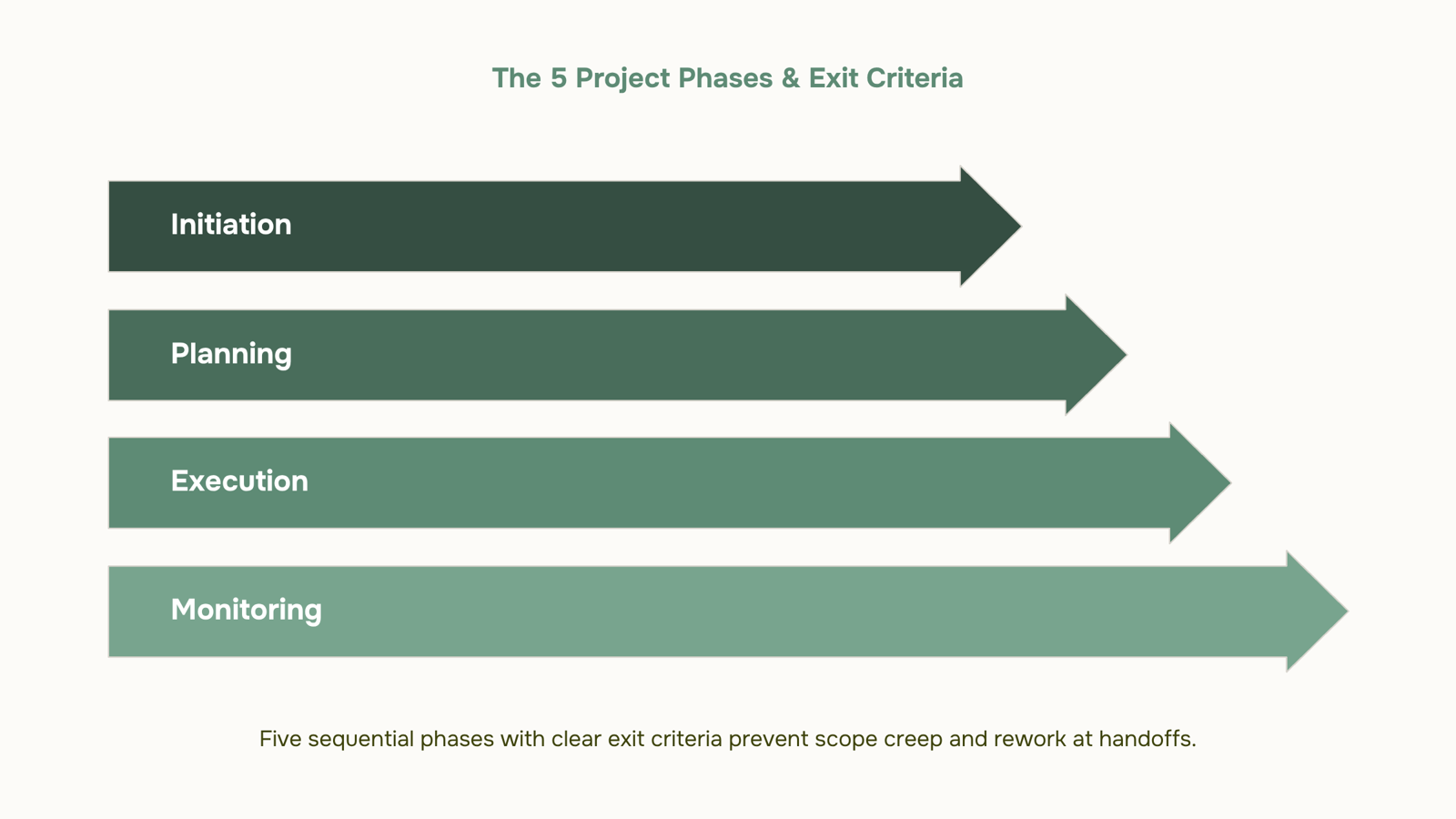
The 5 project phases and what happens in each one
Each of the five project phases has a distinct job, a key deliverable, and a clear signal that tells you it's done. Treating them as checkboxes rather than distinct work modes is where most IT projects quietly lose weeks.
Initiation is where the project earns the right to exist. The team defines the business case, identifies key stakeholders, and produces a project charter that captures scope, objectives, and initial constraints. The exit criterion is simple: a signed charter with named ownership. Without it, you're building on assumptions that will surface as scope disputes later.
Planning is the most underinvested phase in practice. Here you break the work into tasks, assign owners, set a baseline schedule, and document risks. The key deliverable is a project plan that your team can actually execute against, not a slide deck for the sponsor. If you want to build out your planning phase with a repeatable process, the inputs are the same regardless of project size. The phase ends when the plan is approved and resources are confirmed.
Execution is where the work happens. Teams deliver the outputs defined in the plan, and the project manager's job shifts to removing blockers, managing dependencies, and keeping communication tight. The key deliverable is the actual product, system, or service being built. Most project phases and life cycle frameworks treat execution as the longest phase, and for IT projects it usually is.
Monitoring and controlling runs parallel to execution, not after it. This phase tracks schedule variance, budget burn, and scope changes against the approved baseline. The key deliverable is a status report cadence that gives stakeholders accurate visibility. The exit criterion is that all deliverables are accepted and no open change requests remain unresolved. Skipping this phase doesn't save time; it just moves the reckoning to the end, when fixing problems costs more. Phase gate reviews are one structured way to enforce this without adding bureaucracy.
Closure is the phase most teams skip when they're already moving to the next project. It includes formal client or stakeholder sign-off, a lessons-learned session, and archiving of project documentation. The exit criterion is written acceptance from the project sponsor. Teams that skip closure tend to carry unresolved issues into the next project as undocumented assumptions.
If you want to see how these phases connect across a full stages of project management view, the structure holds whether you're running a three-week sprint cycle or a six-month infrastructure rollout. Tools like Taro let you configure phases and milestones directly in the project setup, so the structure is built in from day one rather than retrofitted.
How to manage transitions between phases without losing momentum
Phase transitions are where most projects quietly fall apart. The work looks done, the team moves on, and the gaps only surface two phases later when rework is expensive.
Three handoff failures show up repeatedly in project phases project management work.
Deliverables get declared "done" without a formal exit check: The planning phase closes, execution starts, and nobody confirmed the scope document was actually signed off. Three weeks in, a stakeholder disputes the requirements. Fix this by running a brief phase gate review before any phase closes. One meeting, one sign-off, one written record. That record becomes your defense when scope creep hits.
Ownership doesn't transfer cleanly: The person who ran planning hands off to the execution lead with a verbal summary and a shared folder. Critical context stays in someone's head. The specific action: write a one-page handoff note for every phase transition. It names the open risks, the decisions still pending, and who owns what next. This takes 20 minutes and prevents days of rework.
Monitoring gets treated as a phase rather than a continuous activity: Teams finish execution, then start monitoring. By then, the problems they would have caught in week two are now in week eight. Map your project timeline with monitoring checkpoints built into execution, not after it.
If you're managing multiple projects in parallel, tracking these transitions manually across spreadsheets compounds the risk. Tools like Taro let you build phases and milestones into the project structure directly, so exit criteria are visible before a phase closes rather than remembered after.
How to adjust project phases for agile or sprint-based work
In agile delivery, the five stages of project management don't disappear — they compress. Initiation and planning happen once at the program level, then repeat in miniature at the start of each sprint. Execution, monitoring, and closure run in parallel inside every two-week cycle rather than sequentially across months.
The practical adjustment is about scope, not structure. Instead of a single planning phase that locks requirements for six months, you build out your planning phase at two levels: a lightweight roadmap for the quarter and a detailed sprint plan for the next two weeks. Execution stays continuous. Monitoring shifts from milestone reviews to daily standups and sprint retrospectives.
Where agile teams still need the traditional framework is at phase boundaries. Sprint demos function as lightweight phase gate reviews — a structured moment to confirm the work matches the original intent before the next sprint begins. Skipping that check is where project phases and life cycle discipline breaks down, even in agile shops.
Map your project timeline at the program level so each sprint has a visible position inside the broader delivery arc, not just a backlog.
Centralize your phases in one place
Spreadsheets and status emails don't break projects on their own. They break projects by hiding where one phase ends and the next begins, so nobody catches the drift until a deadline is already missed.
Tracking your project management project phases inside a single tool fixes that. When milestones, completion forecasts, and ownership all live in one view, phase transitions become visible events rather than assumptions. You can map your project timeline against actual progress, spot a slipping milestone before it pulls the next phase off schedule, and run phase gate reviews with real data instead of gut feel.
Taro handles this through project creation with defined phases and milestones, automated progress tracking, and Gantt-based timeline views, so your team always knows which phase is active and what has to close before the next one opens. Track phases and milestones inside Taro to see how it maps to your current workflow.
Common mistakes teams make across project phases
Four errors show up repeatedly across project phases in project management, and most teams only spot them in hindsight.
Skipping phase exit criteria. Teams move from planning to execution before scope is locked. The result is rework that PMI research consistently links to poor upfront planning as the primary driver of project failure.
Treating milestones as decorative. Milestones get added to the timeline but never tied to ownership or a completion condition. They become dates, not checkpoints.
Ignoring transition triggers. What specifically moves a project from design to build? If the answer is "when it feels ready," phase drift is already happening. Review what the different stages of project management actually require at each handoff before you start.
Compressing the planning phase under deadline pressure. This is the most common and most expensive mistake. Cutting planning time rarely saves time overall — it moves the cost into execution, where fixes are harder.
Before your next project kicks off, run your planning process against established best practices to catch these gaps early.
Closing
Project phases give your team a shared language for where work stands and what comes next. Without them, scope creep hides in handoffs, rework compounds, and stakeholders lose trust between milestones. The five-phase structure—initiation, planning, execution, monitoring and controlling, and closure—works whether you're shipping in weeks or months. Start by mapping your current project against these phases and identifying where handoffs break down today. Then move your phases, milestones, and completion forecasting into Taro, where phase structure is built into the project from day one instead of stitched across spreadsheets and status emails. Create a free project in Taro to see how phase gates and ownership transfers work in practice.
FAQ
What are the typical phases of a project lifecycle?
Initiation, planning, execution, monitoring and controlling, and closure. Each phase has a defined purpose, key deliverable, and exit criterion before the next phase begins.
How do I plan and manage each project phase?
Define the phase's purpose and deliverables upfront, assign clear ownership, run a phase gate review before closing, and document decisions in writing. Use a one-page handoff note to transfer context to the next phase owner.
What are the key milestones in each project phase?
Initiation: signed charter. Planning: approved project plan with confirmed resources. Execution: delivered outputs. Monitoring and controlling: no open change requests. Closure: written sponsor sign-off.
Can project phases be adjusted for agile projects?
Yes. Agile compresses phases into sprint cycles but still needs initiation, planning, execution, and closure. Monitoring runs continuously rather than as a separate phase.
How do I ensure a smooth transition between project phases?
Run a formal phase gate review before closing each phase, write a one-page handoff note naming open risks and ownership, and confirm deliverables are signed off in writing.
What is the difference between a project phase and a project task?
Phases are sequential containers that hold multiple tasks and milestones. Tasks are individual units of work. Phases give your team a shared mental model of project progress; tasks are the work itself.
How many phases should a project have?
Five phases work for most projects: initiation, planning, execution, monitoring and controlling, and closure. Smaller projects may compress these, but skipping phases typically causes rework later.


 Elena Petrova15 September 2026


