Enterprise grade workflow execution powered by the Temporal engine. Workflows that survive crashes and outages without losing their place, scale to any volume without losing state, recover from transient failures with automatic retries, keep a full audit ready history of every step that ever ran, and fall back to local execution gracefully when the durable engine is temporarily unreachable. A workflow automation platform built for the business processes you cannot afford to lose halfway through.
Every workflow runs on a durable execution engine that checkpoints state after every step. Transient failures recover automatically with sensible retry behaviour. The full execution history of every run is captured for audit and replay. When the durable engine is temporarily unreachable, workflows fall back to local execution gracefully so nothing stops mid flow.
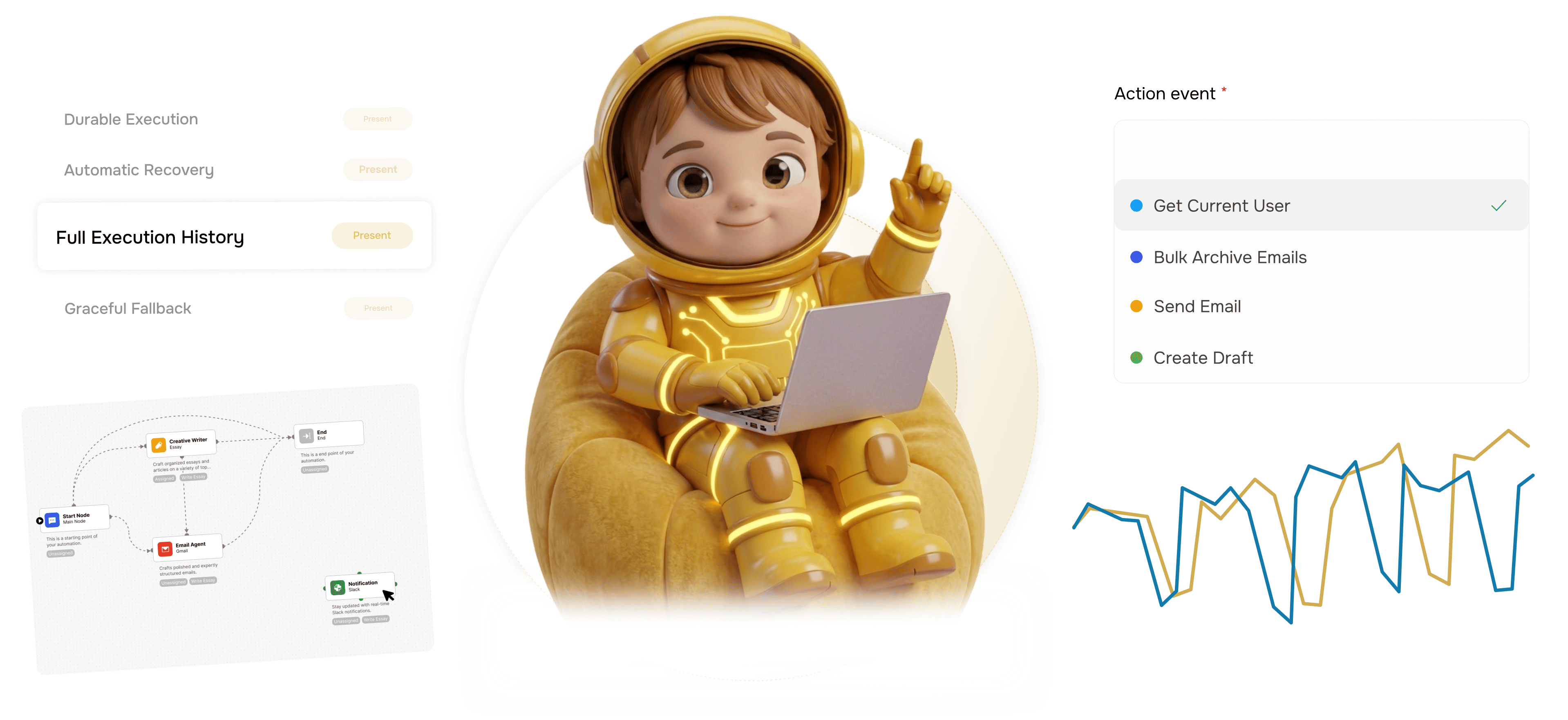
Durable Execution
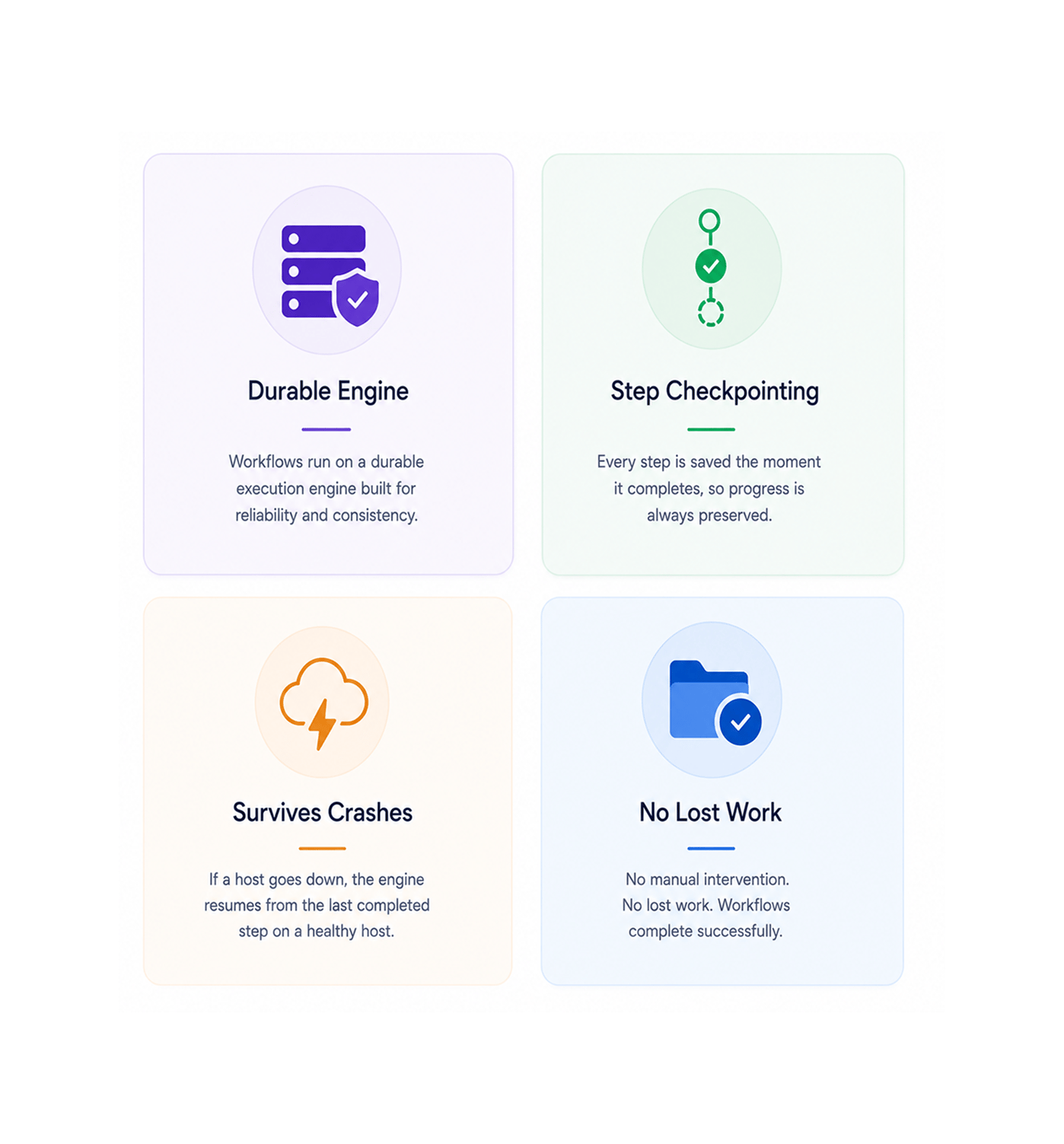
Every step of every workflow runs on a durable execution engine that captures its state the moment it completes. The crash that used to kill a long running workflow halfway through and leave a half finished job in production simply does not happen. If the host running the workflow goes down, the
Automatic Recovery
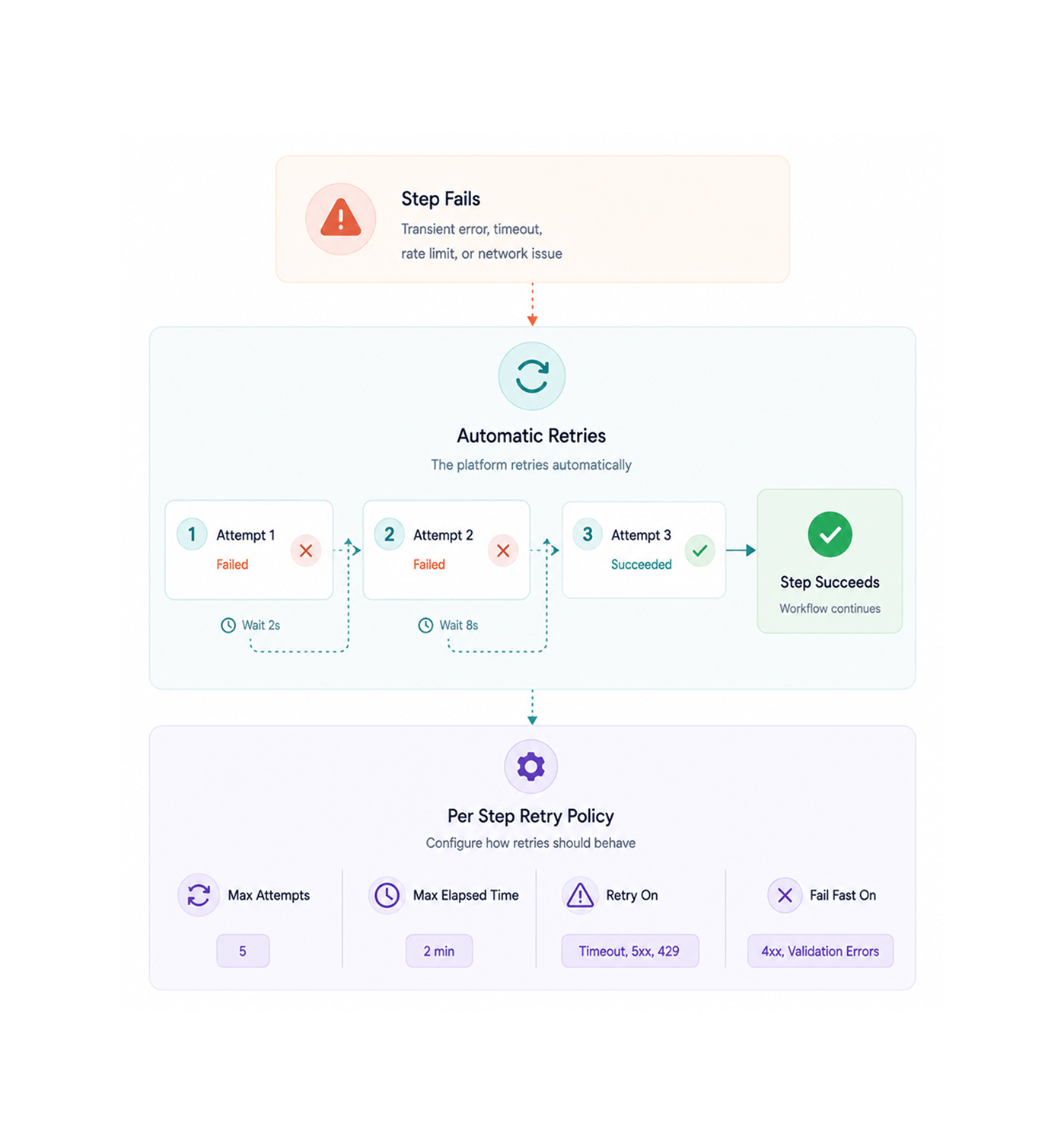
Transient failures a third party service that briefly stops responding, a network blip, a temporary rate limit get retried automatically with sensible backoff. The retry policy can be tuned per step, per integration, or per workflow, with limits on attempt count, maximum elapsed time, and which kinds of errors should retry versus which should fail fast. The midnight ticket that used to wake somebody up over a flapping external service becomes a few seconds of automatic recovery the team never had to see.
Full Execution History
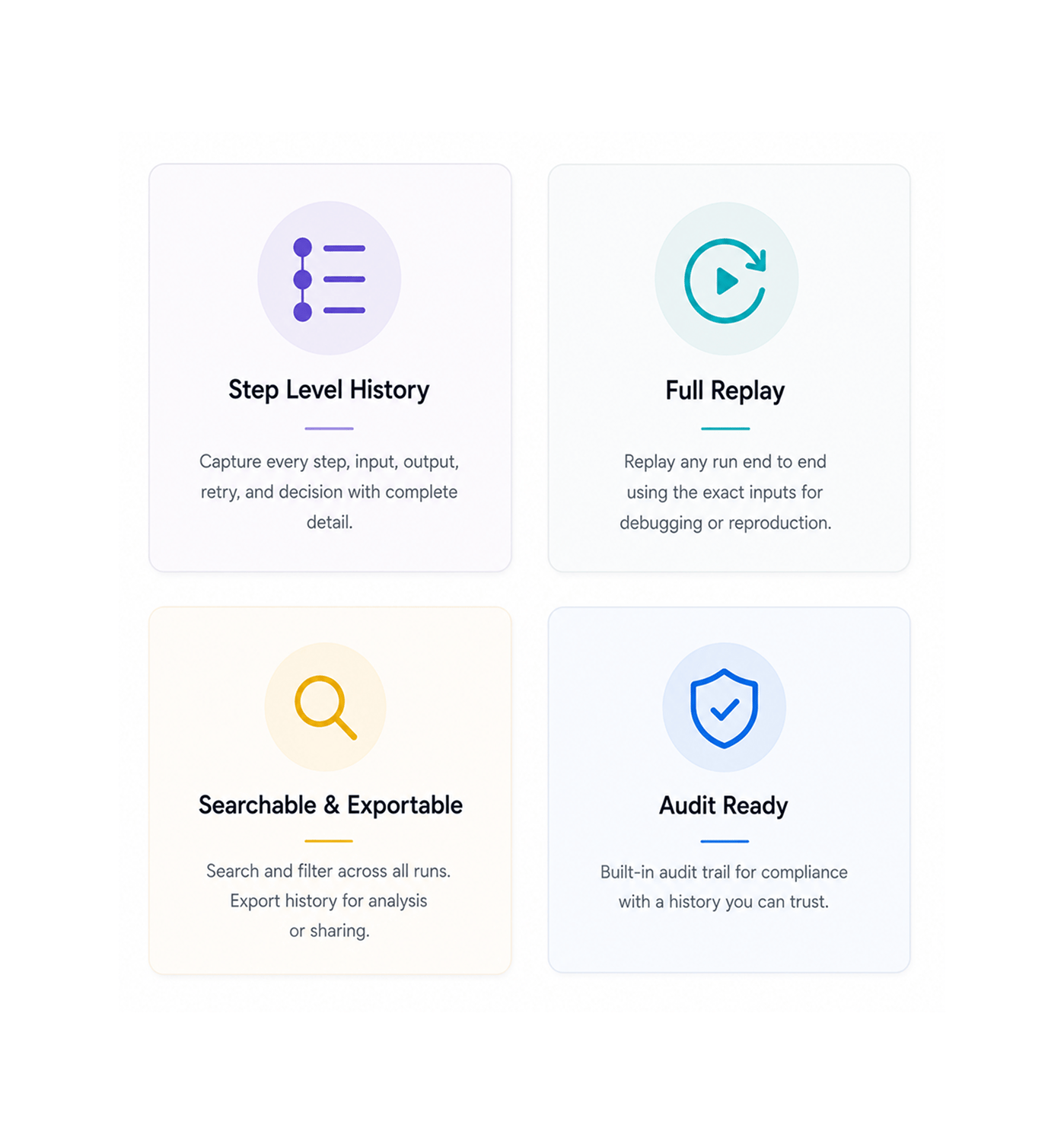
Every run of every workflow keeps a complete history of every step that executed, every input it received, every output it produced, every retry that happened, and every decision the workflow made along the way. The history is searchable, filterable, and exportable, and any run can be replayed end to end against the captured inputs for debugging or reproduction. The audit trail your compliance team has been asking for is built in from day one.
Graceful Fallback
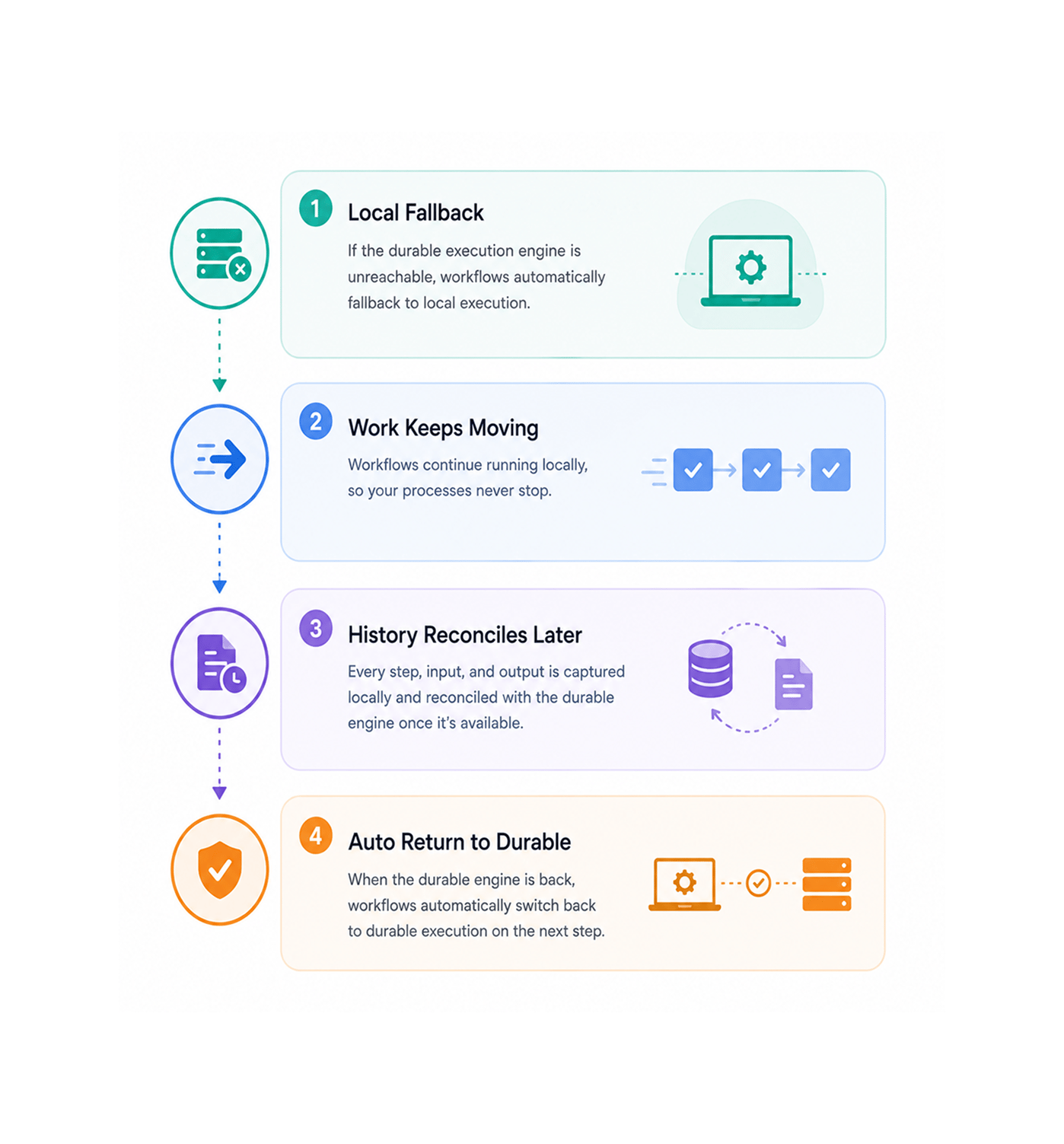
If the durable execution engine is temporarily unreachable for any reason, workflows fall back to local execution automatically so the work keeps moving. The local execution still captures every step, every input, and every output for the history to reconcile later, so even during the rare degraded mode the audit trail stays complete. When the durable engine becomes available again, the workflow returns to durable execution on the very next step without anyone touching anything.
Once a team runs business critical workflows on a durable execution engine instead of a process that loses its place the moment a host crashes the old pattern of writing manual recovery code for every workflow and praying nothing breaks at three in the morning starts looking like the version of automation that was never quite ready for production. These are the changes that show up first.
The classic horror story of a long running workflow that died halfway through, left a deal in a half finished state, and required somebody to figure out manually where to resume simply stops happening. Every step is checkpointed, every crash is recoverable, and every workflow continues from exactly where it left off as soon as a healthy host picks it up. The reliability story your business critical automations always needed is now the default.
Transient errors from third party services, network blips, brief rate limit hits all the small failures that used to fire alerts and pull engineers out of bed get retried automatically with sensible backoff. The on call rotation that used to spend nights chasing flapping integrations gets meaningful sleep back, and the small percentage of genuine incidents that still need attention stand out clearly instead of being lost in the noise.
The durable engine scales horizontally without losing workflow state, so going from a hundred workflow runs per day to ten thousand to a million is a matter of capacity rather than a re architecture project. Workflows do not slow down as volume grows, do not lose their place under load, and do not need to be redesigned to handle the next order of magnitude.
Every step of every run is captured with its inputs, outputs, timing, retry attempts, and final result. Compliance reviews stop being archaeology. Incident investigations stop being detective work. Customer support questions about what happened to this specific record on Tuesday get answered with a search across the execution history rather than a guess based on memory. The audit story your business has needed is built in rather than bolted on.
Any execution can be replayed against the captured inputs to reproduce exactly what happened, which is the kind of reproducibility that turns we cannot figure out why it broke into let us walk through the run step by step right now. Debugging production incidents, testing workflow changes against historical data, and validating bug fixes all become deterministic exercises instead of speculative ones.
In the rare case where the durable engine is temporarily unreachable, workflows do not stop. Local execution kicks in automatically so the work keeps moving, the history keeps being captured, and the team never has to notice the degraded mode. When the durable engine becomes available again, workflows return to it on the very next step. The safety net behind the safety net is built in, which is the design every mission critical system should have.
Durable execution. Automatic recovery. Full history. Smart retries. Local fallback. The execution layer your mission critical workflows have been waiting for.
6800+
Teams running mission critical workflows on
durable execution
Engineering leaders, platform teams, operations specialists running mission critical processes, finance teams handling regulated workflows, and revenue leaders running automations the business cannot afford to lose all use Revo as the workflow automation platform where reliability is the default. The durable execution engine is the foundation. The automatic recovery is the safety net. The full execution history is the audit trail. The local fallback is the safety net behind the safety net. Every team a small business running a handful of business critical workflows or a larger organisation orchestrating hundreds of regulated business process automations gets the same durable engine and the same recovery guarantees.
Execution
Recovery
History
Fallback
The durable execution engine captures workflow state after every step, so a crash, an outage, or a network blip never costs more than the last in flight step. Failed steps retry automatically with smart backoff, transient errors recover without anyone waking up, and the workflow that worked yesterday keeps working today no matter what happens to the host or the third party services it depends on.
A complete enterprise grade execution layer built into the same workflow automation platform your team already uses. Durable execution powered by the Temporal engine, automatic retries with smart backoff, full step level history, horizontal scaling, replay support, and graceful local fallback come together so the workflows your business depends on always finish what they started.
Every workflow runs on a durable execution engine built on Temporal, the open standard for mission critical workflow orchestration. Workflow state is captured after every step, so crashes never lose more than the last in flight operation. The engine handles checkpointing, recovery, scheduling, and timing guarantees so your team can focus on the workflow logic instead of the reliability plumbing.
Transient failures retry automatically with exponential backoff so the workflow gives the failing service room to recover rather than hammering it. Retry policies are tunable per step, per integration, and per workflow, with controls for maximum attempt count, total elapsed time, and which error categories should retry versus fail fast.
Every step of every run is captured with its inputs, outputs, timing, retry attempts, and final result. The history is searchable, filterable, exportable, and retained for the lifetime of the workspace, so audit reviews, incident investigations, and customer support queries all become a search across one place instead of a hunt across logs.
Workflow state is captured after every step rather than only at the end, so a crash mid workflow loses at most the last in flight operation. The engine resumes from the last completed step automatically on a healthy host, with no manual intervention, no lost work, and no half finished records left for somebody to clean up by hand later.
The durable engine scales horizontally as your workflow volume grows. Going from a hundred runs per day to ten thousand to a million is a capacity change rather than a re architecture project. Workflows do not slow down under load, do not lose their state when hosts come and go, and do not need to be redesigned for the next order of magnitude of volume.
If the durable engine is temporarily unreachable, workflows fall back to local execution automatically so the work keeps moving. Local execution still captures every step for the history to reconcile when the durable engine returns. The team never has to notice the degraded mode, and the workflow returns to durable execution on the very next step once the engine is available again.
Every workflow runs on a durable execution engine built on Temporal, the open standard for mission critical workflow orchestration. Workflow state is captured after every step, so crashes never lose more than the last in flight operation. The engine handles checkpointing, recovery, scheduling, and timing guarantees so your team can focus on the workflow logic instead of the reliability plumbing.
Transient failures retry automatically with exponential backoff so the workflow gives the failing service room to recover rather than hammering it. Retry policies are tunable per step, per integration, and per workflow, with controls for maximum attempt count, total elapsed time, and which error categories should retry versus fail fast.
Every step of every run is captured with its inputs, outputs, timing, retry attempts, and final result. The history is searchable, filterable, exportable, and retained for the lifetime of the workspace, so audit reviews, incident investigations, and customer support queries all become a search across one place instead of a hunt across logs.
Workflow state is captured after every step rather than only at the end, so a crash mid workflow loses at most the last in flight operation. The engine resumes from the last completed step automatically on a healthy host, with no manual intervention, no lost work, and no half finished records left for somebody to clean up by hand later.
The durable engine scales horizontally as your workflow volume grows. Going from a hundred runs per day to ten thousand to a million is a capacity change rather than a re architecture project. Workflows do not slow down under load, do not lose their state when hosts come and go, and do not need to be redesigned for the next order of magnitude of volume.
If the durable engine is temporarily unreachable, workflows fall back to local execution automatically so the work keeps moving. Local execution still captures every step for the history to reconcile when the durable engine returns. The team never has to notice the degraded mode, and the workflow returns to durable execution on the very next step once the engine is available again.
Common questions about what durable execution means in practice, how retry policies are configured, what the full history captures, how the engine handles scale under load, the difference between replay and re run, and when the local fallback actually kicks in.
It means the workflow state is captured after every step rather than only held in memory while the workflow is running. If the host running the workflow crashes, gets restarted, or loses power, a healthy host picks up the workflow from the last completed step and continues from there. The user does nothing, the workflow does not need to know recovery happened, and no in flight work is lost beyond the single step that was running when the host died.
Durable execution. Automatic recovery. Full history. Smart retries. Horizontal scale. Graceful local fallback. The execution layer your mission critical automations have always deserved.