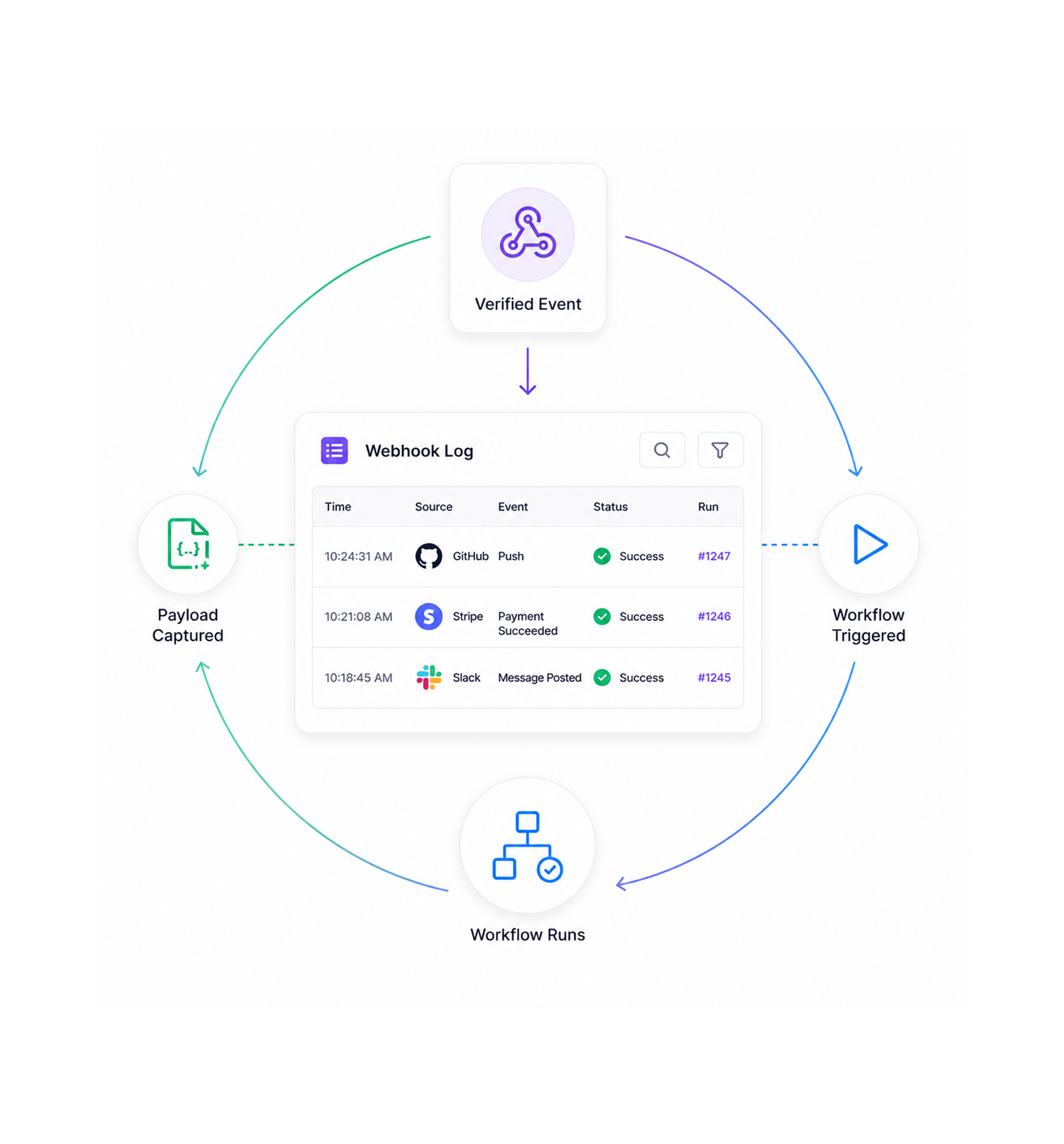
Every event from anywhere lands where it should

Accept incoming events from any external source with trusted signature verification on every request. Native support for GitHub, Stripe, Slack, GitLab, Shopify, and Facebook. Generate a unique webhook address for every workflow, see full event logs in one place, and test with sample payloads before going live. A workflow automation platform that reacts to events the moment they happen, instead of polling for them every few minutes.

Every event
How it works

From event in the wild to running workflow in 4 steps

Generate a unique webhook address for the workflow that should react to the event. Point the external source at the address. The platform verifies every incoming request with trusted signature checks before any workflow runs. Every event lands in the log, and you can test the whole path with sample payloads before going live.

1
2
3
4

Generate Address

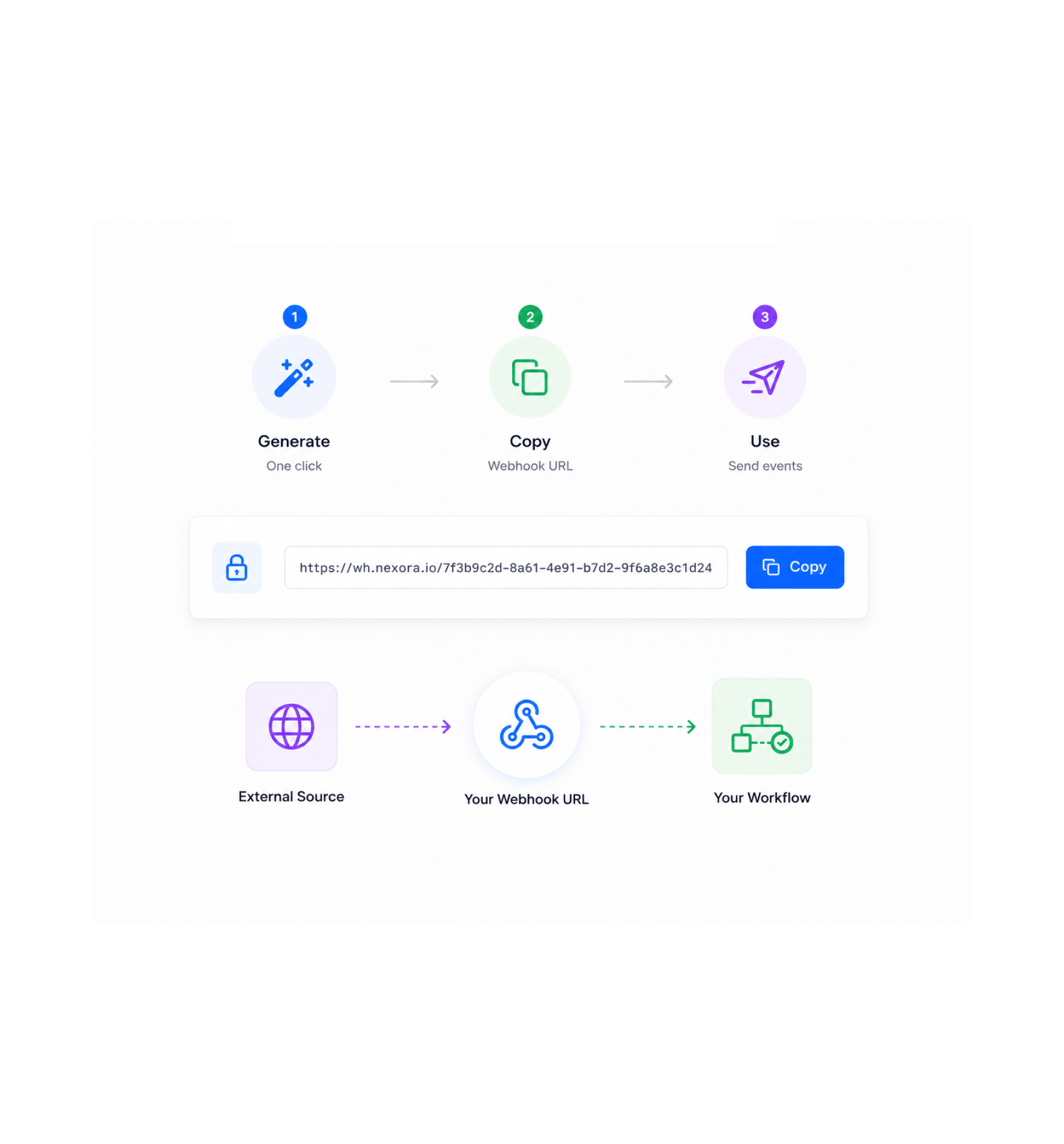
Generate a unique webhook address

Every workflow that wants to react to an external event gets its own unique webhook address, generated in one click and ready to receive traffic the moment it appears. The address is unguessable, scoped to that single workflow, and easy to copy to your clipboard from the configuration panel. No domain to set up, no server to provision, no infrastructure to maintain the platform handles the receiving side entirely.

Unique Per WorkflowOne Click GenerateUnguessableCopy to Clipboard

Point the Source

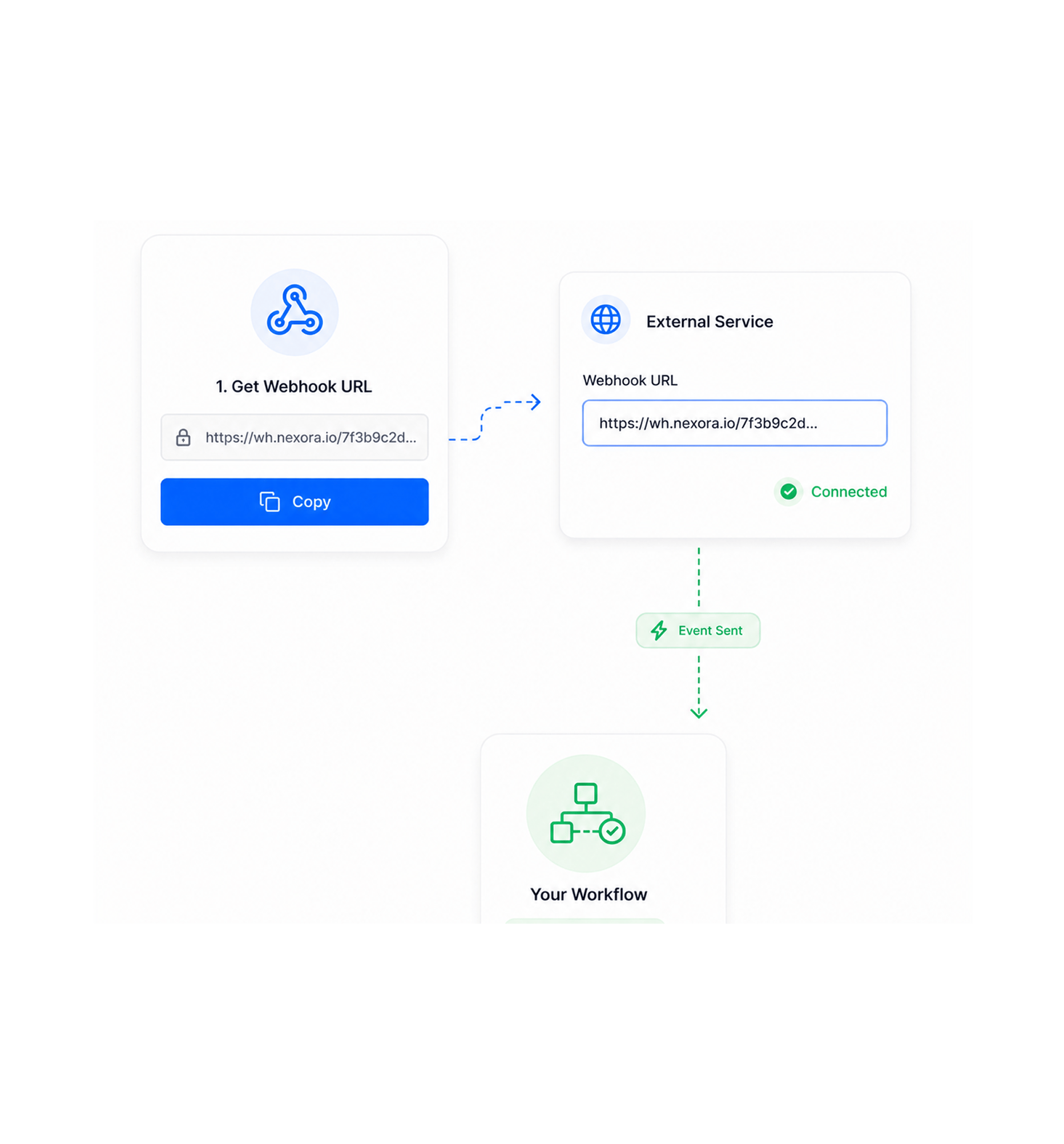
Point your source at the address

Paste the webhook address into the external service's webhook settings. GitHub for repository events, Stripe for payment events, Slack for messaging events, GitLab for code events, Shopify for store events, Facebook for social events or any of the thousands of other services that send webhooks. From that moment on, every event the source produces flows into your workflow in real time.

Any External ServiceReal Time DeliveryNo PollingNo Polling

Verified on Arrival

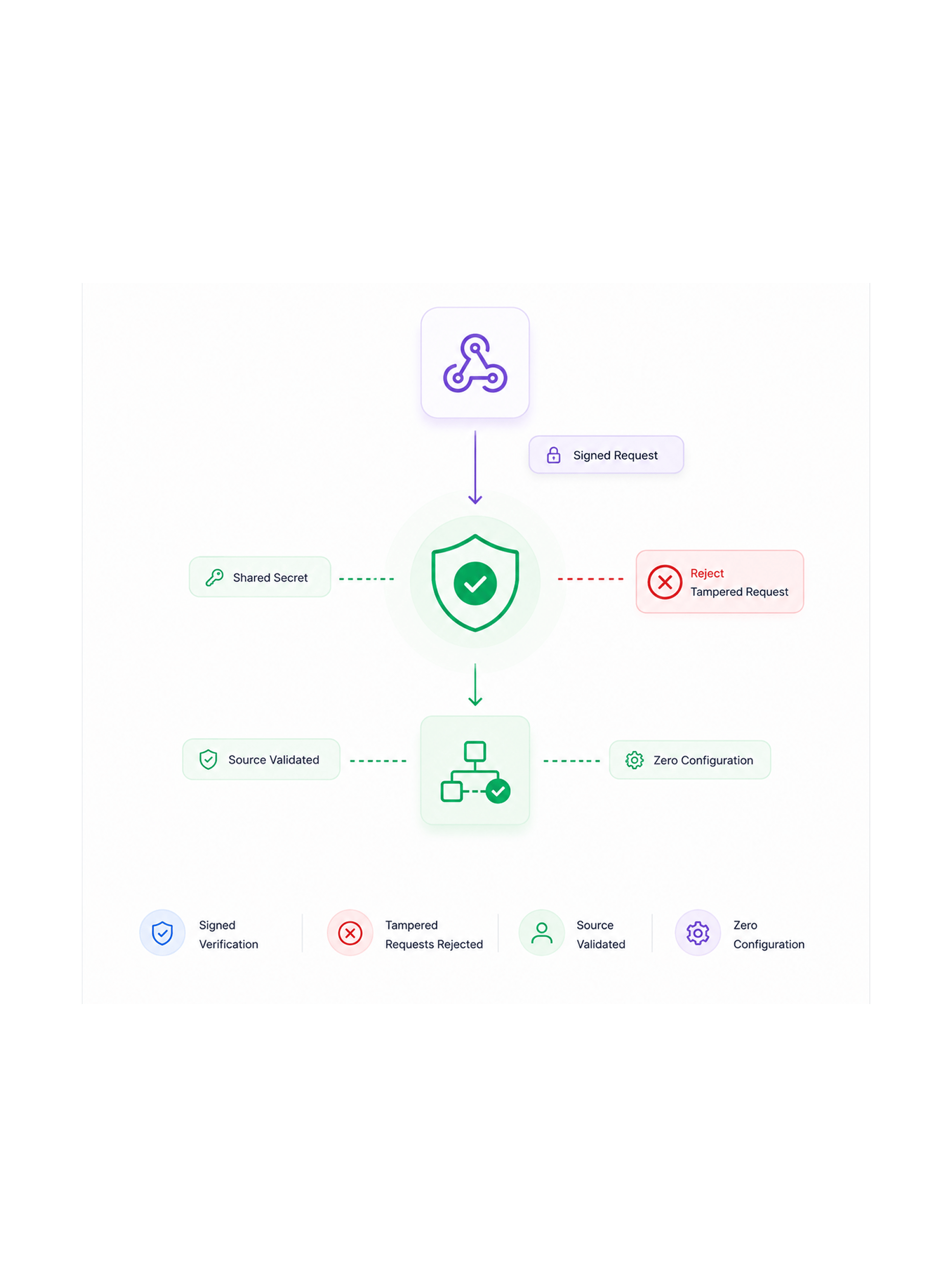
Trusted signature verification on every request

Every incoming request gets verified before any workflow runs. The platform checks the signed signature attached to the request, matches it against the shared secret the source was given, and rejects anything that does not look like it really came from the source. The reassurance that an event genuinely came from your billing platform or your code repository and not from somebody who guessed the webhook address is built in.

Signed VerificationTampered Requests RejectedSource ValidatedZero Configuration

Log & Trigger

Every event logged, every workflow triggered

Verified events land in the full webhook log with the timestamp, the source, the payload, and the resulting workflow run. The log is searchable, filterable, and complete which means debugging a missed trigger or replaying an event that ran into a transient error is one click in the dashboard, not an archaeology session through external service logs. Workflows fire instantly on every verified event, with the payload available to every downstream node.

Full Event LogSearchable & FilterableInstant TriggerPayload to Downstream
Why Teams Choose REVO

Six reasons teams never go back

Once a team has a webhook layer that accepts events from anywhere, verifies every request, logs everything that lands, and replays from sample payloads in one click the old pattern of polling external services for changes starts looking like the slow version of the same workflow. These are the changes that show up first.

Any source, any payload

Any source, any payload

The webhook receiver does not care whether the event is coming from a well known service or a custom internal tool nobody else has heard of. Any source that can send a webhook can fire a workflow on the platform. Payloads of any shape get accepted, parsed, and exposed as variables to downstream nodes. The we cannot integrate with that yet answer simply stops being needed.

Signed requests stay trusted

Signed requests stay trusted

The platform checks the signed signature attached to every incoming request and rejects anything that does not match the shared secret the source was given. A bad actor who guessed the webhook address cannot fire fake events at your workflow, and your team never has to wonder whether the payment notification that arrived at three in the morning was really from the billing platform or from somebody trying to manipulate the system.

Native shortcuts for popular tools

Native shortcuts for popular tools

The native support for GitHub, Stripe, Slack, GitLab, Shopify, and Facebook means the setup for the most common event sources is already done. Pick the provider, the platform knows exactly how to verify their signature format, parse their payload shape, and surface the relevant fields to your workflow. The hour of reading provider documentation that the integration used to take collapses to a couple of minutes.

Test before going live

Test before going live

Sample payloads let you run the workflow end to end with realistic data before the real source ever fires an event at it. Catch the payload shape mismatch, the missing field, the unexpected nesting in the test view rather than during the first real production event. The workflow that goes live for the first time has already been tested with the exact kind of data it is going to receive.

Every event logged forever

Every event logged forever

The full webhook log keeps every received event with its timestamp, source, payload, signature status, and resulting workflow run. Replaying an event that ran into a transient error, debugging a missed trigger, or auditing what happened during a specific window of time becomes a search across one log instead of an archaeology session across the external service's own incomplete activity feed.

One unique address per workflow

One unique address per workflow

Every workflow gets its own unique webhook address. The compromise of one address never affects another, the activity on one is never mixed with the activity on another, and the configuration of one is never accidentally pointed at the wrong source. The clean isolation between workflows that always should have been the default finally is the default.

Stop polling. Start receiving.

Unique webhook addresses, trusted signature verification, native provider flows, full event logs, and sample payload testing all built into the workflow automation platform your team already uses.

Who uses REVO webhooks
Deepak MehrotraDeepak MehrotraDeepak MehrotraDeepak Mehrotra

10800+

Teams firing workflows from real
time events

Built for teams that react to events instead of polling for them

Operations leaders, automation engineers, marketing operations teams, customer success managers, sales operations specialists, and founders use the Revo webhook layer as the front door for every event that should kick off an automation. The unique webhook addresses are the entry points. The trusted signature verification is the security check. The native provider library is the shortcut to popular tools. The full webhook log is the audit trail. Every team a small business reacting to payment events on their billing platform or a larger organisation orchestrating hundreds of business process automations triggered by dozens of upstream services gets the same receiver, the same verification, and the same level of visibility.

Any

Source

Signed

Verification

Native

Providers

Full

Event Logs

Webhook Receiver

Accept from anywhere, verify everything

A unique webhook address per workflow, ready to accept events from any external service that can send them. Every incoming request runs through trusted signature verification before any workflow fires. Every event lands in the searchable log with the payload, the source, the signature status, and the resulting run. The receiver does the security work so the workflow does not have to.

Accept from anywhere, verify everything
Features

Everything the webhook layer ships with

A complete webhook receiver built into the same workflow automation platform your team already uses. Accept events from any external source, verify every request with trusted signature checks, use native flows for the most popular providers, generate a unique address for every workflow, browse a full event log, and test with sample payloads before going live.

Webhooks from Any Source

Webhooks from Any Source

Accept events from any external service that can send a webhook. The well known providers are covered with native flows, the long tail of internal tools and partner services is supported through the generic webhook receiver. Payloads of any shape get accepted, parsed, and exposed to downstream nodes the workflow does not care whether the event came from a famous platform or a custom internal service.

Trusted Signature Verification

Trusted Signature Verification

Every incoming request runs through signature verification before any workflow fires. The signed signature on the request gets checked against the shared secret the source was given, and anything that does not match is rejected before it touches a workflow. Fake events, replay attacks, and tampered payloads all get caught at the door, not somewhere downstream.

Native Support for Popular Providers

Native Support for Popular Providers

GitHub, Stripe, Slack, GitLab, Shopify, and Facebook all come with native provider flows. Pick the provider, the platform handles their signature format, their payload shape, and their event categories out of the box. The setup for the most common event sources collapses from an hour of reading documentation to a couple of minutes of paste and configure.

Unique Webhook Address Per Workflow

Unique Webhook Address Per Workflow

Every workflow that wants to react to external events gets its own unique webhook address, generated in one click. The address is unguessable, scoped to that single workflow, and easy to copy into the external source's settings. Isolation between workflows is the default the activity on one address is never mixed with the activity on another.

Full Webhook Logs

Full Webhook Logs

Every received event lands in the full webhook log with the timestamp, the source, the complete payload, the signature status, and the resulting workflow run. The log is searchable, filterable, and complete debugging a missed trigger, replaying an event that hit a transient error, or auditing activity during a specific window becomes a search across one place instead of a hunt across three.

Test with Sample Payloads

Test with Sample Payloads

Run the workflow end to end with sample payloads before the real source ever fires an event at it. Use the built in samples for the native providers, paste a custom payload from a previous run, or capture a real event in test mode and replay it later. The first real event in production never reveals an issue that the test should have caught.

Webhooks from Any Source

Webhooks from Any Source

Accept events from any external service that can send a webhook. The well known providers are covered with native flows, the long tail of internal tools and partner services is supported through the generic webhook receiver. Payloads of any shape get accepted, parsed, and exposed to downstream nodes the workflow does not care whether the event came from a famous platform or a custom internal service.

Trusted Signature Verification

Trusted Signature Verification

Every incoming request runs through signature verification before any workflow fires. The signed signature on the request gets checked against the shared secret the source was given, and anything that does not match is rejected before it touches a workflow. Fake events, replay attacks, and tampered payloads all get caught at the door, not somewhere downstream.

Native Support for Popular Providers

Native Support for Popular Providers

GitHub, Stripe, Slack, GitLab, Shopify, and Facebook all come with native provider flows. Pick the provider, the platform handles their signature format, their payload shape, and their event categories out of the box. The setup for the most common event sources collapses from an hour of reading documentation to a couple of minutes of paste and configure.

Unique Webhook Address Per Workflow

Unique Webhook Address Per Workflow

Every workflow that wants to react to external events gets its own unique webhook address, generated in one click. The address is unguessable, scoped to that single workflow, and easy to copy into the external source's settings. Isolation between workflows is the default the activity on one address is never mixed with the activity on another.

Full Webhook Logs

Full Webhook Logs

Every received event lands in the full webhook log with the timestamp, the source, the complete payload, the signature status, and the resulting workflow run. The log is searchable, filterable, and complete debugging a missed trigger, replaying an event that hit a transient error, or auditing activity during a specific window becomes a search across one place instead of a hunt across three.

Test with Sample Payloads

Test with Sample Payloads

Run the workflow end to end with sample payloads before the real source ever fires an event at it. Use the built in samples for the native providers, paste a custom payload from a previous run, or capture a real event in test mode and replay it later. The first real event in production never reveals an issue that the test should have caught.

Questions & answers

Everything you need to know

Common questions about which sources can send events, how signature verification actually works, what the native providers do for you, where to find the webhook address, what gets captured in the log, and how to replay or retest a specific event.

Any service that can send a webhook can fire a workflow on the platform. The well known providers GitHub for code events, Stripe for payment events, Slack for messaging events, GitLab for repository events, Shopify for store events, Facebook for social events are covered with native flows that handle the provider's specific format. Everything else is supported through the generic webhook receiver, which accepts payloads of any shape and exposes them as variables to downstream nodes.

Network background
REVO · Variables & Secrets

Stop polling for events. Start receiving
them the moment they happen.

Unique webhook addresses, trusted signature verification, native flows for GitHub, Stripe, Slack, GitLab, Shopify, Facebook, full event logs, and sample payload testing. The webhook layer your workflows actually deserve.