Non blocking execution that never holds up other work. Steps that run in parallel when they do not depend on each other. Conditional execution that branches on the data. Configurable retries with smart waits between attempts. Per step timeouts that protect the whole workflow. Manual intervention nodes that pause for human input when something needs a person. Test mode with mock data that produces no real effects on your systems. A workflow automation platform where the team controls exactly how every workflow runs, instead of hoping the defaults are good enough.
Every workflow runs without blocking other work, with independent steps running in parallel when they can. Branches, retries, and timeouts give precise control over how each step behaves under different conditions. Manual intervention nodes pause for human input when something genuinely needs a person, and test mode lets the team verify the whole flow with mock data before any real effect touches production.
Non Blocking Execution
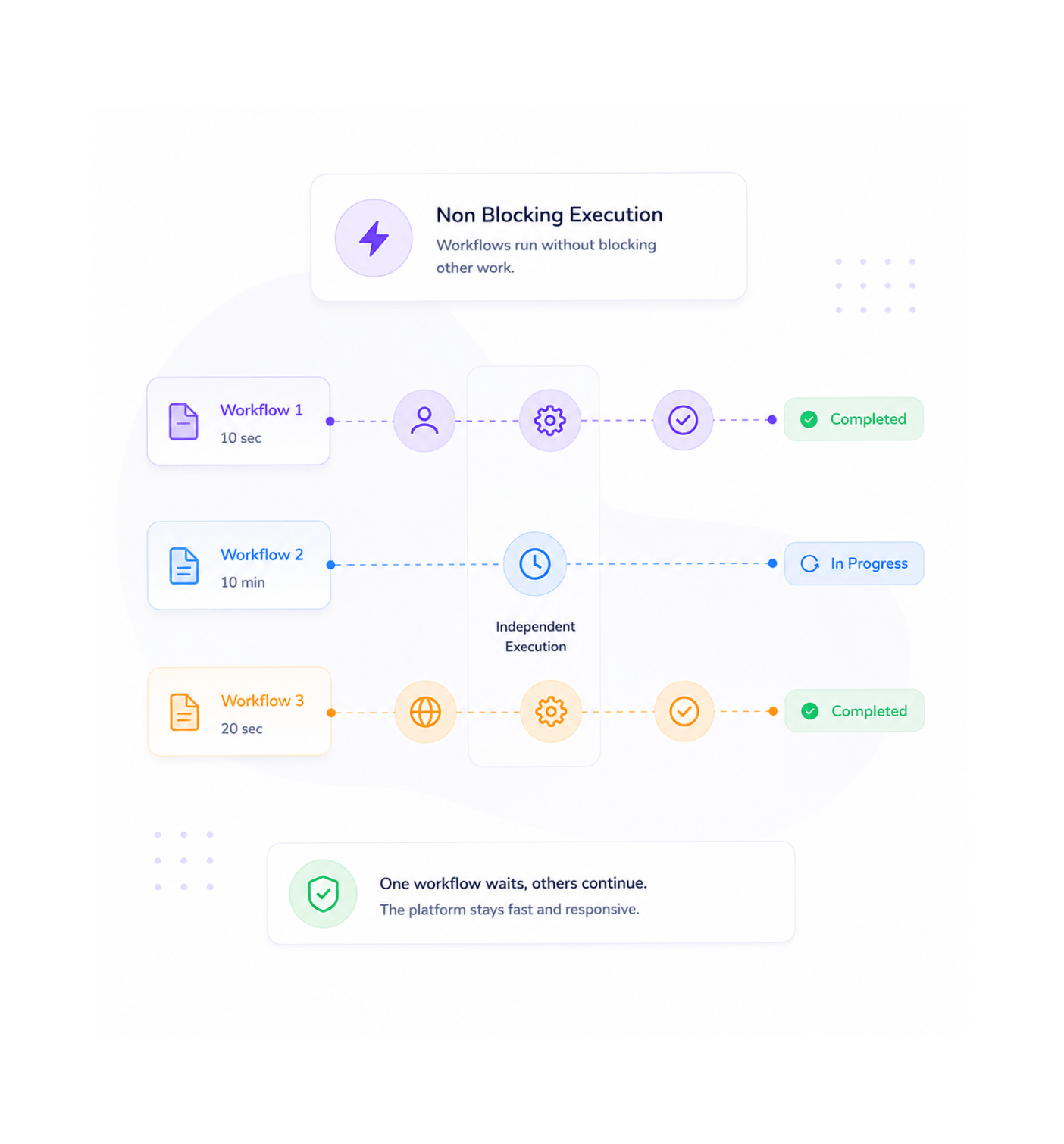
Every workflow runs without blocking other work. A step that is waiting on a third party service does not hold up the next workflow in the queue, a slow operation in one workflow does not slow down a fast operation in another, and the workflow that takes ten minutes does not delay the workflow that takes ten seconds. The whole platform stays responsive even when individual steps are doing slow work, which is exactly how automation at scale should behave.
Parallel Steps
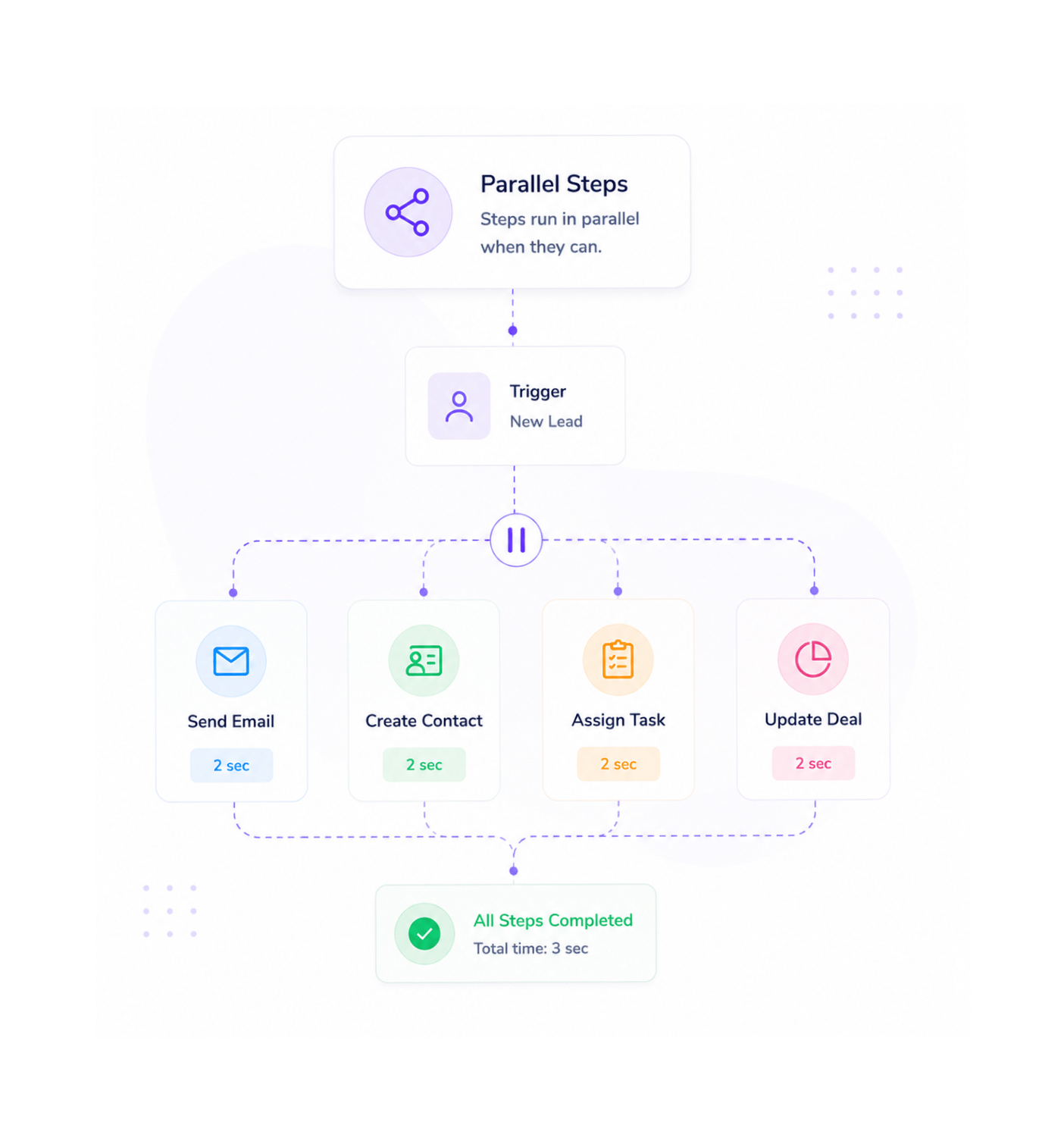
Independent steps in the same workflow run at the same time rather than one after the other. Send the welcome email while creating the contact record while assigning the task while updating the deal all in parallel, finishing in the time of the slowest one rather than the sum of all of them. The workflow that used to take twelve seconds because it ran six two second steps in sequence finishes in three seconds with the steps running in parallel.
Branches, Retries, Timeouts
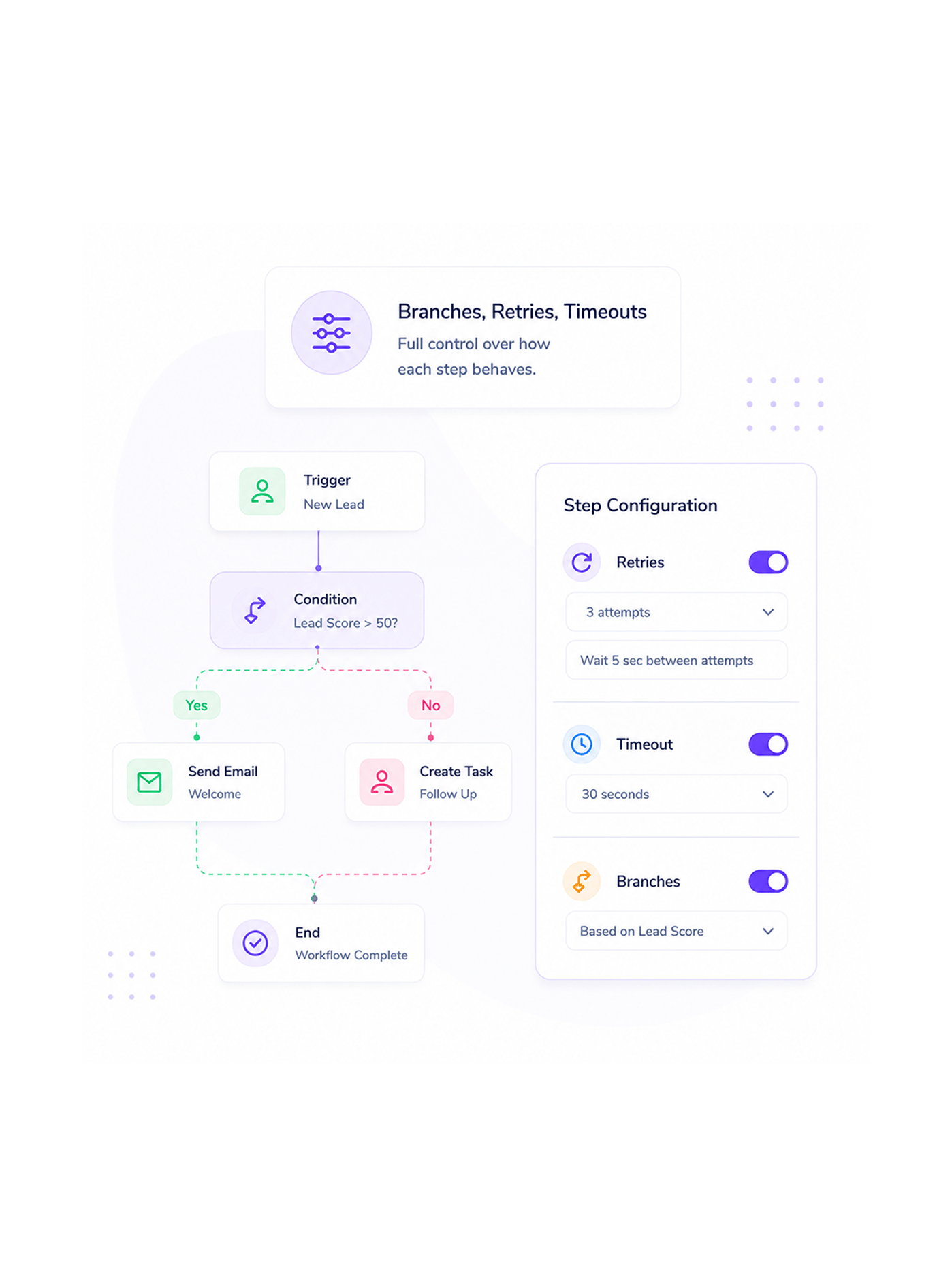
Conditional execution branches the workflow on any field in the data. Configurable retries with smart waits between attempts handle transient failures automatically without retrying forever or backing off too aggressively. Per step timeouts protect the rest of the workflow from a single step that hangs indefinitely on a misbehaving service. Every step has the controls it needs to behave well under every condition, and every control is right there in the step configuration panel.
Manual & Test Mode
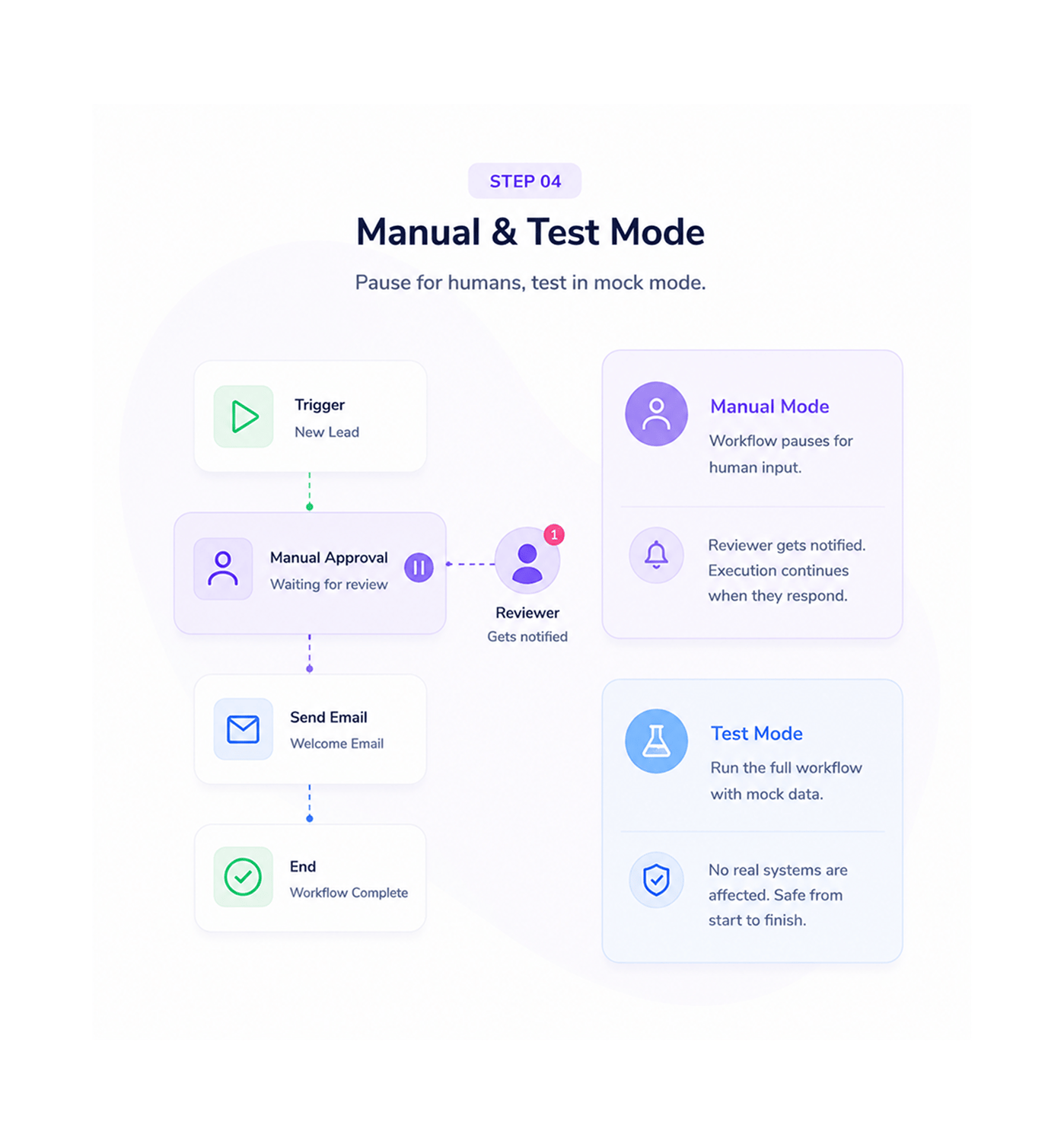
Manual intervention nodes pause the workflow for human input when something genuinely needs a person an approval on a high value deal, a review of an unusual document, a decision on a non standard refund. The workflow waits cleanly, the assigned reviewer gets a notification, and execution continues the moment the person responds. Test mode runs the entire workflow with mock data that flows through every step exactly like a real execution would, except no actual effect touches any real system. Confidence before production, with safety from start to finish.
Once a team has precise control over how every workflow runs non blocking, parallel when possible, conditional, retried sensibly, bounded by timeouts, paused for humans, and testable in mock mode the old pattern of writing workflows on hope and finding out at three in the morning what should have been controlled stops being acceptable. These are the changes that show up first.
Non blocking execution means a slow step in one workflow never holds up a fast step in another, a workflow waiting on a third party service never delays a workflow that has nothing to wait on, and the whole platform stays responsive even under heavy load. The the automation is slow today complaints that used to come up whenever one team's workflow got stuck simply stop happening.
Conditional execution lets workflows respond to the data they receive rather than running the same way every time. The high value deal goes through the approval path, the standard deal goes through the fast path, the refund request from a long term customer takes a different route than the one from a brand new account. Workflows that think before they act produce business results that look thought through rather than mechanical.
The retry policy that makes sense for a quick database write is different from the one that makes sense for a multi minute report generation, and the timeout that protects a fast operation is different from the one that protects a slow one. Per step configuration means every step gets exactly the retry and timeout behaviour it needs rather than a one size fits all policy that is wrong for half of them.
Manual intervention nodes let the workflow pause cleanly for human input where genuine judgement is needed high value approvals, unusual document reviews, non standard exception handling. The reviewer gets notified, the workflow waits without consuming capacity, and execution resumes the instant the person responds. The fully automated except for the bits a person should still see pattern that every team needs finally has a clean home.
Test mode runs the entire workflow with mock data that flows through every step exactly like a real execution would, except no actual effect touches any real system. No real email goes out, no real record gets created, no real invoice gets sent, no real charge happens. The confidence that comes from having tested the whole flow end to end before turning it on in production is now a one click action rather than a separate testing project.
The combination of non blocking execution and parallel steps means the workflow that handles a hundred events a day also handles ten thousand without breaking a sweat or needing to be re architected. Capacity grows with your business rather than becoming a redesign project every time volume doubles, which is exactly the property automation needs to actually keep up with a growing company.
Non blocking execution. Parallel steps. Conditional branches. Configurable retries. Per step timeouts. Human intervention nodes. Test mode with mock data. The execution control your workflows have always deserved.
9700+
Teams running workflows
with precise execution control
Operations leaders running automation at scale, automation engineers tuning workflows for performance and resilience, platform teams responsible for the health of the workspace, customer success managers running workflows with human judgement steps embedded, finance specialists who need approval pauses on regulated transactions, and founders watching the operational behaviour of every business critical workflow all use Revo execution control to make sure every workflow runs exactly the way it should under every condition. Every team a small business running a handful of workflows or a larger organisation orchestrating hundreds of business process automations gets the same controls over how every step of every workflow behaves.
Execution
Steps
Timeouts
Mode
Non blocking execution that never holds up other work. Parallel step support that runs independent operations at the same time. Conditional branching that lets workflows respond to the data they receive. The runtime behaves the way modern automation should behave responsive, efficient, and intelligent about what to do next.
A complete execution control toolkit built into the same workflow automation platform your team already uses. Non blocking execution, parallel step support, conditional branching, configurable retries with timeouts, manual intervention nodes, and test mode with mock data come together so every workflow runs exactly the way it should under every condition.
Every workflow runs without blocking other work. A slow step in one workflow never holds up a fast step in another, a workflow waiting on a third party service never delays anything else, and the whole platform stays responsive even when individual operations are doing slow work. Async runtime behaviour is the default, not a feature you have to enable.
Independent steps in the same workflow run at the same time rather than one after the other. The six step sequence that used to take twelve seconds because it ran in series finishes in three seconds with the steps running in parallel. The platform analyses the dependency graph automatically and runs everything that can run together, together.
Workflows branch on any field in the data the deal value, the lead source, the document type, the customer tier, the country of the contact, any custom field. Conditional nodes use the same visual condition builder as triggers, so building a workflow that thinks before it acts feels exactly like building any other step.
Every step has its own retry policy with maximum attempt count, smart waits between attempts that grow exponentially to give failing services room to recover, and a per step timeout that protects the rest of the workflow from a single misbehaving operation. The defaults are sensible, the overrides are easy, and every step gets exactly the resilience it needs.
Manual intervention nodes pause the workflow for human input where judgement is genuinely needed approvals, reviews, exception handling. The assigned reviewer gets a notification with the workflow context, the workflow waits cleanly without consuming execution capacity, and the next step runs the moment the person responds. Fully automated except for the bits a person should still see.
Test mode runs the entire workflow with mock data that flows through every step exactly like a real execution would, except no actual effect touches any real system. No real email goes out, no real record gets created, no real invoice gets sent. Verify the whole flow with confidence before any real effect touches production.
Every workflow runs without blocking other work. A slow step in one workflow never holds up a fast step in another, a workflow waiting on a third party service never delays anything else, and the whole platform stays responsive even when individual operations are doing slow work. Async runtime behaviour is the default, not a feature you have to enable.
Independent steps in the same workflow run at the same time rather than one after the other. The six step sequence that used to take twelve seconds because it ran in series finishes in three seconds with the steps running in parallel. The platform analyses the dependency graph automatically and runs everything that can run together, together.
Workflows branch on any field in the data the deal value, the lead source, the document type, the customer tier, the country of the contact, any custom field. Conditional nodes use the same visual condition builder as triggers, so building a workflow that thinks before it acts feels exactly like building any other step.
Every step has its own retry policy with maximum attempt count, smart waits between attempts that grow exponentially to give failing services room to recover, and a per step timeout that protects the rest of the workflow from a single misbehaving operation. The defaults are sensible, the overrides are easy, and every step gets exactly the resilience it needs.
Manual intervention nodes pause the workflow for human input where judgement is genuinely needed approvals, reviews, exception handling. The assigned reviewer gets a notification with the workflow context, the workflow waits cleanly without consuming execution capacity, and the next step runs the moment the person responds. Fully automated except for the bits a person should still see.
Test mode runs the entire workflow with mock data that flows through every step exactly like a real execution would, except no actual effect touches any real system. No real email goes out, no real record gets created, no real invoice gets sent. Verify the whole flow with confidence before any real effect touches production.
Common questions about what non blocking execution means in practice, how parallel steps are scheduled, exactly which retry options are available, how per step timeouts are configured, how manual intervention nodes pause and resume the workflow, and what test mode does and does not cover.
It means every workflow runs independently of every other workflow, and every step that is waiting on something does not consume execution capacity while it waits. A workflow waiting on a third party service to respond does not hold up another workflow that is ready to run. A slow step in one workflow does not slow down a fast step in another. The platform handles thousands of workflows in flight at the same time without any single one blocking another, which is the runtime property automation needs to behave well at scale.
Non blocking execution. Parallel steps. Conditional branches. Configurable retries. Per step timeouts. Manual intervention. Test mode with mock data. The execution control layer your workflows have always deserved.