



Webhooks in. Actions out. Durable in between.
HMAC-verified webhooks. JWT-authenticated app calls. Custom HTTP nodes with full header and body control. Variable interpolation with {{trigger.data.field}}. Conditions with 14 comparison operators. JSON workflow import/export. Long-lived API tokens. Plus a Developer Console to register your own app — triggers, actions, OAuth.
Developer Stack
webhook · /v1/hook/d8a1f2c4
github.push · HMAC sha256 verified · 2.4k/day
api_token · revo_live_***k4n2
scope:workflow.execute · last used 12s ago
DevConsole · "internal-billing"
3 triggers · 8 actions · OAuth registered
Workflow exported · onboarding-v2.json
14 KB · 12 nodes · ready to import in staging
Every new tool needs another integration.
You're running out of weekends.
In-house integrations decay
You built the GitHub-to-Linear sync last year. It's broken because GitHub deprecated an endpoint. You fix it. Stripe rotates a key. You fix it. Slack changes a payload format. You fix it. The integration tax is paid in weekends, indefinitely.
Webhook signature verification is plumbing
Every inbound webhook needs HMAC verification, replay protection, timestamp tolerance, and signature comparison. You implement it once per source. Then you implement it again for the next service. The code is the same. The bugs are different.
No-code platforms don't scale to your team
Zapier works for marketing. It doesn't work when you need custom HTTP, variable interpolation, JSON manipulation, version-controlled workflows, or programmatic triggering from your codebase. You end up building around it anyway.
 Revo gives you both surfaces. Visual workflows for the team. Code-grade primitives for you.
Visual where it helps.
Programmable where it matters.

Webhooks with HMAC built in
Every webhook endpoint Revo creates supports HMAC signature verification out of the box. Configure the secret, pick the algorithm, set the header. Inbound requests with bad signatures are rejected at the edge before any workflow step runs. The plumbing you were going to write is already there.
- HMAC verification on every webhook
- Per-workflow endpoints with config secrets
- Reject bad-signature payloads at the edge

Custom HTTP nodes and variable interpolation
When the connector doesn't exist, drop in a custom HTTP node. Full control over method, headers, body, auth. Variable interpolation everywhere — {{trigger.data.field}}, {{step_2.output.id}}, {{vars.api_key}}. Workflow Variable Manager for secrets and globals. The escape hatch that always works.
- Custom HTTP nodes with full request control
- Variable interpolation across all fields
- Variable Manager for globals and secrets

Workflows as code, when you want
Every workflow exports as JSON. Version-control it in git. Diff changes in PRs. Re-import in staging, then in production. Long-lived API tokens trigger workflows programmatically from anywhere. Developer Console lets you register your own app with custom triggers and actions exposed as first-class building blocks.
- JSON import/export for git-managed workflows
- Long-lived API tokens for programmatic triggers
- Developer Console to register custom apps
Three patterns the engineering team doesn't need to maintain anymore.
GitHub events into your full stack
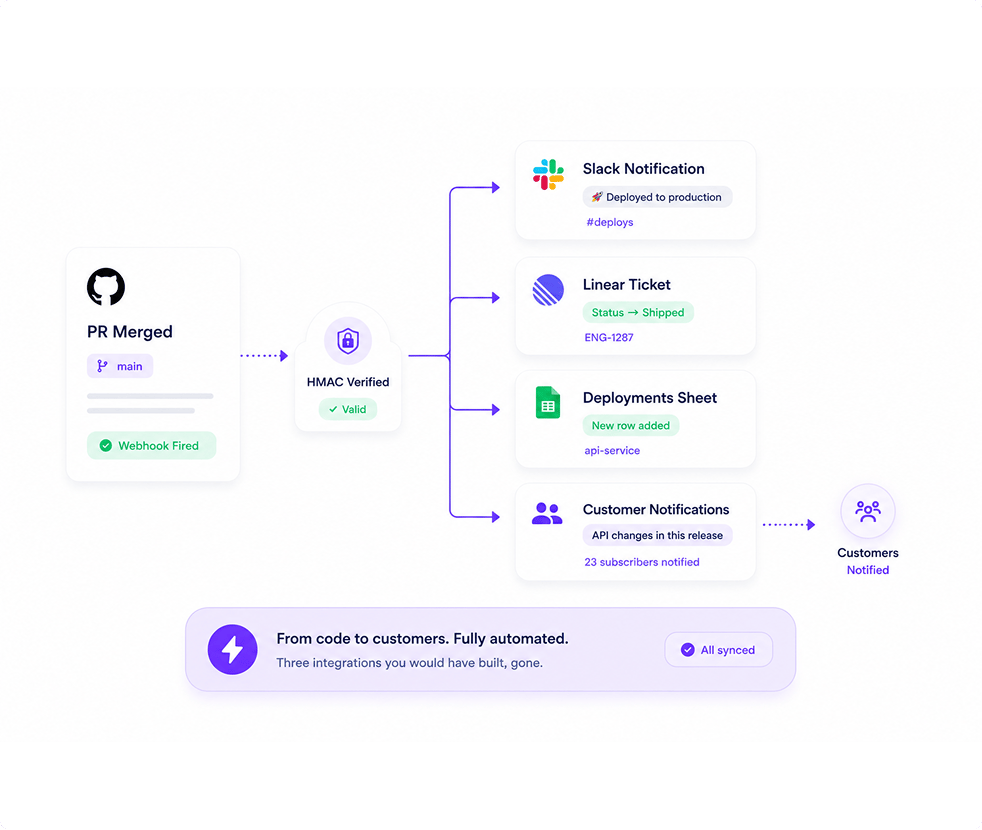
A PR merges. The webhook fires with HMAC verified. Slack gets a deploy notification. The Linear ticket flips to "shipped". A row lands in the deployments sheet. If the PR touches the API, a notification goes to the customers who subscribed to that release. Three integrations you would have built, gone.
Numbers from real
engineering teams.
I had three Node.js scripts running on a forgotten EC2 instance doing integration work nobody knew about. We ported them to Revo workflows in a week. Now they're version-controlled, retryable, and observable. The EC2 instance is gone.
— Staff Engineer, B2B Platform
1000+
External apps via Pipedream
5
Native WorksBuddy app integrations
14
Condition operators in branching
99.7%
Workflow execution success rate
Solo, platform team,
or embedded automation.

Solo Engineer
You're the integrations team. Revo eats the maintenance burden — connector updates, retry logic, replay state — so your weekends come back.

Platform Team
You serve internal teams who want automations. Standing up Revo lets them self-serve. You handle the governance and the custom apps.

Embedded Automation
Your product needs to let customers configure workflows. Register your app in the Developer Console. Use Revo as the engine. Build the UX you want on top.

Replace Internal Cron
Cron jobs running on a forgotten box. Port them to Revo workflows. Get version control, retry semantics, observability, and one fewer box to maintain.
What engineers ask before they pick an automation platform.
Three things. First, Revo is the native automation engine inside the WorksBuddy suite — Lio, Taro, Sigi, Inzo, and Evox are first-class apps with full trigger and action surfaces, not third-party connectors. Second, every workflow runs on Temporal.io for durable execution, automatic retries, and full state recovery — Zapier silently fails, Revo doesn't. Third, you get 1000+ external apps via Pipedream Connect plus a Developer Console to register your own apps, so you're not stuck waiting for a connector to ship.
Stop maintaining integrations that should maintain themselves.
See custom HTTP nodes, the Developer Console, and JSON workflow export in a 30-minute demo.